16 Results for "

Rhodamine123

" in MedChemExpress (MCE) Product Catalog:
Products (16)

16 Results for "Rhodamine123" in MCE Product Catalog:

29
29 Cited Publications
Cat. No.: HY-D0816
CAS No.: 62669-70-9
Synonyms: RH-123; R-22420
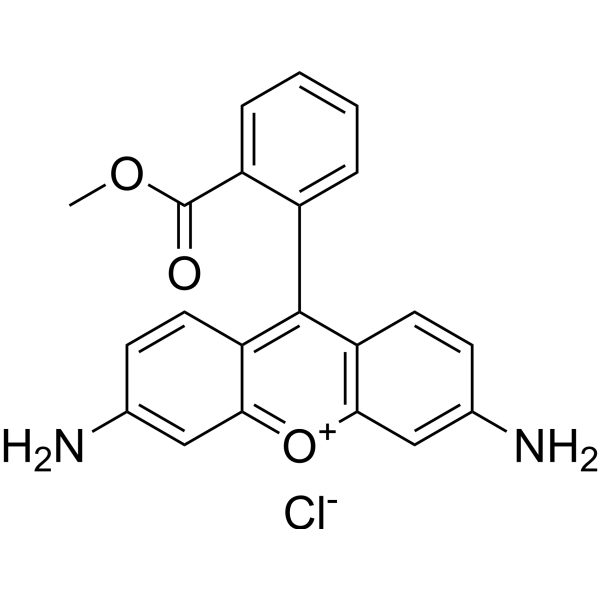
Rhodamine dyes are membrane-permeable cationic fluorescent probes that specifically recognize mitochondrial membrane potentials, thereby attaching to mitochondria and producing bright fluorescence, and at certain concentrations, rhodamine dyes have low toxicity to cells, so they are commonly used to detect mitochondria in animal cells, plant cells, and microorganisms .
loading...
    loading...
23
23 Cited Publications
Cat. No.: HY-101894
CAS No.: 109244-58-8
Purity:  99.83%
Synonyms: DHR 123
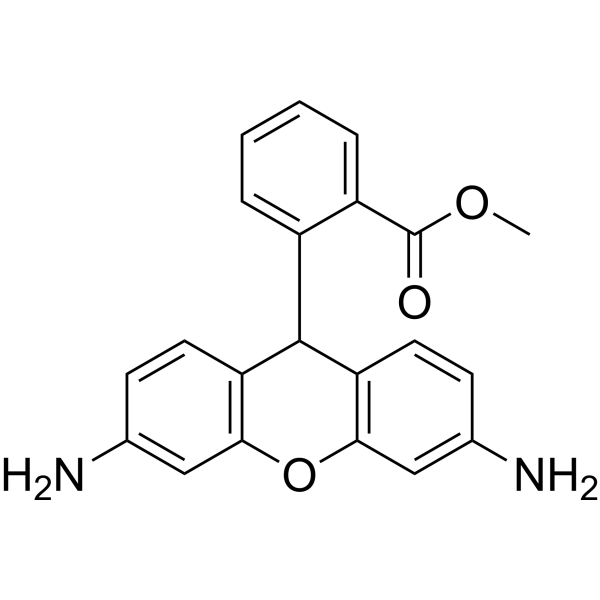
Dihydrorhodamine 123 (DHR 123) is a non-fluorescent reactive oxygen species (ROS) indicator. Dihydrorhodamine 123 is oxidized to fluorescent Rhodamine 123 (HY-D0816) within cells in the presence of reactive oxygen species and it localizes in mitochondria (Ex/Em = 515/536 nm).
loading...
    loading...
Cat. No.: HY-D0996
CAS No.: 181885-68-7
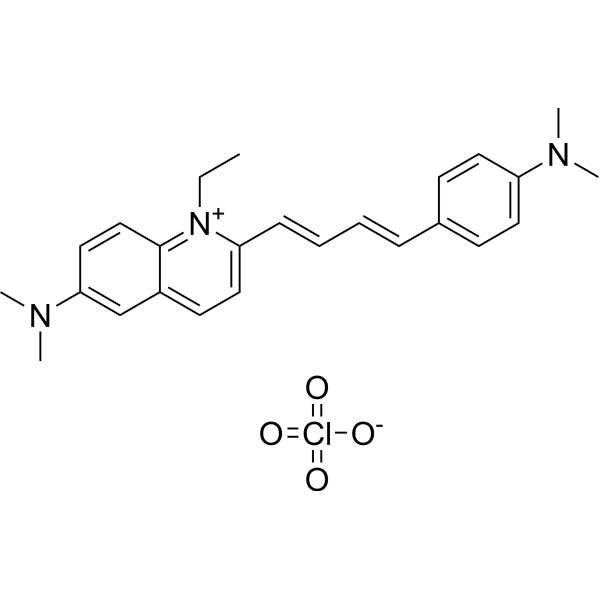
Lds-751 is a nucleic acid stain that mainly detects DNA. Lds-751 is a nucleic acid stain that mainly detects DNA. Lds-751 has a high affinity for DNA and fluorescence is enhanced after binding, but the maximum emission wavelength is 670nm. Lds-751 and Thiazole orange can be used for the differentiation of red blood cells, platelets, reticulocytes, and nucleated cells and can be stimulated at 488nm. Studies have shown that LDS-751 binds almost exclusively to mitochondria when incubated with nucleated living cells. After nucleated Acridine Orange (HY-101879) staining and LDS-751 treatment of cells, confocal microscopy revealed almost no co-location of the cells. Staining with Rhodamine 123 (HY-D0816), a dye known to bind polarized mitochondria, was almost identical to the pattern observed with LDS-751 .
loading...
    loading...
Cat. No.: HY-DY1054
CAS No.: 62669-70-9
Rhodamine dyes are membrane-permeable cationic fluorescent probes that specifically recognize mitochondrial membrane potentials, thereby attaching to mitochondria and producing bright fluorescence, and at certain concentrations, rhodamine dyes have low toxicity to cells, so they are commonly used to detect mitochondria in animal cells, plant cells, and microorganisms .
Solvent and concentration: DMSO: 5 mM
loading...
    loading...
Cat. No.: HY-DY1037
CAS No.: 109244-58-8
Dihydrorhodamine 123 (DHR 123) (solution) is a non-fluorescent reactive oxygen species (ROS) indicator. Dihydrorhodamine 123 is oxidized to fluorescent Rhodamine 123 (HY-D0816) within cells in the presence of reactive oxygen species and it localizes in mitochondria (Ex/Em = 515/536 nm).
Solvent and concentration: DMSO: 10 mM
loading...
    loading...
Cat. No.: HY-155032
CAS No.: 2303508-09-8
Target:  

P-glycoprotein

Research Areas:  

Cancer

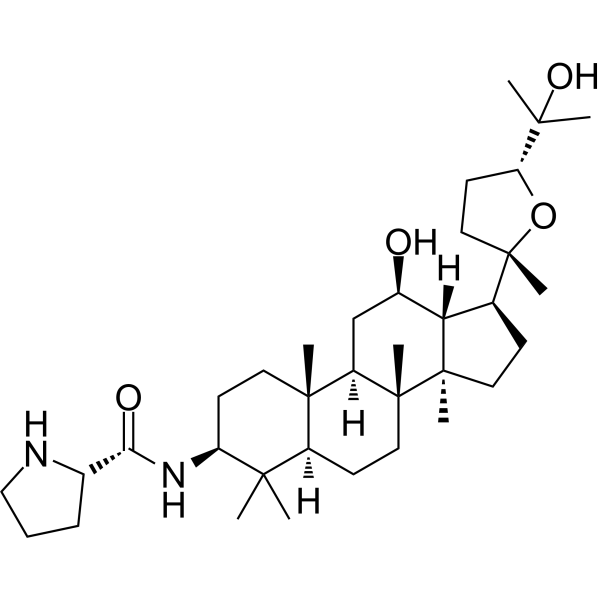
P-gp inhibitor 15 (compound 7a) is a nonsubstrate inhibitor of P-glycoprotein (Pgp). P-gp inhibitor 15 inhibits Pgp-ATPase activity,and interfers Pgp-mediated Rhodamine123 efflux. P-gp inhibitor 15 also enhances the inhibitory efficacy of Paclitaxel (HY-B0015),inhibits tumor progress in nude mice KBV xenograft tumors model .
loading...
    loading...
Cat. No.: HY-P4403
CAS No.: 223538-61-2
Synonyms: (Z-Asp-Glu-Val-Asp)₂-Rhodamine 110
Research Areas:  

Others

Z-DEVD-R110 ((Z-Asp-Glu-Val-Asp)2-Rhodamine 110) is a fluorogenic caspase-3/7 substrate. Z-DEVD-R110 can be used to detect apoptosis. Z-DEVD-R110 is a rhodamine derivative with two four–amino acid (DEVD) peptides linked to the fuorophore .
loading...
    loading...
Cat. No.: HY-P10322
Target:  

Fluorescent Dye

Research Areas:  

Cancer

Z-IETD-R110 is a fluorescent substrate of caspases. Z-IETD-R110 acts as a substrate for caspase-8. When caspase-8 is activated, it can recognize and cut Z-IETD-R110, releasing fluorophore, which can be detected by fluorescence microscopy. Z-IETD-R110 can be used to study oxidative stress-induced apoptosis, particularly in pancreatic acinar cells .
loading...
    loading...
Cat. No.: HY-157483
Target:  

P-glycoprotein

Research Areas:  

Cancer

P-gp inhibitor 18 (compound 6G) is a potent inhibitor of P-gp. P-gp inhibitor 18 inhibits rhodamine 123 efflux in the P-gp overexpressed leukemia cells, K562/Dox .
loading...
    loading...
Cat. No.: HY-157484
Target:  

P-glycoprotein

Research Areas:  

Cancer

P-gp inhibitor 19 (Compound 6i) is a P-gp inhibitor. P-gp inhibitor 19 can inhibit the efflux of rhodamine 123 (HY-D0816) in P-gp-overexpressing leukemia cells K562/Dox and also restore the sensitivity of DOX-resistant cells .
loading...
    loading...
Cat. No.: HY-162714
CAS No.: 2631659-57-7
Target:  

P-glycoprotein

Research Areas:  

Cancer

C3N-Dbn-Trp2 is an inhibitor for ATP-binding cassette transporter ABCB1. C3N-Dbn-Trp2 inhibits the ABCB1-mediated Rhodamine 123 (HY-D0816) efflux in cells HEK293T and HCT-15 with IC50 of 5.9 µM and 2.2 µM. C3N-Dbn-Trp2 inhibits the Doxorubicin (HY-15142A) efflux, enhances the cytotoxicity of Doxorubicin in ABCB1-expressing cells .
loading...
    loading...
Cat. No.: HY-138074
CAS No.: 93074-04-5
Synonyms: 5-Ketomilbemycin A4 oxime; 5-Oxomilbemycin A4 5-oxime
Target:  

Parasite

Research Areas:  

Infection

Milbemycin A4 oxime (5-Ketomilbemycin A4 oxime; 5-Oxomilbemycin A4 5-oxime) is a derivative of Milbemycin A4 (HY-126906) and a component of Milbemycin oxime (HY-B0778), both of which have insecticidal and nematicidal activities. Milbemycin A4 oxime (0.05 mg/kg) reduces the number of microfilariae in naturally infected dogs with D. immitis and inhibits the growth of clinical isolates of Candida glabrata (MIC80=16-32 μg/mL). Milbemycin A4 oxime (2.5 μg/mL) blocks the efflux of Fluconazole (HY-B0101) from clinical isolates of Candida glabrata. Milbemycin A4 oxime enhances doxorubicin-induced cell growth inhibition and increases the intracellular accumulation of doxorubicin and P-glycoprotein substrate Rhodamine 123 (HY-D0816) in doxorubicin-resistant but not sensitive MCF-7 breast cancer cells in a concentration-dependent manner.
loading...
    loading...
Cat. No.: HY-101894R
CAS No.: 109244-58-8
Synonyms: DHR 123 (Standard)
Dihydrorhodamine 123 (Standard) is the analytical standard of Dihydrorhodamine 123 (HY-101894). This product is intended for research and analytical applications. Dihydrorhodamine 123 (DHR 123) is a non-fluorescent reactive oxygen species (ROS) indicator. Dihydrorhodamine 123 is oxidized to fluorescent Rhodamine 123 (HY-D0816) within cells in the presence of reactive oxygen species and it localizes in mitochondria (Ex/Em = 515/536 nm).
loading...
    loading...
Cat. No.: HY-164585
CAS No.: 352652-36-9
Target:  

P-glycoprotein

Research Areas:  

Cancer

P-gp modulator-6 is a P-glycoprotein (P-gp) modulator. P-gp modulator-6 regulates the substrate specificity of P-gp and enhances the efflux activity of Daunorubicin (HY-13062A) and Rhodamine 123 (HY-D0816). P-gp modulator-6 can be used in the research of multidrug-resistant cancers. P-gp modulator-6 can be used in the research of multidrug-resistant pancreatic cancer and multidrug-resistant colon cancer .
loading...
    loading...
Cat. No.: HY-P11476
CAS No.: 88064-36-2
Research Areas:  

Others

(Z-AR)2Rh110 is a Rhodamine derivative. (Z-AR)2Rh110 can be hydrolyzed by trypsin .
loading...
    loading...
Cat. No.: HY-184587
Antibacterial agent 356 is an orally active antibacterial agent. Antibacterial agent 356 binds to the Mrr1 transcription factor, inhibits the expression of the MDR1 efflux pump gene, reduces the efflux of Rhodamine 123, and increases the accumulation of intracellular substrates in drug-resistant Candida albicans cells. Antibacterial agent 356 induces mitochondrial membrane potential reduction and ROS accumulation in Candida albicans, inhibits the yeast-hypha transition process, and suppresses its biofilm formation. Antibacterial agent 356 reverses efflux pump-mediated drug resistance in azole-resistant Candida albicans with overexpressed Mdr1. Antibacterial agent 356 improves the survival rate of Galleria mellonella larvae infected with azole-resistant Candida albicans*CA632, and reduces the renal fungal load and renal tissue damage in infected BALB/c mice. Antibacterial agent 356 can be used for the research of Candida albicans infection .
loading...
    loading...
  • 1

