11 Results for "

SCN cells

" in MedChemExpress (MCE) Product Catalog:
Products (11)

11 Results for "SCN cells" in MCE Product Catalog:

1
1 Cited Publications
Cat. No.: HY-15469
CAS No.: 1019779-04-4
Target:  

P2X Receptor

Research Areas:  

Neurological Disease

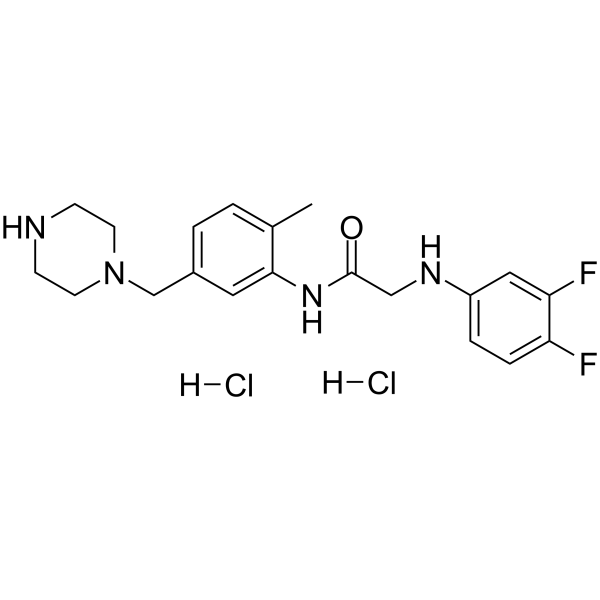
GW791343 dihydrochloride is a potent human P2X7 receptor negative allosteric modulator (exhibits species-specific activity), produces a non-competitive antagonist effect on human P2X7 receptor, with a pIC50 of 6.9-7.2. GW791343 dihydrochloride can enhance ATP rhythm. GW791343 dihydrochloride can be used in study of neurological disease .
loading...
    loading...
Cat. No.: HY-W782083
CAS No.: 1583289-85-3
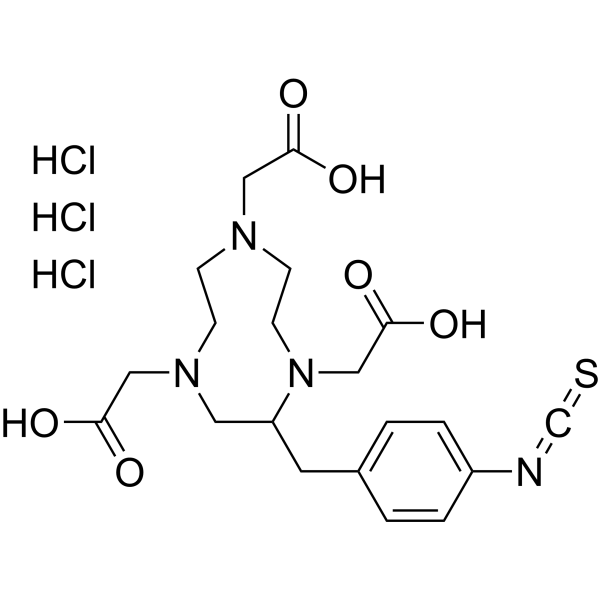
p-SCN-Bn-NOTA trihydrochloride is a macrocyclic chelator. p-SCN-Bn-NOTA trihydrochloride can be covalently coupled to molecules such as peptides through the thiocyanate group to form hexacoordinate copper (such as 64Cu) complexes. p-SCN-Bn-NOTA trihydrochloride specifically binds to GRPR or EGFR highly expressed on the surface of tumor cells, mediating tumor enrichment of radioactive probes. p-SCN-Bn-NOTA trihydrochloride can be used to study malignant tumors expressing GRPR or EGFR, such as prostate cancer and colorectal cancer .
loading...
    loading...
Cat. No.: HY-150514
CAS No.: 1381459-14-8
Purity:  99.34%
Target:  

Prion Protein

Research Areas:  

Infection

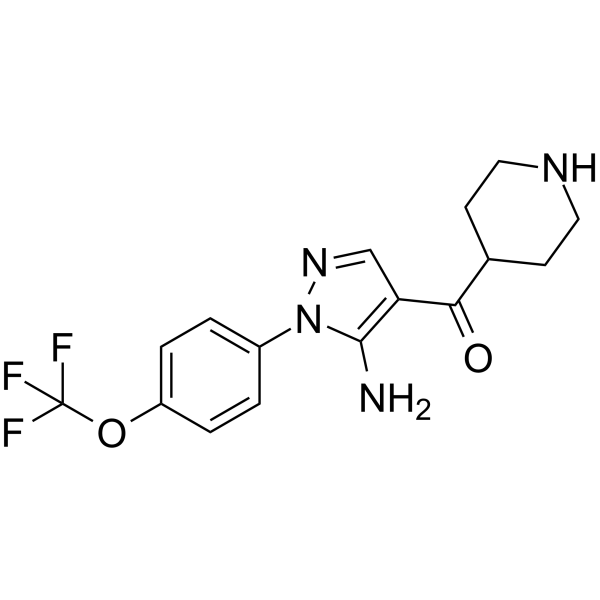
ARN1468 (compound 5) is an orally active and potent SerpinA3n inhibitor. ARN1468 can inhibit serpins activity would set the protease free to further reduce prion accumulation. ARN1468 shows anti-prion effect in ScGT1 RML, ScGT1 22L, ScN2a RML, and ScN2a 22L cell lines, with EC50 values of 8.64, 19.3, 11.2, and 6.27 μM .
loading...
    loading...
Cat. No.: HY-178106
Target:  

Drug Intermediate

Research Areas:  

Cancer

SCN2 is a esterase-responsive prodrug-based amphiphile composed of SN38 (HY-13704) and di-(triazole-[12]aneN3, N) moiety through a 7‑carbon alkyl chains. SCN2 has excellent self-assembly and reversible siRNA condensation capabilities as well as anti-proliferation activity against cancer cells. SCN2 can be used for synthesis of nanoparticles for drug delivery of lung cancer .
loading...
    loading...
Cat. No.: HY-W081348
CAS No.: 60798-06-3
1-(4-Methoxyphenyl)-3-methyl-1H-pyrazol-5(4H)-one (Compound 2) has antiprion activity in ScN2a and F3 cells with IC50 values of 13 nM and 25 nM, respectively .
loading...
    loading...
Cat. No.: HY-15470
CAS No.: 309712-55-8
Target:  

P2X Receptor

Research Areas:  

Neurological Disease

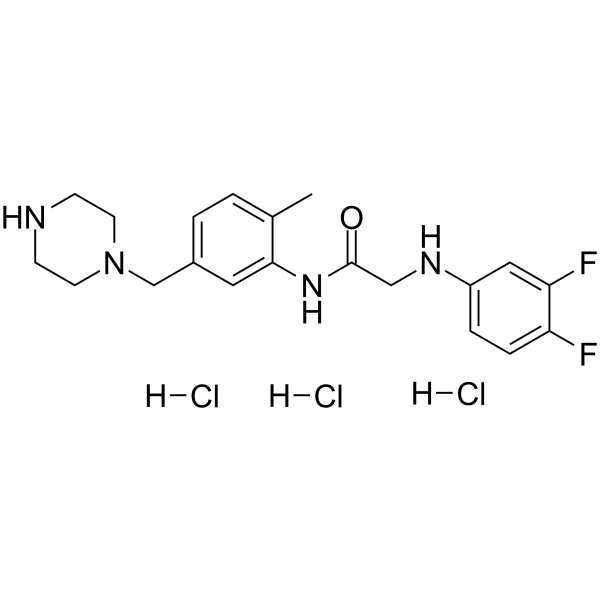
GW791343 trihydrochloride is a potent human P2X7 receptor negative allosteric modulator (exhibits species-specific activity), produces a non-competitive antagonist effect on human P2X7 receptor, with a pIC50 of 6.9-7.2. GW791343 trihydrochloride can enhance ATP rhythm. GW791343 trihydrochloride can be used in study of neurological disease .
loading...
    loading...
Cat. No.: HY-D1056A5
Synonyms: LPS, from Escherichia coli (K-235)
Lipopolysaccharides, from E. coli (Escherichia coli) K-235 are lipopolysaccharide endotoxins and TLR-4 activators derived from E. coli, classified as S-type LPS, which can activate pathogen-associated molecular patterns (PAMP) of the immune system and induce cellular secretion of migrasomes. Lipopolysaccharides, from E. coli K-235 exhibit a typical three-part structure: O-antigen (O-antigen), core oligosaccharide (core oligosaccharide), and lipid A (Lipid A). Lipopolysaccharides, from E. coli K-235 have a mitogenic effect on C57BL/10ScN spleen cells. Additionally, LPS purified using butanol and deoxycholic acid methods stimulates spleen cells in C57BL/10ScCR and C3H/HeJ mice .
It is recommended to prepare a solution with concentration ≥2 mg/mL. Vortex thoroughly for more than 10 minutes. Due to the adsorption characteristics of LPS, silanized container or low adsorption centrifuge tubes should be used for aliquoting and storage, and mix thoroughly before use.
loading...
    loading...
Cat. No.: HY-107662
CAS No.: 34320-83-7
Purity:  99.72%
Target:  

Apoptosis

Research Areas:  

Infection Cancer

TCS PrP Inhibitor 13, an antiprion agent, is a cellular prion protein (PrP C) inhibitor. TCS PrP Inhibitor 13, as a protease-resistant form of prion protein (PrP-res) accumulation inhibitor, shows an IC50 value of 3 nM in both ScN2a and F3 cell lines. TCS PrP Inhibitor 13 induces Schwannoma cells apoptosis .
loading...
    loading...
Cat. No.: HY-107662R
CAS No.: 34320-83-7
Research Areas:  

Infection Cancer

TCS PrP Inhibitor 13 (Standard) is the analytical standard of TCS PrP Inhibitor 13 (HY-107662). This product is intended for research and analytical applications. TCS PrP Inhibitor 13, an antiprion agent, is a cellular prion protein (PrPC) inhibitor. TCS PrP Inhibitor 13, as a protease-resistant form of prion protein (PrP-res) accumulation inhibitor, shows an IC50 value of 3 nM in both ScN2a and F3 cell lines. TCS PrP Inhibitor 13 induces Schwannoma cells apoptosis .
loading...
    loading...
Cat. No.: HY-184898
CAS No.: 2128304-65-2
Target:  

Chloride Channel

Research Areas:  

Inflammation/Immunology

PDSinh-C01 is a reversible, non-competitive pendrin (SLC26A4) inhibitor with an IC50 of 2.5 μM. PDSinh-C01 inhibits pendrin-mediated Cl /SCN exchange activity, reduces cell counts, protein levels, and pro-inflammatory cytokine production in bronchoalveolar lavage fluid. PDSinh-C01 can be used in research related to acute lung injury and cystic fibrosis .
loading...
    loading...
Cat. No.: HY-184897
CAS No.: 312724-83-7
Target:  

Chloride Channel NF-κB

Research Areas:  

Inflammation/Immunology

YS-01 is an inhibitor of pendrin (SLC26A4) with pulmonary protective activity. YS-01 inhibits pendrin-mediated anion exchange activity, reduces pendrin expression, and suppresses the activation of NF-κB and the production of proinflammatory cytokines. YS-01 alleviates lipopolysaccharide-induced and ventilator-induced lung injury. YS-01 attenuates ovalbumin-induced airway hyperresponsiveness, inflammatory infiltration, epithelial thickening and goblet cell hyperplasia, and reduces eosinophil and neutrophil counts. YS-01 decreases MUC5AC transcription levels induced by IL-4, reverses the reduction of airway surface liquid volume, and inhibits the increase of apical SCN concentration in epithelial cells. YS-01 can be used in studies related to lung injury and allergic asthma .
loading...
    loading...
  • 1

