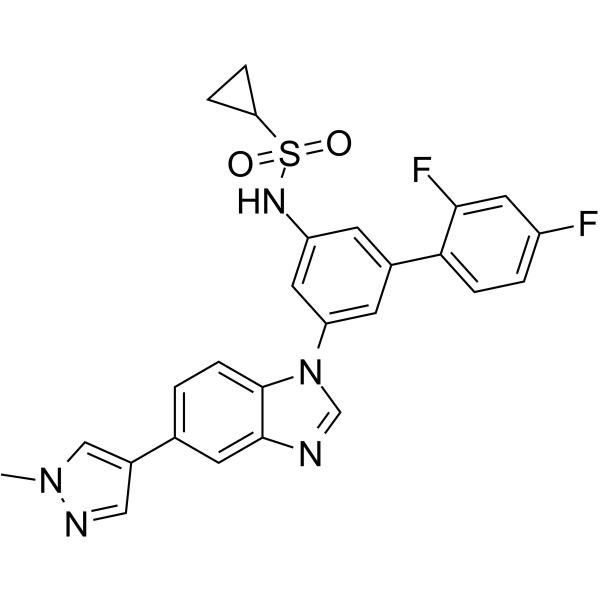
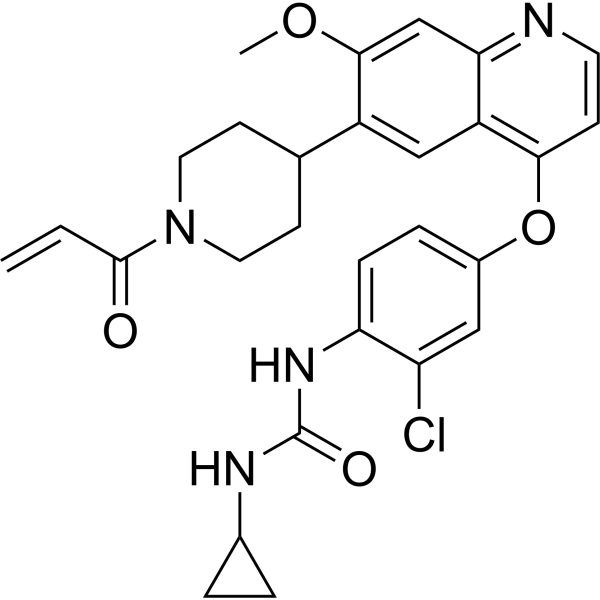
8 Results for "

SNU16

" in MedChemExpress (MCE) Product Catalog:
Products (8)

8 Results for "SNU16" in MCE Product Catalog:

Cat. No.: HY-119367
CAS No.: 1430723-35-5
Purity:  99.91%
Target:  

FGFR VEGFR

Research Areas:  

Cancer

ODM-203 is an orally active and selective FGFR/VEGFR inhibitor with IC50 values of 6, 11, 16, 5, 9, 26 and 35 nM for FGFR3/1/2 and VEGFR3/2/1/4, respectively. ODM-203 has strong anti-tumour activity and activates immune responses in the tumour microenvironment .
loading...
    loading...
Cat. No.: HY-P991584

Target:  

FGFR

Research Areas:  

Cancer

HuGAL-FR21 is a humanized antiFGFR2IIIb IgG1 monoclonal antibody. HuGAL-FR21 can block the binding of FGF2, FGF7, and FGF10 to FGFR2IIIb and inhibit FGF-induced phosphorylation of FGFR2IIIb. HuGAL-FR21 can downregulate the expression of FGFR2 in SNU-16 cells. HuGAL-FR21 shows the significant anti-tumor activity in athymic nude mice bearing gastric cancer xenograft models. HuGAL-FR21 can be used for research on cancer such as gastric cancer .
loading...
    loading...
Cat. No.: HY-163985
CAS No.: 3099123-99-3
Target:  

PROTACs FGFR Apoptosis

Research Areas:  

Cancer

PROTAC FGFR2 degrader 1 (compound N5) is a PROTAC that effectively targets FGFR2 with DC50 of 6.46 nM, the FGFR2 IC50 is 0.08 nM. PROTAC FGFR2 degrader 1 has anti-proliferative activity and highly selective, induces G0/G1 arrest of KATOIII and SNU16 cell cycle and inhibits apoptosis by reducing the activation of p-ERK and p-PLCγ, the downstream proteins of FGFR2. PROTAC FGFR2 degrader 1 potently inhibits the growth of SNU16 xenograft tumors in mouse model .
loading...
    loading...
Cat. No.: HY-178238
CAS No.: 3040077-52-6
Research Areas:  

Cancer

LD2-3 is a cytotoxic compound derived from Exatecan (HY-13631), designed to be conjugated with anti-FGFR2b or anti-CEA antibodies to form intact antibody-drug conjugate (ADC) molecules. LD2-3 exhibits a remarkable bystander killing effect: it not only effectively kills FGFR2b-positive tumor cells, but also eliminates surrounding FGFR2b-negative cells in co-culture and mixed tumor xenograft models, thereby inducing complete tumor regression. LD2-3 can be used for anti-tumor research in relevant fields such as gastric cancer and lung cancer .
loading...
    loading...
Cat. No.: HY-172916
Target:  

SHP2 FGFR p38 MAPK ERK

Research Areas:  

Cancer

LC-SF-14 is a selective dual inhibitor of SHP2 and FGFR (IC50 values are 71.6 and 8.9 nM, respectively). LC-SF-14 inhibits FGFR2-FRS2α-SHP2-MAPK signaling and ERK phosphorylation. LC-SF-14 inhibits the proliferation of KATOIII cancer cells (IC50: 9.2 nM). LC-SF-14 has antitumor activity in the SNU-16 xenograft mouse model. LC-SF-14 can be used in FGFR2-driven gastric cancer research .
loading...
    loading...
Cat. No.: HY-162577
CAS No.: 3047446-75-0
Target:  

FGFR

Research Areas:  

Cancer

FGFR-IN-14 (compound 10h) is a pan-FGFR inhibitor. FGFR-IN-14 inhibits FGFR1, FGFR2, FGFR3 and FGFR2 V564F gatekeeper mutant with IC50s of 46, 41, 99, and 62 nM, respectively. FGFR-IN-14 strongly suppresses NCI-H520 lung cancer cells, SNU-16 and KATO III gastric cancer cells proliferation with IC50s of 19, 59, and 73 nM, respectively .
loading...
    loading...
Cat. No.: HY-170919
CAS No.: 3025799-28-1
Target:  

FGFR

Research Areas:  

Cancer

FGFR2/3-IN-2 (compound 10) is an orally active FGFR2 and FGFR3 inhibitor. FGFR2/3-IN-2 inhibits FGFR2 and FGFR3 with IC50s of 3.7 nM and 31.2 nM (preincubation time 1 h), respectively. FGFR2/3-IN-2 spares FGFR1/4 and other kinases without causing diarrhea and serum phosphate elevation in vivo. FGFR2/3-IN-2 induces tumor stasis or regression in the SNU-16 gastric cancer model .
loading...
    loading...
Cat. No.: HY-155028
CAS No.: 2658488-68-5
Target:  

FGFR

Research Areas:  

Cancer

FGFR-IN-11 (compound I-5) is an orally active and covalent FGFR inhibitor with IC50 values of 9.9 nM (FGFR1), 3.1 nM (FGFR2), 16 nM (FGFR3), and 1.8 nM (FGFR4), respectively. FGFR-IN-11 inhibits multiple cancer cell proliferation with nanomolar activity. FGFR-IN-11 inhibits tumor growth significantly in xenograft mice models .
loading...
    loading...

