1. Search Result
Search Result
Isoforms Recommended: YTHDF2
Results for "

YTHDF2

" in MedChemExpress (MCE) Product Catalog:

12

Inhibitors & Agonists

3

Natural
Products

1

Recombinant Proteins

1

Antibodies

3

Oligonucleotides

Targets Recommended:
Cat. No. Product Name Target Research Areas Chemical Structure
  • HY-174982

    YTHDF Cancer
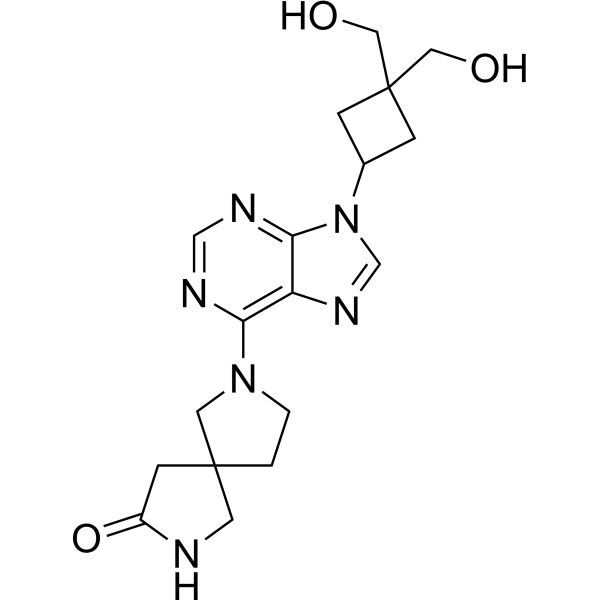
    YTHDF2 ligand-1 (Compound 23) is a competitive, selective, and high-affinity YTHDF2 ligand with an IC50 of 11 μM and a Kd of 1.3 μM. YTHDF2 ligand-1 competes with m 6A-RNA for binding to YTHDF2. YTHDF2 ligand-1 is applicable for cancer research .
    YTHDF2 ligand-1
  • HY-154919
    DC-Y13-27
    4 Publications Verification

    YTHDF FOXO MMP Pyroptosis Interleukin Related Endocrinology Cancer
    DC-Y13-27 is a DC-Y13 derivative and YTHDF2 inhibitor (KD: 37.9 μM). DC-Y13-27 inhibits YTHDF2, restores FOXO3 and TIMP1 protein levels, and reduces MMP1/3/7/9 expression. DC-Y13-27 induces Pyroptosis and increases IL-1β secretion. DC-Y13-27 reduces intervertebral disc degeneration and enhances the response to radiotherapy in colon cancer and melanoma. DC-Y13-27 has antitumor activity against breast cancer [2] .
    DC-Y13-27
  • HY-N0353
    Curdione
    2 Publications Verification

    (+)-Curdione

    Ferroptosis Apoptosis Reactive Oxygen Species (ROS) Autophagy Glutathione Peroxidase Keap1-Nrf2 Heme Oxygenase (HO) TGF-β Receptor Indoleamine 2,3-Dioxygenase (IDO) Cardiovascular Disease Neurological Disease Cancer
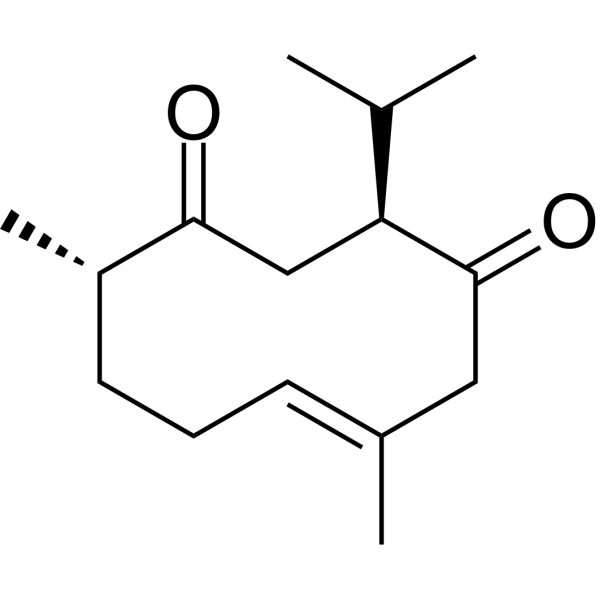
    Curdione ((+)-Curdione) is an orally active sesquiterpenoid. Curdione inhibits platelet aggregation. Curdione induces ferroptosis in colorectal cancer via m6A methylation mediated by METTL14 and YTHDF2. Curdione inhibits ferroptosis in Isoproterenol (HY-B0468)-induced myocardial infarction by regulating the Keap1/Trx1/GPX4 signaling pathway, suppressing oxidative stress (ROS) and apoptosis. Curdione ameliorates Doxorubicin (HY-15142)-induced cardiotoxicity by inhibiting oxidative stress (ROS) and activating the Nrf2/HO-1 pathway. Curdione ameliorates sepsis-induced lung injury by inhibiting platelet-mediated neutrophil extracellular trap formation. Curdione ameliorates Bleomycin (HY-17565A)-induced pulmonary fibrosis by inhibiting TGF-β-induced fibroblast-to-myofibroblast differentiation. Curdione exhibits neuroprotective effects against focal cerebral ischemia-reperfusion injury in rats. Curdione exerts antiproliferative effects against human uterine leiomyosarcoma by targeting IDO1. Curdione protects vascular endothelial cells and atherosclerosis by regulating DNMT1-mediated ERBB4 promoter methylation. Curdione inhibits inducible prostaglandin E2 production (IC50 = 1.1 μM) and cyclooxygenase 2 expression [2] .
    Curdione
  • HY-173008

    Apoptosis YTHDF Cancer
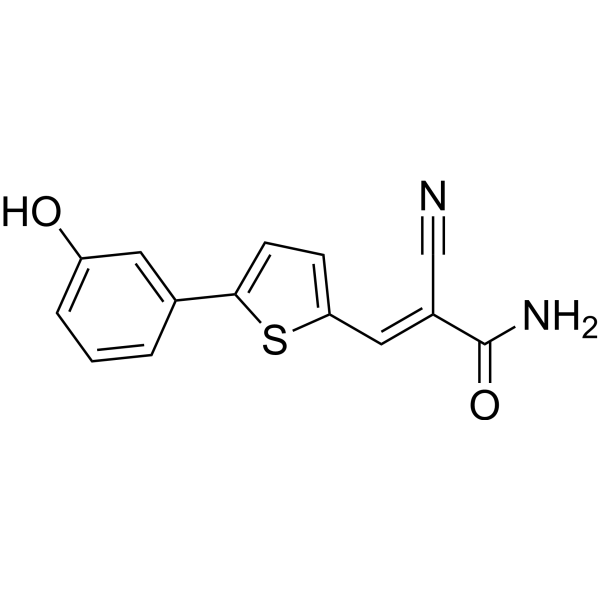
    YTHDF2-IN-1 (Compound CK-75) is a selective YTHDF2 inhibitor (Kd = 26.2 μM). YTHDF2-IN-1 binds to a small hydrophobic pocket on the YTH domain of YTHDF2, disrupting the interaction between YTHDF2 and m 6A-modified RNA. YTHDF2-IN-1 induces cell cycle arrest and Apoptosis. YTHDF2-IN-1 is applicable to research on chronic myeloid leukemia, colon cancer and choriocarcinoma .
    YTHDF2-IN-1
  • HY-137341

    PROTACs YTHDF Cancer
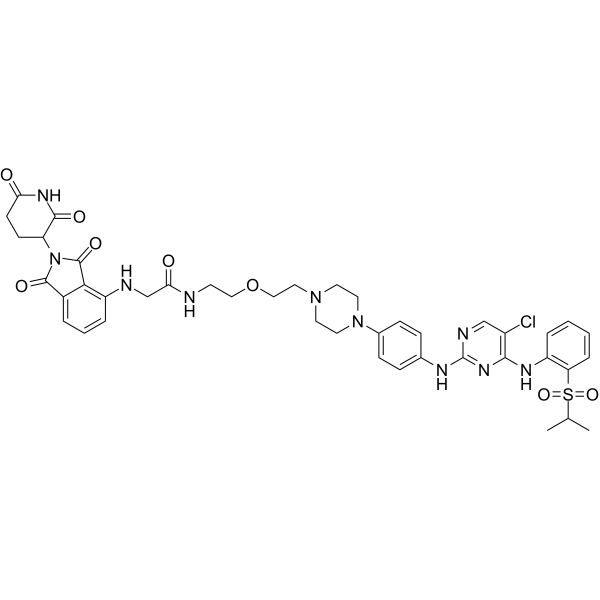
    SK-3-91 is a PROTAC-type multi-kinase degrader that can jointly induce the degradation of the largest number of unique kinases (more than 125 unique kinases). SK-3-91 induces protein degradation through the ubiquitin biotinylation (E-STUB) pathway. SK-3-91 degrades YTHDF2. SK-3-91 inhibits cell proliferation and induces morphological changes. (Pink: TAE648 ligand (HY-169396); Blue: E3 ligase ligand (HY-131717); Black: Linker (HY-140819). The E3 ligase ligand and linker can form a conjugate (HY-169397)) [2].
    SK-3-91
  • HY-168610

    Epigenetic Reader Domain YTHDF Cancer
    YTH-IN-1 (compound N-7) is a pan-YTH domain inhibitor with the IC50 values of 39 μM, 34 μM, 35 μM, 48 μM and 30 μM for human YTH YTHDF1, YTH YTHDF2, YTH YTHDF3, YTH YTHDC1, and YTH YTHDC2, respectively .
    YTH-IN-1
  • HY-RS15938

    Small Interfering RNA (siRNA) YTHDF Others

    YTHDF2 Human Pre-designed siRNA Set A contains three designed siRNAs for YTHDF2 gene (Human), as well as a negative control, a positive control, and a FAM-labeled negative control.

    YTHDF2 Human Pre-designed siRNA Set A
    YTHDF2 Human Pre-designed siRNA Set A
  • HY-N0086R
    N6-Methyladenosine (Standard)
    1 Publications Verification

    6-Methyladenosine (Standard); N-Methyladenosine (Standard)

    Endogenous Metabolite Influenza Virus Reference Standards Infection
    N6-Methyladenosine (Standard) is the analytical standard of N6-Methyladenosine. This product is intended for research and analytical applications. N6-Methyladenosine is the most prevalent internal (non-cap) modification present in the messenger RNA (mRNA) of all higher eukaryotes. N6-Methyladenosine can modifies viral RNAs and has antiviral activities. In Vitro: N6-methyladenosine (m6A) is selectively recognized by the human YTH domain family 2 (YTHDF2) protein to regulate mRNA degradation. N6-methyladenosine (m6A), a prevalent internal modification in the messenger RNA of all eukaryotes, is post-transcriptionally installed by m6A methyltransferase (e.g., MT-A70) within the consensus sequence of G(m6A)C (70%) or A(m6A)C (30%). N6-methyladenosine (m6A)-containing RNAs are greatly enriched in the YTHDF-bound portion and diminished in the flow-through portion . N6-methyladenosine (m6A), the most abundant internal RNA modification, functions in diverse biological processes, including regulation of embryonic stem cell self-renewal and differentiation. N6-methyladenosine (m6A) is a large protein complex, consisting in part of methyltransferase-like 3 (METTL3) and methyltransferase-like 14 (METTL14) catalytic subunits [2].
    N6-Methyladenosine (Standard)
  • HY-175885

    PROTACs Fat Mass and Obesity-associated Protein (FTO) Apoptosis Caspase PARP YTHDF Cancer
    PROTAC FTO degrader 1 is a Fat Mass and Obesity-associated Protein (FTO) PROTAC degrader. PROTAC FTO degrader 1 selectively degrades FTO depending on VHL E3 ligase and ubiquitin-proteasome system. PROTAC FTO degrader 1 can increase m6A modifications on mRNAs associated with ribosome biogenesis and promote their YTHDF2-mediated decay. PROTAC FTO degrader 1 can inhibit cancer cells proliferation and induce apoptosis. PROTAC FTO degrader 1 can be used for the research of cancer, such as acute myeloid leukemia (AML) . (Structure Note: Pink: FTO ligand (HY-175886); Blue: VHL ligand (HY-112078); Black: linker (HY-W002042); VHL ligand-Linker: (HY-139218))
    PROTAC FTO degrader 1
  • HY-RS16947

    Small Interfering RNA (siRNA) Others

    Ythdf2 Mouse Pre-designed siRNA Set A contains three designed siRNAs for Ythdf2 gene (Mouse), as well as a negative control, a positive control, and a FAM-labeled negative control.

    Ythdf2 Mouse Pre-designed siRNA Set A
    Ythdf2 Mouse Pre-designed siRNA Set A
  • HY-RS23390

    Small Interfering RNA (siRNA) Others

    Ythdf2 Rat Pre-designed siRNA Set A contains three designed siRNAs for Ythdf2 gene (Rat), as well as a negative control, a positive control, and a FAM-labeled negative control.

    Ythdf2 Rat Pre-designed siRNA Set A
    Ythdf2 Rat Pre-designed siRNA Set A
  • HY-N0353R

    (+)-Curdione (Standard)

    Reference Standards Ferroptosis Apoptosis Reactive Oxygen Species (ROS) Autophagy Glutathione Peroxidase Keap1-Nrf2 Heme Oxygenase (HO) TGF-β Receptor Indoleamine 2,3-Dioxygenase (IDO) Others
    Curdione (Standard) is the analytical standard of Curdione. This product is intended for research and analytical applications. Curdione ((+)-Curdione) is an orally active sesquiterpenoid. Curdione inhibits platelet aggregation. Curdione induces ferroptosis in colorectal cancer via m6A methylation mediated by METTL14 and YTHDF2. Curdione inhibits ferroptosis in Isoproterenol (HY-B0468)-induced myocardial infarction by regulating the Keap1/Trx1/GPX4 signaling pathway, suppressing oxidative stress (ROS) and apoptosis. Curdione ameliorates Doxorubicin (HY-15142)-induced cardiotoxicity by inhibiting oxidative stress (ROS) and activating the Nrf2/HO-1 pathway. Curdione ameliorates sepsis-induced lung injury by inhibiting platelet-mediated neutrophil extracellular trap formation. Curdione ameliorates Bleomycin (HY-17565A)-induced pulmonary fibrosis by inhibiting TGF-β-induced fibroblast-to-myofibroblast differentiation. Curdione exhibits neuroprotective effects against focal cerebral ischemia-reperfusion injury in rats. Curdione exerts antiproliferative effects against human uterine leiomyosarcoma by targeting IDO1. Curdione protects vascular endothelial cells and atherosclerosis by regulating DNMT1-mediated ERBB4 promoter methylation. Curdione inhibits inducible prostaglandin E2 production (IC50 = 1.1 μM) and cyclooxygenase 2 expression [2] .
    Curdione (Standard)

Inquiry Online

Your information is safe with us. * Required Fields.

Salutation


Country or Region *

Applicant Name *


Organization Name *

Department *


Email Address *


Product Name *

Cat. No.


Requested quantity *

Phone Number *


Remarks

Inquiry Online

Inquiry Information

Product Name:
Cat. No.:
Quantity:
MCE Japan Authorized Agent:

