



YTHDF2 Antibody (YA6146)
(Synonyms: HGRG8, YTHDF2, YTH domain-containing family protein 2, DF2, CLL-associated antigen KW-14, High-glucose-regulated protein 8, Renal carcinoma antigen NY-REN-2)Based on 1 Customer Validation
YTHDF2 Antibody (YA6146) is a Rabbit-derived and non-conjugated IgG monoclonal antibody, targeting to YTHDF2.
-
Host:
Rabbit
-
Isotype:
IgG
-
Application:
WB, IHC-P, ICC/IF, IP, ELISA
-
Reactivity :
Human, Mouse, Rat
-
Formulation:
Supplied in PBS, 50% glycerol, 0.05% Proclin 300, 0.05%BSA
-
Conjugation:
Non-conjugated


To place orders, for customer services and technical support, please contact: MedChemExpress USA
Tel: 609-228-6898 E-mail: [email protected] [email protected]





Applications
| Application |
IHC-P

IHC-P: Immunohistochemistry-Paraffin
|
WB
WB: Western Blot
|
ICC/IF
ICC/IF: Immunocytochemistry/
Immunofluorescence |
ELISA
ELISA: Enzyme Linked Immunosorbent Assay
|
IP
IP: Immunoprecipitation
|
|---|---|---|---|---|---|
| Dilution Ratio | 1:200-1:1000 | 1:1000-1:5000 | 1:200-1:1000 | 1:5000-1:20000 | 1:50-1:200 |


Product Details
YTHDF2 Antibody (YA6146) is a Rabbit-derived and non-conjugated IgG monoclonal antibody, targeting to YTHDF2.
-
Host Rabbit

-
Clonality Monoclonal

-
Species ReactivityHuman, Mouse, Rat
-
Observed Molecular WeightObserved band size: 62 kDa
Note: Due to possible protein modifications or aggregation, the molecular weight should be confirmed by actual measurement, and the predicted value is for reference only.

-
Calculated Molecular Weight Predicted band size: 62 kDa

Protein A
Non-conjugated
Unmodified
IgG


Product Properties
-
Appearance
Solution
-
Formulation
Supplied in PBS, 50% glycerol, 0.05% Proclin 300, 0.05%BSA
-
Concentration
Batch-dependent, Please check the COA for the concentration of each lot. Check Lot Concentration
-
Storage & Stability
Stored at -20°C for 1 year. Avoid repeated freeze / thaw cycles.
-
Shipping
Shipping with blue ice.


Verification Images
-
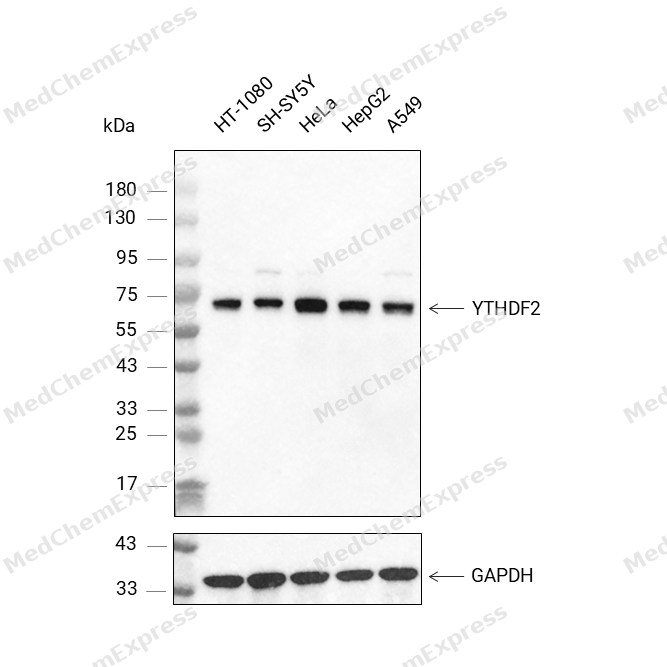 Western blot analysis was performed on protein extracts (30 μg) from HT-1080 (lane 2), SH-SY5Y (lane 3), HeLa (lane 4), HepG2 (lane 5), and A549 (lane 6) using YTHDF2 antibody. Proteins were transferred onto a 0.45 μm PVDF membrane using the Trans-Blot® Turbo™ system for 13 min. The membrane was then blocked with 5% nonfat milk in TBST (HY-K1025) for 1 h at room temperature. Thhe primary antibody (1:1000) and loading control antibody GAPDH Antibody (HRP) (HY-P80954A) (1:2500) were diluted in 5% nonfat milk in TBST and incubated with the membrane overnight at 4°C. After washing, the membrane of primary antibody was incubated with HRP-conjugated goat anti-rabbit IgG (H&L) secondary antibody (HY-P8001) (1:5000) diluted in 5% nonfat milk in TBST for 1 h at room temperature. Protein bands were visualized using an Ultra High Sensitivity ECL detection kit (HY-K1005).
 -
 Western blot analysis of extracts from HeLa (lane 1(20μg)) using YTHDF2 Antibody (HY-P86454) . Proteins were transferred to a PVDF membrane and blocked with 5% nonfat dry milk in TBST for 1.5 hour at room temperature. The primary antibody (1/2000) and Loading control antibody (β Actin, 1/10000) was used in 5% nonfat dry milk in TBST at 4℃ overnight. Goat Anti-Rabbit IgG-HRP Secondary Antibody (1/10,000) was used for 1 hour at room temperature.


Background
-
Function
YTHDF2 is a cytoplasmic m6A reader that controls m6A-modified RNA fate through mRNA degradation and, in selected contexts, translation regulation[1][2]. Mechanistically, YTHDF2-mediated mRNA decay targets multiple TGF-β signaling components in early postnatal mouse hippocampal neural stem cells, thereby limiting quiescence acquisition and supporting neurogenesis[1]. In glioma models, YTHDF2 accelerates UBXN1 mRNA degradation through METTL3-mediated m6A recognition, activates NF-κB signaling, and promotes malignant progression[3]. In glioblastoma stem cells, YTHDF2 instead stabilizes MYC and VEGFA transcripts, identifies a cancer-specific dependency, and links the YTHDF2-MYC-IGFBP3 axis to tumor growth[2]. Compared with related YTHDF isoforms, YTHDF proteins share m6A-reader activity but display distinct cellular functions because their low-complexity N termini, post-translational modifications, subcellular localization, and partner competition differ[4]. For experimental applications, linsitinib preferentially targeted YTHDF2-expressing glioblastoma stem cells, while a YTHDF2-specific small-molecule inhibitor suppressed tumor-cell translation and reversed paclitaxel resistance in ovarian cancer models[2][5].
-
Subcellular Localization
Cytoplasm, cytosol; Cytoplasm, P-body; Cytoplasm, Stress granule; Nucleus
-
Expression
Tissue_specificity:Highly expressed in induced pluripotent stem cells (iPSCs) and down-regulated during neural differentiation
Induction:Following heat shock stress -
Isoforms & Post-Translational Modification
Q9Y5A9 has 2 isomers: Q9Y5A9-1: 62334 Da (predicted); Q9Y5A9-2: 56877 Da (predicted).
Ubiquitinated by the SCF(SKP2) complex, leading to its degradation -
Subunit
Interacts with CNOT1; interaction is direct and promotes recruitment of the CCR4-NOT complex (PubMed:27558897, PubMed:32492408). Interacts with YTHDF3 (PubMed:28106072). Interacts with RIDA/HRSP12; interaction leads to recruitment of the ribonuclease P/MRP complex (PubMed:30930054)
-
SwissProt ID
-
Synonyms
HGRG8, YTHDF2, YTH domain-containing family protein 2, DF2, CLL-associated antigen KW-14, High-glucose-regulated protein 8, Renal carcinoma antigen NY-REN-2


Documentation
-
Data Sheet (263 KB)
-
SDS (252 KB)
- English - EN (252 KB)
- Français - FR (252 KB)
- Deutsch - DE (252 KB)
- Norwegian - NO (252 KB)
- Español - ES (252 KB)
- Swedish - SV (252 KB)
- Italian - IT (252 KB)
- Korean - KR (252 KB)
- Portuguese - PT (252 KB)
-
User Guide for Antibodies (1077 KB)
References
[1]. Zhang F, et al. m6A/YTHDF2-mediated mRNA decay targets TGF-β signaling to suppress the quiescence acquisition of early postnatal mouse hippocampal NSCs. Cell Stem Cell. 2025 Jan 2;32(1):144-156.e8. [Content Brief]
[2]. Dixit D, et al. The RNA m6A Reader YTHDF2 Maintains Oncogene Expression and Is a Targetable Dependency in Glioblastoma Stem Cells. Cancer Discov. 2021 Feb;11(2):480-499. [Content Brief]
[3]. Chai RC, et al. YTHDF2 facilitates UBXN1 mRNA decay by recognizing METTL3-mediated m6A modification to activate NF-κB and promote the malignant progression of glioma. J Hematol Oncol. 2021 Jul 10;14(1):109. [Content Brief]
[4]. Zou Z, et al. The YTHDF proteins display distinct cellular functions on m6A-modified RNA. Trends Biochem Sci. 2024 Jul;49(7):611-621. [Content Brief]
[5]. Liu T, et al. The RNA-stability-independent role of the RNA m6A reader YTHDF2 in promoting protein translation to confer tumor chemotherapy resistance. Mol Cell. 2025 Jun 19;85(12):2320-2336.e9. [Content Brief]

 Powered by Bioz
