10 Results for "

aryl radical

" in MedChemExpress (MCE) Product Catalog:
Products (10)

10 Results for "aryl radical" in MCE Product Catalog:

1
1 Cited Publications
Cat. No.: HY-W002805
CAS No.: 66572-56-3
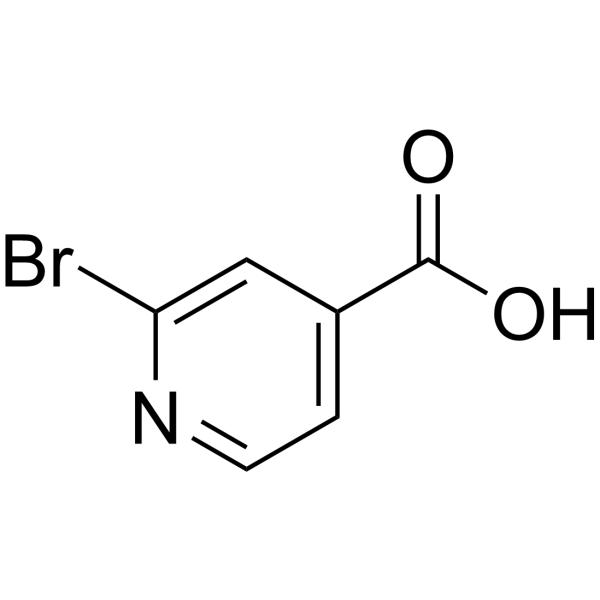
2-Bromoisonicotinic acid is a (hetero)aryl bromide building block and DNA-conjugated headpiece for photochemical C-H heteroarylation in DNA-encoded library synthesis. 2-Bromoisonicotinic acid generates a nucleophilic pyridyl radical intermediate. 2-Bromoisonicotinic acid, when conjugated to DNA, leaves electrophilic handles intact for subsequent library diversification .
loading...
    loading...
Cat. No.: HY-W008598
CAS No.: 403-29-2
Synonyms: p-Fluorophenacyl bromide
Target:  

DNA/RNA Synthesis

Research Areas:  

Cancer

2-Bromo-4'-fluoroacetophenone (p-Fluorophenacyl bromide) is a photoinducible DNA cleavage inducer.2-Bromo-4'-fluoroacetophenone generates fluorine-substituted phenyl radicals upon excitation and irradiation to cleave DNA, converting circular supercoiled DNA to circular relaxed and linear DNA forms.2-Bromo-4'-fluoroacetophenone exhibits concentration-dependent DNA cleaving activity.2-Bromo-4'-fluoroacetophenone can be used for the research of cancer .
loading...
    loading...
Cat. No.: HY-120976
CAS No.: 157230-67-6
Purity:  99.84%
Research Areas:  

Others

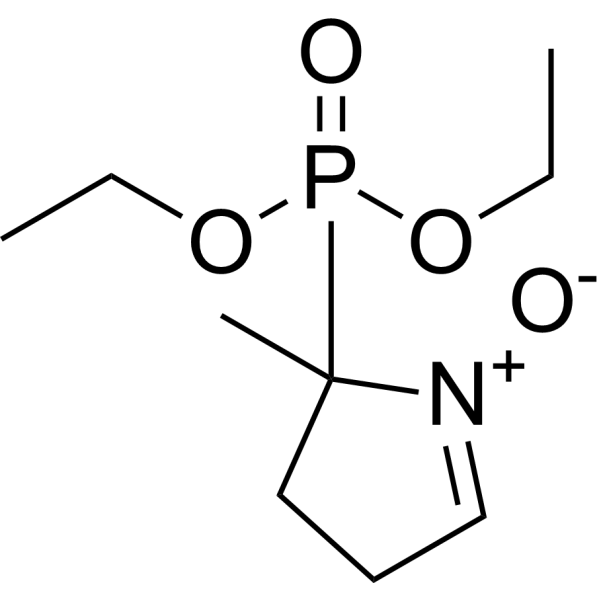
DEPMPO is a phosphorus-substituted nitrone spin trap probe that can capture superoxide anions and hydroxyl radicals. DEPMPO forms stable spin adducts with hydroxyl, aryl, sulfite and superoxide radicals, and the formation of these adducts can be inhibited by catalase or superoxide dismutase. DEPMPO is rapidly absorbed after intraperitoneal injection and distributes uniformly in the liver, heart and blood of mice. DEPMPO can be used in studies related to oxygen radical detection .
loading...
    loading...
Cat. No.: HY-W039724
CAS No.: 492-22-8
Research Areas:  

Others

Thioxanthone is a powerful photocatalyst for organic reactions. Thioxanthone mediates energy transfer, single-electron transfer, and hydrogen atom transfer processes. As a photoredox catalyst, Thioxanthone is used in nickel-catalyzed self-coupling reactions of aryl halides, arylation reactions of H-phosphine oxides/H-phosphites, decarbonylation reactions of cyclopropenones, and reactions generating acyl radicals from aromatic aldehydes .
loading...
    loading...
Cat. No.: HY-150175
CAS No.: 1786411-17-3
Target:  

Fluorescent Dye

Research Areas:  

Inflammation/Immunology

HKSOX-1 and its derivatives (HKSOX-1r and HKSOX-1m) are novel fluorescent probes designed for highly sensitive and selective detection of the superoxide anion radical (O2 •−) in cellular environments. These probes utilize an aryl trifluoromethanesulfonate group that undergoes O2 •−-mediated cleavage, releasing a free phenol and emitting fluorescence. They demonstrate excellent specificity and sensitivity across various pH ranges, withstand interference from strong oxidants and reductants typical in cellular contexts. HKSOX-1r, optimized for cellular retention, has been effectively employed in diverse assays including confocal imaging, flow cytometry, and zebrafish embryo studies, highlighting its utility in investigating O2 •− roles in inflammation, mitochondrial stress, and other physiological processes .
loading...
    loading...
Cat. No.: HY-W088188
CAS No.: 14024-48-7
Synonyms: Cobalt(II) acetylacetonate
Research Areas:  

Others

Co (acac)2 is an organometallic compound with catalytic activity, in which the central cobalt ion is chelated with acetylacetonate ligands. Co (acac)2 can serve as a precursor for thin films and nanomaterials, and is applicable to researches in organic synthesis, materials science, industrial applications, and other fields .
loading...
    loading...
Cat. No.: HY-W800683
CAS No.: 220446-74-2
Research Areas:  

Others

4-Azide-TFP-Amide-SS-Sulfo-NHS consists of an aryl azide, a cleavable disulfide bond, and an NHS ester. The aryl azide can be photo-activated with UV light (250 to 350 nm) for conjugation with biomolecules. Fluoro helps to stabilize the free radical intermediate. The NHS ester reacts with amines. The disulfide bond can be cleaved by reducing agents.
loading...
    loading...
Cat. No.: HY-W800632
CAS No.: 191163-45-8
Research Areas:  

Others

4-Azide-TFP-Amide-SS-propionic acid contains an aryl azide, a cleavable disulfide bond, and a carboxylic acid. The aryl azide can be photo-activated with UV light (250 to 350 nm) for conjugation with biomolecules. Fluoro helps to stabilize the free radical intermediate. The carboxylic acid can be reacted with amines in the presence of an activator to form an amide bond. The disulfide bond can be cleaved via reducing agents.
loading...
    loading...
Cat. No.: HY-W800635
CAS No.: 2566404-74-6
Research Areas:  

Others

4-Azide-TFP-Amide-PEG4-acid contains an aryl azide and a carboxylic acid with a PEG spacer to increase aqueous solubility and decrease steric hinderance during ligation. The aryl azide can be photo-activated with UV light (250 to 350 nm) for conjugation with biomolecules. Fluoro helps to stabilize the free radical intermediate. The carboxylic acid can be reacted with amines in the presence of an activator to form an amide bond.
loading...
    loading...
Cat. No.: HY-187230
CAS No.: 6373-11-1
Research Areas:  

Others

Aceanthrenequinone is a polycyclic aromatic hydrocarbon quinone organic compound that belongs to the category of free radical photoinitiators. Aceanthrenequinone activates the Aryl Hydrocarbon Receptor pathway, induces the expression of CYP1A protein in the vascular system of zebrafish embryos, and causes the death of embryos at 120 hpf. Aceanthrenequinone exhibits low cytotoxicity toward primary cells and various cell lines, and induces dose-dependent apoptosis. Aceanthrenequinone can be used in studies related to industrial or biomedical applications .
loading...
    loading...

