1. Search Result
Search Result
Results for "

cell membrane preparations

" in MedChemExpress (MCE) Product Catalog:

13

Inhibitors & Agonists

3

Biochemical Assay Reagents

1

Peptides

1

Natural
Products

1

Isotope-Labeled Compounds

2

Oligonucleotides

Cat. No. Product Name Target Research Areas Chemical Structure
  • HY-141613

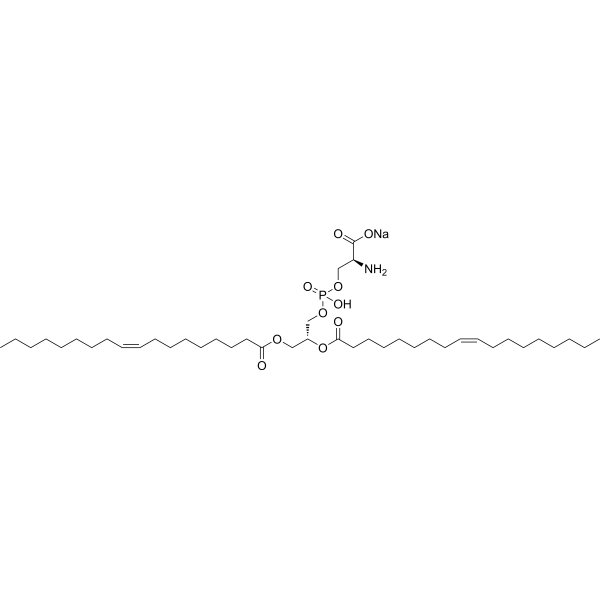
    DOPS-NA

    Liposome Others
    1,2-Dioleoyl-sn-glycero-3-phospho-L-serine sodium (DOPS-NA) is a ubstitute for Phosphoserine/phosphatidylserine. 1,2-Dioleoyl-sn-glycero-3-phospho-L-serine sodium can be used together with DOPC and DOPE in lipid mixtures for the synthesis of liposomes. 1,2-Dioleoyl-sn-glycero-3-phospho-L-serine sodium can self-assemble into single-layer or double-layer membrane structures, similar to cell membranes, and possesses high membrane fluidity and flexibility. 1,2-Dioleoyl-sn-glycero-3-phospho-L-serine is widely applied in membrane biology, cell membrane research, lipid preparation, and drug delivery systems .
    1,2-Dioleoyl-sn-glycero-3-phospho-L-serine sodium
  • HY-127032

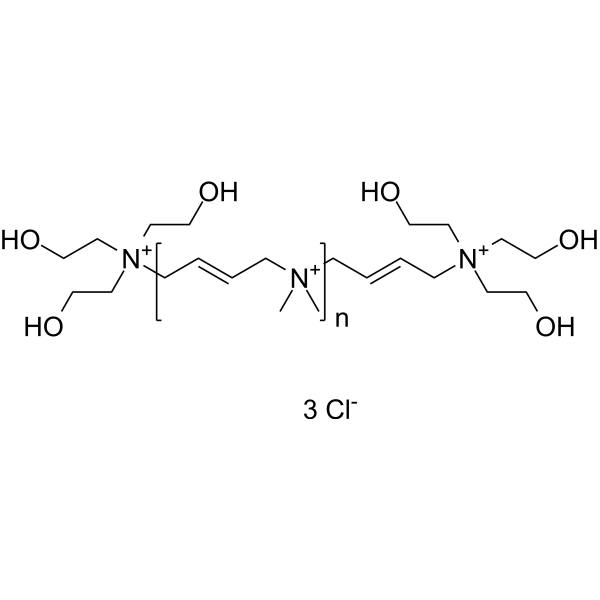
    Polidronium chloride

    Biochemical Assay Reagents Infection
    Polyquaternium-1 (Polidronium chloride; PQ-1) is an antimicrobial preservative and an activator of NF-κB. Polyquaternium-1 targets bacterial cell membranes, commonly used in ophthalmic surgery. Polyquaternium-1 adsorbs to the surface of microbial membranes through its polycationic properties, destroying membrane integrity and inducing potassium ion leakage, leading to bacterial death. Polyquaternium-1 exerts antimicrobial effects at a concentration of 0.001% and has low toxicity to mammalian cells. Polyquaternium-1 can be used to prepare products such as glaucoma eye drops (Travoprost preparations containing PQ-1), artificial tears, and contact lens solutions to reduce the ocular surface toxicity of traditional preservatives such as benzalkonium chloride (HY-B2232) .
    Polyquaternium-1
  • HY-P5107

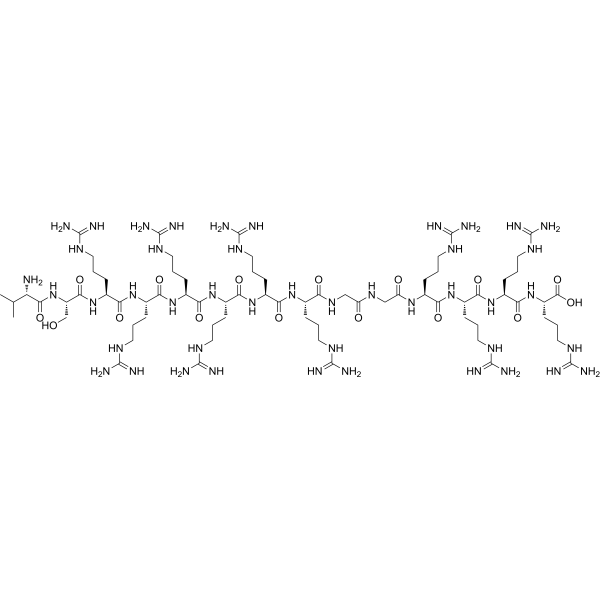
    LMWP; TDSP5

    VEGFR Cancer
    Low molecular weight protamine (LMWP;TDSP5) is a truncated arginine-rich protamine peptide, as well as a heparin/low-molecular-weight heparin antidote and a cell-penetrating delivery carrier. Low molecular weight protamine neutralizes heparin-induced anticoagulant activities, including aPTT, anti-Xa and anti-IIa activities, and also neutralizes anti-Xa activity of commercially available low-molecular-weight heparin preparations. Low molecular weight protamine translocates across mammalian cell membranes, delivers conjugated impermeable molecules across tumor tissues, enhances skin permeability of conjugated epidermal growth factor, and accelerates wound healing when conjugated with epidermal growth factor. Low molecular weight protamine retains the in vitro cell proliferation activity of conjugated EGF, and also enables site-specific conjugation with peptides or proteins via genetic recombination. Low molecular weight protamine can be used in studies related to colon adenocarcinoma, skin wounds and diabetic skin wounds .
    Low molecular weight protamine
  • HY-103172

    P2Y Receptor Metabolic Disease
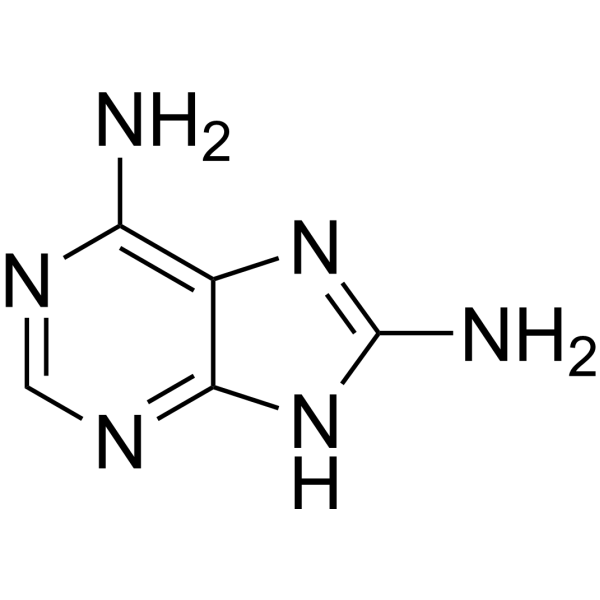
    8-Aminoadenine is an adenine receptor 1 (rAde1R) inhibitor with a Ki of 6.51 μM in rat and 0.0341 μM in human. 8-Aminoadenine inhibits isoprenaline-induced cAMP accumulation and adenine uptake in astrocytoma cells expressing rAde1R. 8-Aminoadenine serves as a lead structure for the development of adenine receptor ligands to elucidate the functions of the adenine receptor family .
    8-Aminoadenine
  • HY-156786

    Reactive Oxygen Species (ROS) Influenza Virus SARS-CoV HSV Infection
    TLD-1433 is the fourth-generation ruthenium (II) based photodynamic compound (PDC). TLD-1433 is activated by green light (525 ± 25 nm) and efficiently generates ROS to achieve pathogen inactivation. After photoinactivation, TLD-1433 significantly induces lipid peroxidation of the cell membrane, which can directly damage the integrity of the viral envelope. TLD-1433 has ID50 for enveloped viruses (such as H1N1 influenza virus, coronavirus OC43, HSV-1, Zika virus) is as low as nanomolar level; for non-enveloped viruses (such as adenovirus Ad5, mammalian rotavirus MRV), a concentration of micro-molar level is required for inactivation. TLD-1433 has antigen retention property and can be used for the preparation of inactivated vaccines .
    TLD-1433
  • HY-W553514

    Biochemical Assay Reagents
    DL-α-Phosphatidylcholine, distearoyl is a synthetic form of phosphatidylcholine that has the activity of spontaneously forming bilayer membranes in aqueous environments. DL-α-Phosphatidylcholine, distearoyl is an important component of biological membranes and provides support for the integrity of cell structures. DL-α-Phosphatidylcholine, distearoyl plays a key role in the preparation of compound delivery systems to improve the solubility and biocompatibility of compounds.
    DL-α-Phosphatidylcholine, distearoyl
  • HY-138694R

    Antibiotic Reference Standards Infection
    Cholesterol (Excipient) (Standard) is the analytical standard of Cholesterol (Excipient). This product is intended for research and analytical applications. Cholesterol Excipient is a component of cell membranes, and precursors certain hormones, vitamin D and bile acids. Cholesterol Excipient can be used as an excipient in pharmaceutical preparations for its amphiphilicity, good biocompatibility and biodegradability .
    5-Benzyloxygramine (Standard)
  • HY-157699

    Liposome Biochemical Assay Reagents
    1,2-Dioleoyl-sn-glycero-3-phospho-(1'-myo-inositol-5'-phosphate) ammonium is a membrane-bound signaling molecule with intracellular activity in regulating membrane trafficking and signal transduction. 1,2-Dioleoyl-sn-glycero-3-phospho-(1'-myo-inositol-5'-phosphate) ammonium can be used in the preparation of liposomes to enhance the efficiency of compound delivery. 1,2-Dioleoyl-sn-glycero-3-phospho-(1'-myo-inositol-5'-phosphate) ammonium can also act as a coordinator of the actin cytoskeleton and participate in the regulation of cell morphology and motility.
    1,2-Dioleoyl-sn-glycero-3-phospho-(1'-myo-inositol-5'-phosphate) ammonium
  • HY-N19295

    PI4K Cancer
    Echiguanine A is a phosphatidylinositol 4-kinase (PI4KIIα) inhibitor with an IC50 of 0.04 μg/mL. Echiguanine A inhibits phosphatidylinositol 4-kinase activity in cell membrane extracts. Echiguanine A is applicable for cancer research .
    Echiguanine A
  • HY-141613S

    (2S,8R,19Z)DOPS-d3 ammonium

    Isotope-Labeled Compounds Others
    (2S,8R,19Z)1,2-Dioleoyl-sn-glycero-3-phospho-L-serine-d3 ammonium ((2S,8R,19Z)DOPS-d3 ammonium) is the deuterium labeled (2S,8R,19Z)1,2-Dioleoyl-sn-glycero-3-phospho-L-serine ammonium (HY-141613). 1,2-Dioleoyl-sn-glycero-3-phospho-L-serine sodium (DOPS-NA) is a ubstitute for Phosphoserine/phosphatidylserine. 1,2-Dioleoyl-sn-glycero-3-phospho-L-serine sodium can be used together with DOPC and DOPE in lipid mixtures for the synthesis of liposomes. 1,2-Dioleoyl-sn-glycero-3-phospho-L-serine sodium can self-assemble into single-layer or double-layer membrane structures, similar to cell membranes, and possesses high membrane fluidity and flexibility. 1,2-Dioleoyl-sn-glycero-3-phospho-L-serine is widely applied in membrane biology, cell membrane research, lipid preparation, and drug delivery systems .
    (2S,8R,19Z)1,2-Dioleoyl-sn-glycero-3-phospho-L-serine-d3 ammonium
  • HY-182724

    Transmembrane Glycoprotein Inflammation/Immunology
    PSB-18422 is a GPR17 agonist, with an EC50 of 0.0279 μM for humans, 0.47 μM for rats, 0.753 μM for mice, and a human Ki of 1.46 μM. PSB-18422 triggers intracellular calcium mobilization via cross-species activation of GPR17. PSB-18422 can be used in the research of allergic bronchial inflammation .
    PSB-18422
  • HY-181682

    Neurokinin Receptor Endocrinology
    NK3R antagonist-1 is an orally active neurokinin-3 receptor (NK3R) antagonist with an IC50 of 53.61 nM. NK3R antagonist-1 reduces plasma luteinizing hormone (LH) levels in ovariectomized rat models. NK3R antagonist-1 is applicable to research related to menopausal hot flushes .
    NK3R antagonist-1
  • HY-14341

    5-HT Receptor Metabolic Disease
    E-6837 is a selective and orally active 5-HT6 receptor ligand. E-6837 demonstrates partial agonism at a presumably silent rat 5-HT6 receptor and full agonism at a constitutively active human 5-HT6 receptor by monitoring the cAMP signaling pathway. E-6837 induces hypophagia, reduces fat mass and body weight, and improves glycemic control. E-6837 can be used for the research of obesity .
    E-6837

Inquiry Online

Your information is safe with us. * Required Fields.

Salutation


Country or Region *

Applicant Name *


Organization Name *

Department *


Email Address *


Product Name *

Cat. No.


Requested quantity *

Phone Number *


Remarks

Inquiry Online

Inquiry Information

Product Name:
Cat. No.:
Quantity:
MCE Japan Authorized Agent:

