34 Results for "

cross-linked hydrogels

" in MedChemExpress (MCE) Product Catalog:
Products (34)

34 Results for "cross-linked hydrogels" in MCE Product Catalog:

2
2 Cited Publications
Cat. No.: HY-W013508
CAS No.: 106797-53-9
I2959 is widely used as a photoinitiator for photochemical cross-linking of hydrogels, and the combination of I2959 and CMA hydrogel has been used as a bio-ink for biological 3D printing applications. In addition, I2959 has a high free radical generation efficiency and is cytotoxic to rapidly dividing cell lines .
loading...
    loading...
Cat. No.: HY-137383
CAS No.: 102568-43-4
Purity:  99.72%
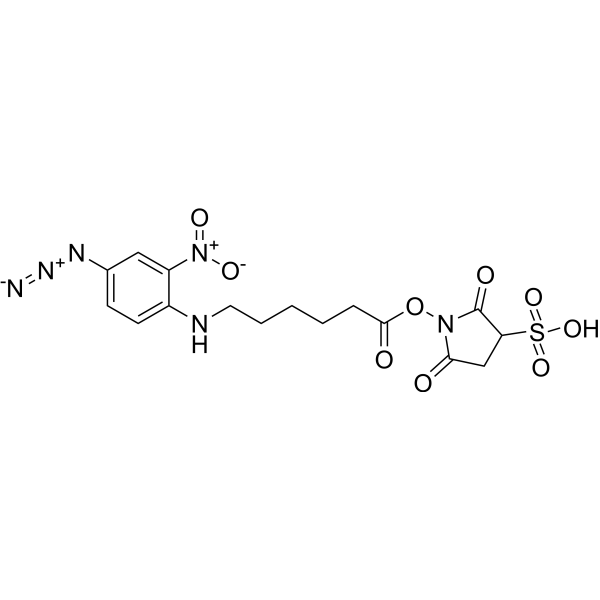
Sulfo-SANPAH is a primary amine-nitrobenzene azide cross-linker. Sulfo-SANPAH improves the functionalization process of PDMS surfaces, is covalently bound to the PAAm gel surface. Sulfo-SANPAH is widely used to crosslink ECM proteins to various substrates, including acrylic-based hydrogels, such as polyacrylamide hydrogels. Sulfo-SANPAH facilitates covalent binding through its negatively charged sulfonate group on its N-hydroxysuccinimide ester ring and a photoactivated phenyl azide group that is highly reactive with nucleophiles and free radicals .
loading...
    loading...
Cat. No.: HY-W035129
CAS No.: 1426827-79-3
Research Areas:  

Others

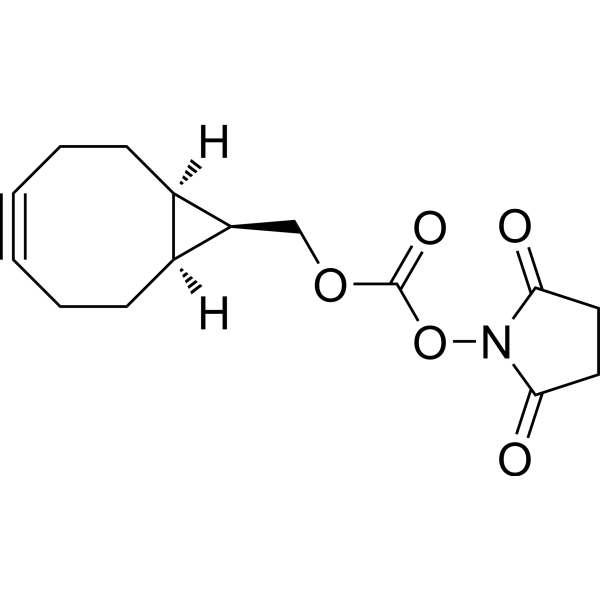
endo-BCN-NHS carbonate is an elastin-like protein (ELP) modification reagent. endo-BCN-NHS carbonate can react with lysine residues in ELP to make ELP carry BCN groups, and then cross-link ELP through strain-promoted azide-alkyne cycloaddition (SPAAC) reaction. endo-BCN-NHS carbonate promotes hydrogel formation. endo-BCN-NHS carbonate is mainly used in cell encapsulation related research .
loading...
    loading...
Cat. No.: HY-W110542N
CAS No.: 26570-48-9
Synonyms: PEGDA (MW 250),MEHQ as inhibitor
Poly(ethylene glycol) diacrylate (PEGDA) (MW 250), MEHQ as inhibitor is a versatile polymer material that is widely used as a building material for hydrogel scaffolds, especially in the fields of tissue engineering and regenerative medicine. Poly(ethylene glycol) diacrylate (MW 250), MEHQ as inhibitor can be used to construct optical cross-linked hydrogel implants .
loading...
    loading...
Cat. No.: HY-Y0850U6
CAS No.: 9002-89-5
Synonyms: Polyvinyl alcohol (Mw 205000); Poly(Ethenol) (Mw 205000)
PVA (Polyvinyl alcohol) (Mw 205000) is a polyvinyl alcohol with a molecular weight of 205000, which is used as a biological additive. PVA (Mw 205000) can be cross-linked through physical or chemical methods to form hydrogels, and is widely applied in fields such as biomedicine, food packaging, textiles, papermaking, sensing, and electronic devices. After PVA enema, it has an improving effect on acute colitis induced by DSS (HY-116282C) in mice .
loading...
    loading...
Cat. No.: HY-112624J
CAS No.: 9004-54-0
Synonyms: Dextran 4; Dextran D4; Dextran T4(MW 3200-4800)
Dextran 4,000 is a mucus rheology modifier. The dextran molecules in Dextran 4,000 can reduce the cross-link density of mucus through osmotic effects and hydrogen bond substitution, and reduce viscoelasticity and improve the mucociliary/cough clearance index by destroying the DNA-mucin network structure in mucus. Dextran 4,000 has the ability to improve the rheological properties and clearance ability of cystic fibrosis (CF) sputum, and can be used in the study of inhalation therapy or aerosol delivery of mucostatic respiratory diseases. The Dextran series of compounds are also natural polysaccharide drug carriers that can be connected to drugs through covalent bonding methods such as ester bonds, amide bonds or click chemistry, or self-assembled to form carriers such as nanoparticles and hydrogels. Dextran is biodegradable and biocompatible, and can achieve targeted delivery and controlled release of drugs. Dextran derivatives can prolong the half-life of drugs, increase local concentrations, and reduce the activity of immune clearance .
loading...
    loading...
Cat. No.: HY-W243303J
CAS No.: 9003-01-4
Poly(acrylic acid) (MW 250000) is a synthetic cationic electrolyte containing abundant carboxyl groups (-COOH), which exhibits excellent water absorption and retention properties and is often cross-linked to form hydrogels. Poly(acrylic acid) (with a molecular weight of 250,000). Poly(acrylic acid) (MW 250000) can be used as a non-collagenous analog in the biomimetic mineralization research of type I collagen. Poly(acrylic acid) (MW 250000) has pH responsiveness and biocompatibility and is often used as a drug carrier, surface modifier and functional material .
loading...
    loading...
Cat. No.: HY-P3159
CAS No.: 1428885-83-9
Research Areas:  

Others

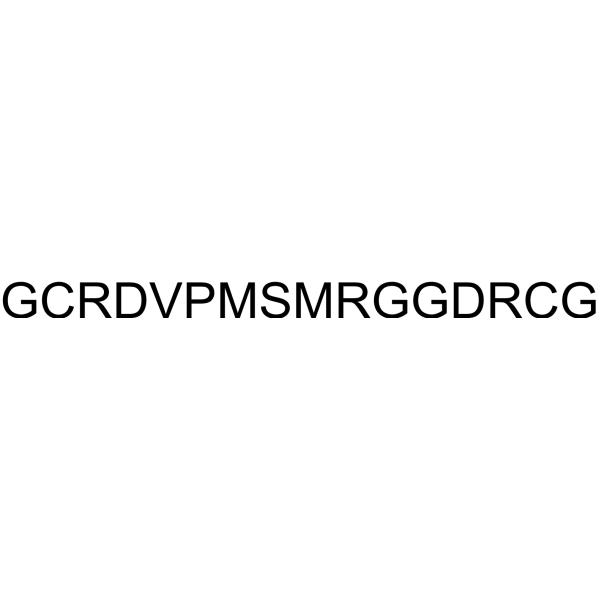
VPM peptide is a dithiol protease-cleavable peptide cross-linker. VPM peptide can be incorporated into the backbone of the PEG-diacrylate (PEG-DA) macromer to form PEG hydrogel .
loading...
    loading...
Cat. No.: HY-W440548
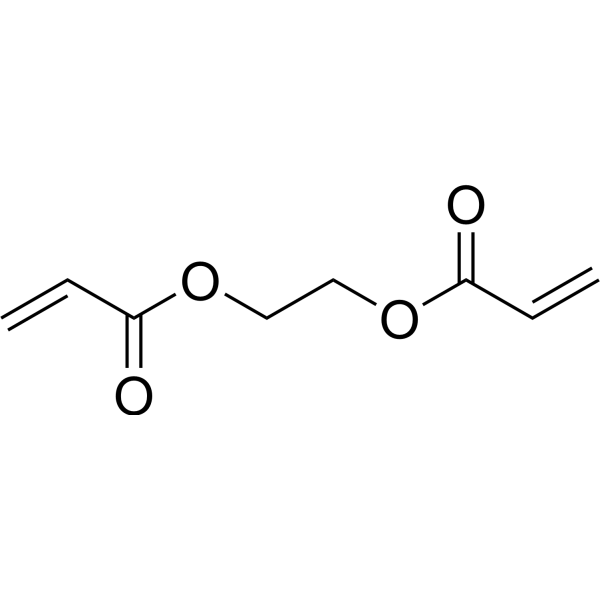
CAS No.: 2274-11-5
Synonyms: Ethylene diacrylate
Research Areas:  

Others

Ethylene glycol diacrylate (Ethylene diacrylate) is a polymer precursor used to form covalently crosslinked hydrogels with a degree of polymerization of 13 .
loading...
    loading...
Cat. No.: HY-172380A
PCL-PEG-PCL diacrylate (MW 800) is an amphiphilic triblock copolymer composed of PEG and two polycaprolactones (PCL). PCL-PEG-PCL diacrylate (MW 800) can be cross-linked by free radical polymerization and/or photopolymerization to form a cross-linked hydrogel network .
loading...
    loading...
Cat. No.: HY-168937
HS-PEG2000-NH2 hydrochloride is a bifunctional cross-linker that can be used to synthesize PEG hydrogels .
loading...
    loading...
Cat. No.: HY-158222A
Synonyms: AlgMA (MW 300000)
Alginate Methacryloyl (MW 300000) is a methacryloyl alginate with potential for use as a tissue engineering scaffold and 3D printing ink. Alginate Methacryloyl (MW 300000) is biocompatible, non-immunogenic, has low toxicity and is capable of physical cross-linking with divalent cations such as calcium . Alginate Methacryloyl (MW 300000) needs to self-assemble into fibrous hydrogel under the action of photoinitiator LAP (HY-44076), and target bioactive adhesion sites, play an inherent supporting role for tissue cells and biodegradable activity.
Application: cell culture, biological 3D printing, tissue engineering, etc.
loading...
    loading...
Cat. No.: HY-145485
Purity:  ≥97.0%
Target:  

PROTAC Linkers

Research Areas:  

Others

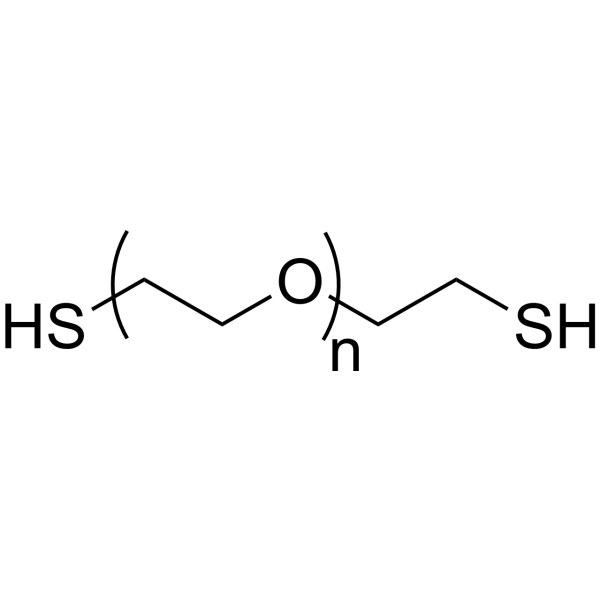
HS-PEG3400-SH, a linear homobifunctional PEG, is a cross-linker. HS-PEG-SH can be used for drug delivery and preparation of PEG hydrogels .
loading...
    loading...
Cat. No.: HY-W110707
CAS No.: 143-27-1
Synonyms: Hexadecylamine
Research Areas:  

Cancer

Cetylamine (Hexadecylamine) is an amphipathic hexadecyl alkylamine. Cetylamine enhances phase separation of aqueous PVA solutions, promotes the formation of PVA crystalline domains while remaining amorphous itself, and enables the preparation of surfactant-free, solvent-free, and crosslinker-free PVA hydrogels via freeze-thaw blending. Cetylamine can serve as the cationic surfactant component in ion-crosslinked micelles, which can load hydrophobic drugs and deliver them to breast cancer cells. Cetylamine is applicable to breast cancer-related research .
loading...
    loading...
Cat. No.: HY-158222
Synonyms: AlgMA (MW 50000)
Alginate Methacryloyl (MW 50000) is a methacryloyl alginate with potential for use as a tissue engineering scaffold and 3D printing ink. Alginate Methacryloyl (MW 50000) is biocompatible, non-immunogenic, has low toxicity and is capable of physical cross-linking with divalent cations such as calcium . Alginate Methacryloyl (MW 50000) needs to self-assemble into fibrous hydrogel under the action of photoinitiator LAP (HY-44076), and target bioactive adhesion sites, play an inherent supporting role for tissue cells and biodegradable activity.
Application: cell culture, biological 3D printing, tissue engineering, etc.
loading...
    loading...
Cat. No.: HY-172380
PCL-PEG-PCL diacrylate (MW 800) is an amphiphilic triblock copolymer composed of PEG and two polycaprolactones (PCL). PCL-PEG-PCL diacrylate (MW 800) can be cross-linked by free radical polymerization and/or photopolymerization to form a cross-linked hydrogel network .
loading...
    loading...
Cat. No.: HY-172354
Acrylate-PEG2000-NHS is a photosensitive PEG compound that can be cross-linked when exposed to ultraviolet light and is used to synthesize PEG hydrogels .
loading...
    loading...
Cat. No.: HY-158228
Synonyms: PLMA
Poly-L-lysine Methacryloyl (PLMA) is methacrylated polylysine. When Poly-L-lysine Methacryloyl is cross-linked on polyetheretherketone (PEEK) through UV-induced cross-linking, it can improve the hydrophilicity of PEEK and retain its own degradation bioinertness . Poly-L-lysine Methacryloyl needs to self-assemble into fibrous hydrogel under the action of photoinitiator LAP (HY-44076), and target bioactive adhesion sites, play an inherent supporting role for tissue cells and biodegradable activity.
Application: cell culture, biological 3D printing, tissue engineering, etc.
loading...
    loading...
Cat. No.: HY-Y0850U2
CAS No.: 9002-89-5
Synonyms: Polyvinyl alcohol (Mw 130000, 87-89% hydrolyzed, ~2700 polymerization); Poly(Ethenol) (Mw 130000, 87-89% hydrolyzed, ~2700 polymerization)
PVA (Polyvinyl alcohol; Poly(Ethenol)) (Mw 130000, 87-89% hydrolyzed, ~2700 polymerization) is a non-toxic, biodegradable, and highly biocompatible semicrystalline synthetic polymer. PVA (Mw 130000, 87-89% hydrolyzed, ~2700 polymerization) acts as a coating agent to improve tableting performance, and can be cross-linked with sodium trimetaphosphate to prepare tubular vascular grafts or form hydrogels for use as artificial articular cartilage and sustained-release matrices for growth factors. PVA (Mw 130000, 87-89% hydrolyzed, ~2700 polymerization) enhances the redox cycle of iron species in photo-assisted Fenton reactions to simultaneously generate hydrogen peroxide and degrade pollutants, enabling integrated sustainable waste management and water treatment. PVA (Mw 130000, 87-89% hydrolyzed, ~2700 polymerization) is used in the manufacture of biodegradable films and in studies of dry or minimally invasive ex vivo wounds, but cannot form freeze-thaw cross-linked solid sheets for wound dressings .
loading...
    loading...
Cat. No.: HY-Y0425
CAS No.: 623-27-8
Terephthalaldehyde is a crosslinking agent. Terephthalaldehyde forms a crosslinked structure inside the gelatin matrix by forming Schiff base imines with the amino groups of gelatin, thereby constructing a three-dimensional network. Terephthalaldehyde improves the hydrophobicity of the gelatin matrix, delays water vapor penetration and enhances the liquid water resistance of gelatin films. Terephthalaldehyde can be used as a crosslinking agent to prepare crosslinked chitosan hydrogel (CAAT) via ultrasound-induced synthesis. Terephthalaldehyde helps CAAT hydrogels selectively adsorb anionic dyes from aqueous media, including multi-component systems containing cationic dyes. Terephthalaldehyde serves as a starting material for the synthesis of bis-heterocyclic compounds (including bis-thiazole and bis-triazolopyrimidine compounds) .
loading...
    loading...

