13 Results for "

deubiquitination

" in MedChemExpress (MCE) Product Catalog:
Products (13)

13 Results for "deubiquitination" in MCE Product Catalog:

15
15 Publications Verification
Cat. No.: HY-110078
CAS No.: 412960-54-4
Purity:  99.56%
Target:  

p97 Apoptosis

Research Areas:  

Cancer

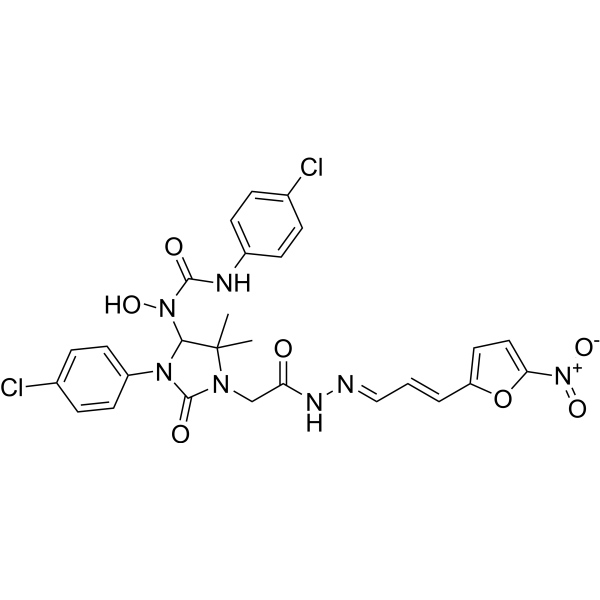
Eeyarestatin I, a potent endoplasmic reticulum-associated protein degradation (ERAD) inhibitor, is a potent protein translocation inhibitor. Eeyarestatin I inhibits Sec61 translocon. Eeyarestatin I targets the p97-associated deubiquitinating process (PAD) and inhibits atx3-dependent deubiquitination. Eeyarestatin I interferes at a step prior to proteasomal degradation. Eeyarestatin I induces cell death via the proapoptotic protein NOXA and has anticancer effects .
loading...
    loading...
4
4 Cited Publications
Cat. No.: HY-101666
CAS No.: 924296-39-9
Purity:  98.91%
Research Areas:  

Metabolic Disease Cancer

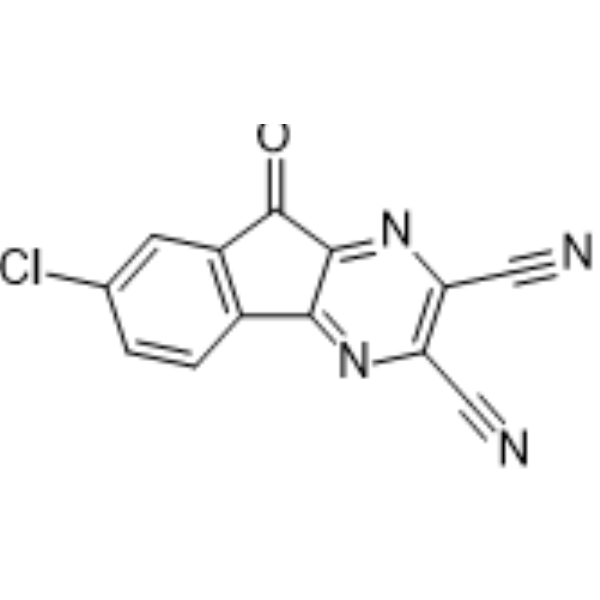
HBX 41108 is an inhibitor of ubiquitin-specific protease 7 (USP7) with an IC50 of 424 nM. HBX 41108 inhibits USP7-mediated p53 deubiquitination to stabilize p53 and inhibits cancer cell growth. BX 41108 can be used in cancer and diabetes research .
loading...
    loading...
1
1 Cited Publications
Cat. No.: HY-157403
Purity:  99.60%
Target:  

Virus Protease SARS-CoV

Research Areas:  

Infection

Jun12682 is an orally active SARS-CoV-2 papain-like protease (PL pro) inhibitor, with a Ki value of 37.7 nM and an EC50 value of 1.1 μM in the FlipGFP PL pro assay. Jun12682 has efficacy in hindering PL pro both deubiquitination and deISGylation, with Ki values of 63.5 and 38.5 nM, respectively. Jun12682 exhibits resistance in multiple PL pro mutant strains, and its enzymatic activity is comparable to that of the wild-type. Jun12682 can be used for the study of the SARS-CoV-2 .
loading...
    loading...
Cat. No.: HY-160700
CAS No.: 2839740-79-1
Target:  

Deubiquitinase JNK

Research Areas:  

Cancer

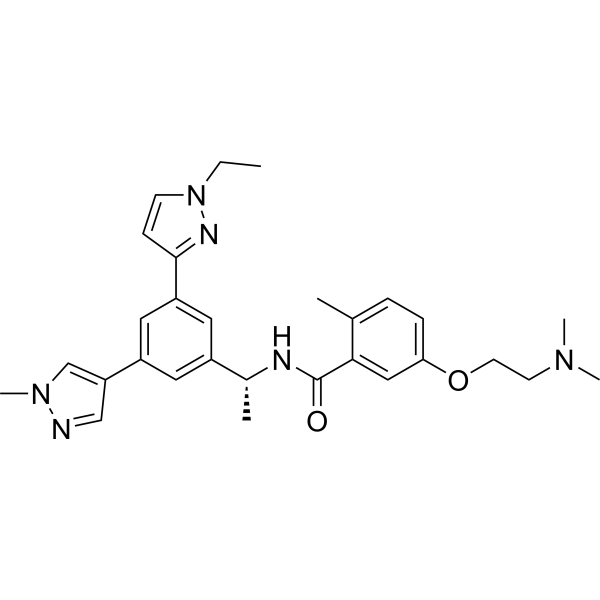
TNG348 is an orally available allosteric inhibitor of the ubiquitin-specific protease USP1. TNG348 specifically and efficiently inhibits the activity of USP1, inhibiting its deubiquitination of proliferative PCNA and FANCD2, thereby disrupting the DNA repair process. TNG348 has inhibitory activity against breast and ovarian cancers carrying BRCA1/2 mutations and other homologous recombination defects (HRD) .
loading...
    loading...
Cat. No.: HY-161909
CAS No.: 2511541-78-7
Research Areas:  

Neurological Disease

USP30-IN-1 is a potent and selective USP30 inhibitor, with IC50 values of 94 nM and 4 nM in vivo and in vitro, respectively, and Ki values of 0.33 μM (Krippendorf method) and 0.38 μM (traditional method), respectively. USP30-IN-1 covalently binds to the catalytic cysteine (Cys77) of USP30, blocks ubiquitin substrate binding to inhibit deubiquitination, and ultimately induces mitophagy. USP30-IN-1 can be used for the research of idiopathic Parkinson's disease and mitophagy-related diseases .
loading...
    loading...
Cat. No.: HY-P10416
Synonyms: Q14 peptide
Research Areas:  

Others Neurological Disease

Q14 is a polypeptide derived from the USP30 (ubiquitin specific peptidase 30) transmembrane (TM) domain with the ability to inhibit the deubiquitination activity of USP30 (IC50=57.2 nM). Q14 reduces USP30 activity by inhibiting the interaction between the USP30 transmembrane domain and its catalytic domain. Q14 peptide contains the LC3 interaction region (LIR) motif, which enables it to bind to the LC3 and accelerate the formation of autophagosomes, thereby promoting mitophagy. Q14 can be used in the study of neurodegenerative diseases as well as mitochondrial quality control and cell metabolism .
loading...
    loading...
Cat. No.: HY-175538
Research Areas:  

Cancer

USP10-IN-4 is a potent ubiquitin-specific protease 10 (USP10) inhibitor with an IC50 of 10.87 μM and a Kd of 365 nM. USP10-IN-4 effectively inhibits USP10-mediated proteasomal degradation of downstream proteins YAP and p53, leading to the subsequent downregulation of CDK4 in the p53 signaling pathway. USP10-IN-4 promotes apoptosis in HCC cells and inhibits the onset and progression of liver cancer. USP10-IN-4 can used for the study of hepatocellular carcinoma (HCC) .
loading...
    loading...
Cat. No.: HY-168917
CAS No.: 149934-19-0
Synonyms: 9-AMN
Target:  

SARS-CoV Virus Protease

Research Areas:  

Infection

9-Aminominocycline (9-AMN) is the inhibitor for SARS-CoV-2 papain-like protease (SARS-CoV-2 PLpro), inhibits its deubiquitination (DUB) activity and protease activity with IC50 of 4.55 µM and 4.15 µM. 9-Aminominocycline inhibits the SARS-CoV variants Delta and Omicron replication in Calu-3 cell with IC50 of 1.04 µM and 2.35 µM .
loading...
    loading...
Cat. No.: HY-110078R
CAS No.: 412960-54-4
Research Areas:  

Cancer

Eeyarestatin I (Standard) is the analytical standard of Eeyarestatin I (HY-110078). This product is intended for research and analytical applications. Eeyarestatin I, a potent endoplasmic reticulum-associated protein degradation (ERAD) inhibitor, is a potent protein translocation inhibitor. Eeyarestatin I inhibits Sec61 translocon. Eeyarestatin I targets the p97-associated deubiquitinating process (PAD) and inhibits atx3-dependent deubiquitination. Eeyarestatin I interferes at a step prior to proteasomal degradation. Eeyarestatin I induces cell death via the proapoptotic protein NOXA and has anticancer effects .
loading...
    loading...
Cat. No.: HY-183363
Target:  

Deubiquitinase

Research Areas:  

Cancer

USP1-IN-17 is an orally active USP1/UAF1 complex inhibitor. USP1-IN-17 exhibits potent anti-proliferative activity against BRCA1-mutant human breast cancer MDA-MB-436 cells, with an IC50 value of 8.1 nM. USP1-IN-17 binds to USP1 to stabilize the enzyme conformation, impairs deubiquitination function, elevates the monoubiquitination level of PCNA, inhibits cancer cell proliferation, and induces DNA damage accumulation. USP1-IN-17 can be used for the research of BRCA1-mutated cancers .
loading...
    loading...
Cat. No.: HY-183725
CAS No.: 3060520-82-0
Research Areas:  

Inflammation/Immunology

MS5128 is an OTUB1-based deubiquitinase-targeting chimera (DUBTAC) targeting CFTR. MS5128 recruits OTUB1 to CFTR to induce deubiquitination and stabilization of CFTR. MS5128 can be used for the research of cystic fibrosis . (Blue: CFTR Ligand (HY-183724); Pink: OTUB1 Ligand (HY-13262); Black: Linker)
loading...
    loading...
Cat. No.: HY-101666R
CAS No.: 924296-39-9
HBX 41108 (Standard) is the analytical standard of HBX 41108 (HY-101666). This product is intended for research and analytical applications. HBX 41108 is an inhibitor of ubiquitin-specific protease 7 (USP7) with an IC50 of 424 nM. HBX 41108 inhibits USP7-mediated p53 deubiquitination to stabilize p53 and inhibits cancer cell growth. BX 41108 can be used in cancer and diabetes research .
loading...
    loading...
Cat. No.: HY-180561
CAS No.: 3076807-15-0
Research Areas:  

Cancer

WWQ-03-012 is a selective DESI2 inhibitor with an IC50 of 47.3 nM. WWQ-03-012 binds covalently to DESI2, blocks its enzymatic activity, and inhibits DESI2-mediated deSUMOylation, deubiquitination and stabilization of mutant JAK2, thereby promoting the complete degradation of mutant JAK2 via the intracellular ubiquitin-proteasome system and inducing apoptosis, while exerting no significant effect on wild-type JAK2. WWQ-03-012 can be used for research on myeloproliferative neoplasms (MPN) and secondary acute myeloid leukemia (sAML), especially for hematological malignancies carrying the JAK2-V617F mutation and those resistant to Ruxolitinib (HY-50856) .
loading...
    loading...
  • 1

