10 Results for "

gramineous

" in MedChemExpress (MCE) Product Catalog:
Products (10)

10 Results for "gramineous" in MCE Product Catalog:

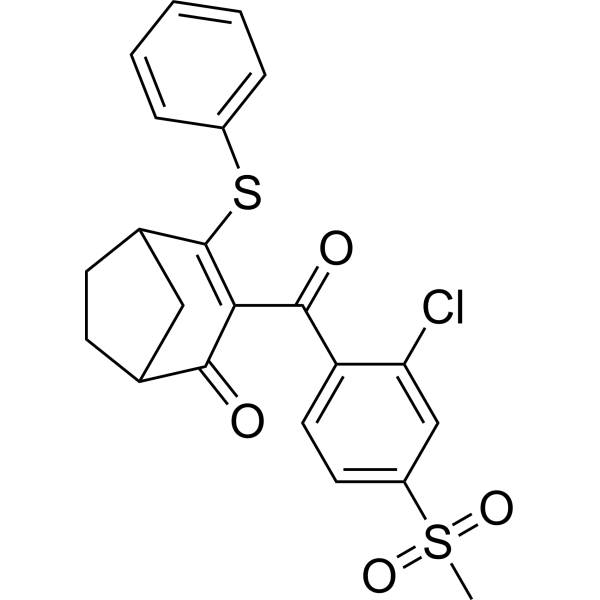
Cat. No.: HY-118742
CAS No.: 156963-66-5
Purity:  99.25%
Research Areas:  

Others

Benzobicyclon is a 4-HPPD inhibitor and herbicide that reacts with water to form a hydrolysate of the active herbicide benzobicycline, causing bleaching and death of weeds. Benzobicyclon is effective against grass, sedge and broadleaf weeds. Benzobicyclon effectively targets sulfonylurea herbicide-resistant biotypes as well as wild-type weeds .
loading...
    loading...
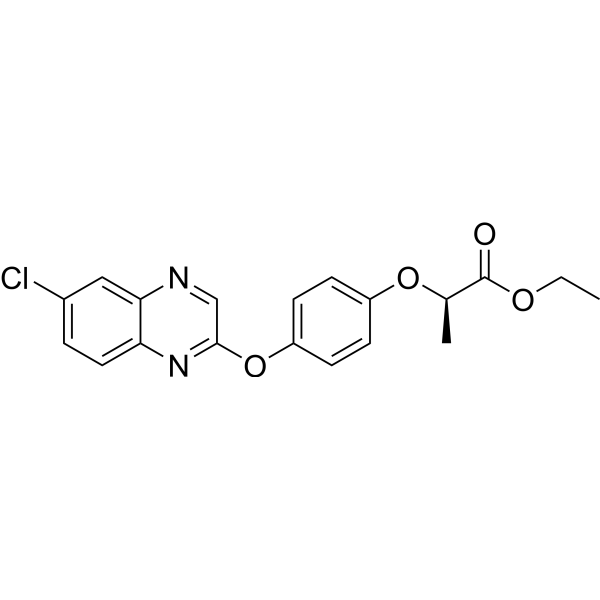
Cat. No.: HY-B1950
CAS No.: 100646-51-3
Synonyms: (R)-Quizalofop ethyl; Quinofop-ethyl
Research Areas:  

Infection

Quizalofop-P-ethyl is a low-toxicity herbicide, a highly selective new type of post-emergence herbicide for dryland crops, with high selectivity between gramineous weeds and dicotyledonous crops, and it has good control efficacy against gramineous weeds in broadleaf crop fields.
loading...
    loading...
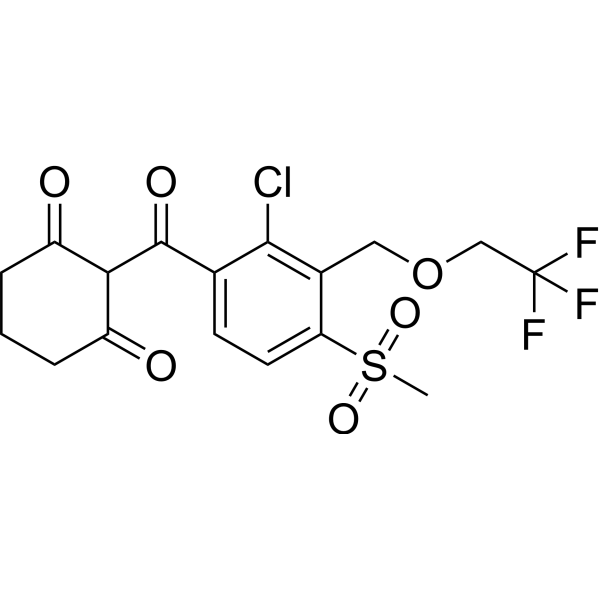
Cat. No.: HY-137910
CAS No.: 335104-84-2
Purity:  98.84%
Research Areas:  

Infection

Tembotrione is a herbicide belonging to the HPPD (dioxygenase) inhibitor class with crop selectivity. Tembotrione effectively controls a variety of weeds including broadleaf and gramineous species by disrupting carotenoid synthesis, which leads to chlorophyll degradation and leaf whitening. Mixing Tembotrione with isoxaflutole or adding surfactants optimizes its efficacy and reduces phytotoxicity, with no residual impact on subsequent cruciferous crops, thus helping to increase maize grain yield. The activity of Tembotrione decreases under drought conditions, and under specific conditions (such as double-dose treatment), it may cause reversible yellowing and even yield reduction in crops such as poppy .
loading...
    loading...
Cat. No.: HY-118742R
CAS No.: 156963-66-5
Research Areas:  

Others

Benzobicyclon (Standard) is the analytical standard of Benzobicyclon. This product is intended for research and analytical applications. Benzobicyclon is a 4-HPPD inhibitor and herbicide that reacts with water to form a hydrolysate of the active herbicide benzobicycline, causing bleaching and death of weeds. Benzobicyclon is effective against grass, sedge and broadleaf weeds. Benzobicyclon effectively targets sulfonylurea herbicide-resistant biotypes as well as wild-type weeds .
loading...
    loading...
Cat. No.: HY-137910R
CAS No.: 335104-84-2
Research Areas:  

Others

Tembotrione (Standard) is the analytical standard of Tembotrione. This product is intended for research and analytical applications. Tembotrione is a drug that may reduce the productivity of carrots. Tembotrione has the activity of reducing carrot stem mass. Tembotrione can be used to study the total productivity of carrot . Tembotrione is a herbicide belonging to the HPPD (dioxygenase) inhibitor class with crop selectivity. Tembotrione effectively controls a variety of weeds including broadleaf and gramineous species by disrupting carotenoid synthesis, which leads to chlorophyll degradation and leaf whitening. Mixing Tembotrione with isoxaflutole or adding surfactants optimizes its efficacy and reduces phytotoxicity, with no residual impact on subsequent cruciferous crops, thus helping to increase maize grain yield. The activity of Tembotrione decreases under drought conditions, and under specific conditions (such as double-dose treatment), it may cause reversible yellowing and even yield reduction in crops such as poppy .
loading...
    loading...
Cat. No.: HY-167959
CAS No.: 26544-20-7
Target:  

Herbicide

Research Areas:  

Infection

MCPA-isooctyl is a selective conductive phenoxycarboxylate herbicide and an alternative to 2,4-D Butyl ester (HY-B0867). MCPA-isooctyl effectively controls broadleaf weeds in various crop fields via post-emergence foliar or soil treatment. MCPA-isooctyl is absorbed by the roots, stems and leaves of plants; it is easily metabolized and detoxified in gramineous crops, but difficult to metabolize in dicotyledonous weeds, causing stem and leaf distortion, root deformation, and eventually weed death. When formulated into chitosan nanoparticles, MCPA-isooctyl still significantly inhibits the growth of weeds in wheat fields, and reduces their chlorophyll content and biomass at low doses .
loading...
    loading...
Cat. No.: HY-W714212
CAS No.: 33245-39-5
Fluchloralin is a dinitroaniline herbicide that effectively controls annual gramineous and broadleaf weeds primarily by inhibiting tubulin synthesis and cell division . Fluchloralin exhibits cytotoxicity and genotoxicity, and promotes cell apoptosis by activating apoptotic signaling proteins, forming DNA ladder bands, inducing cell shrinkage and nuclear fragmentation .
loading...
    loading...
Cat. No.: HY-184988
CAS No.: 3123222-14-7
Target:  

Herbicide HPPD

Research Areas:  

Metabolic Disease

HPPD-IN-10 is an inhibitor of Arabidopsis thaliana 4-hydroxyphenylpyruvate dioxygenase (HPPD), with an IC50 of 0.06 μM and a Kd of 0.265 μM. HPPD-IN-10 blocks the HPPD-mediated catalytic conversion of 4-hydroxyphenylpyruvate, downregulates the biosynthesis of plastoquinone and tocopherol, induces weed bleaching, and inhibits root and shoot growth. HPPD-IN-10 can be used in herbicide-related research on gramineous and broadleaf weeds in farmlands, such as barnyard grass and purslane .
loading...
    loading...
Cat. No.: HY-121139
CAS No.: 756-09-2
Synonyms: 2,2,3,3-Tetrafluoropropionic acid; 3H-Tetrafluoropropionic acid
Target:  

Herbicide

Research Areas:  

Others

Flupropanate (2,2,3,3-Tetrafluoropropionic acid; 3H-Tetrafluoropropionic acid) is a soil-active selective herbicide and plant growth inhibitor that acts by inhibiting radicle growth and lipid biosynthesis in sensitive plants. Flupropanate exhibits high-efficiency control of Stipa weeds (such as Nassella neesiana and N. trichotoma) in pastures, and reduces the coverage of the invasive species Eragrostis curvula. Meanwhile, Flupropanate is sensitive to gramineous plants like ryegrass, but shows good selective tolerance to plantain, chicory and some leguminous plants. Studies show that in the protected area with Mediterranean climate in southwestern Australia, Flupropanate produces no significant non-target effects on native plant communities, functional groups or the endangered species Grevillea curviloba, indicating high ecological safety .
loading...
    loading...
Cat. No.: HY-W681876
CAS No.: 147411-69-6
Research Areas:  

Others

(E)-Pyriminobac-methyl is an Acetolactate synthase inhibitor and a pyrimidinylbenzoate Herbicide. (E)-Pyriminobac-methyl inhibits acetolactate synthase and blocks the biosynthesis of branched-chain amino acids. The herbicidal activity of (E)-Pyriminobac-methyl against Echinochloa crus-galli and Leptochloa chinensis is 1.5-2 times higher than that of Bensulfuron-methyl (HY-B0870) .
loading...
    loading...

