



Flupropanate

Based on 1 Customer Validation
Flupropanate (2,2,3,3-Tetrafluoropropionic acid; 3H-Tetrafluoropropionic acid) is a soil-active selective herbicide and plant growth inhibitor that acts by inhibiting radicle growth and lipid biosynthesis in sensitive plants. Flupropanate exhibits high-efficiency control of Stipa weeds (such as Nassella neesiana and N. trichotoma) in pastures, and reduces the coverage of the invasive species Eragrostis curvula. Meanwhile, Flupropanate is sensitive to gramineous plants like ryegrass, but shows good selective tolerance to plantain, chicory and some leguminous plants. Studies show that in the protected area with Mediterranean climate in southwestern Australia, Flupropanate produces no significant non-target effects on native plant communities, functional groups or the endangered species Grevillea curviloba, indicating high ecological safety.
For research use only. We do not sell to patients.
- Purity : 99.94%
- CAS No.: 756-09-2
- Formula: C3H2F4O2
- Molecular Weight:146.04
-
Storage:Pure form -20°C, 3 years , 4°C, 2 years ; In solvent -80°C, 6 months , -20°C, 1 month


To place orders, for customer services and technical support, please contact: MedChemExpress USA
Tel: 609-228-6898 E-mail: [email protected] [email protected]


-
 Biological Activity
-
Chemical Information
-
Solvent & Solubility
- Purity & Documentation
- References
-
 Help & FAQs


-

HY-109540
PerfluorohexaneHIFU Enhancer -
HY-W008186
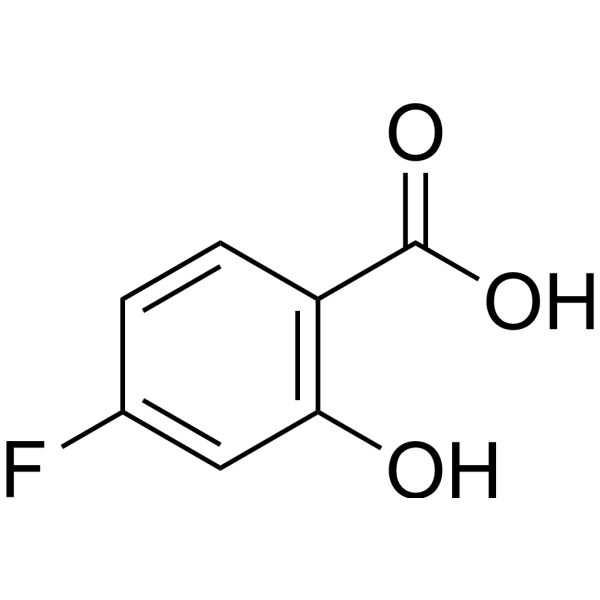
4-Fluoro-2-hydroxybenzoic acidBiochemical Reagent -

HY-21200
Perfluoroheptanesulfonic acidPerfluoroalkyl Compounds -

HY-W081162
Tetrafluorophthalic acidMetal-organic Framework -

HY-W037331
4,4-Difluorobenzhydrol -

HY-W039283
MCH-1 antagonist 2MCH1 Antagonist -
HY-79541
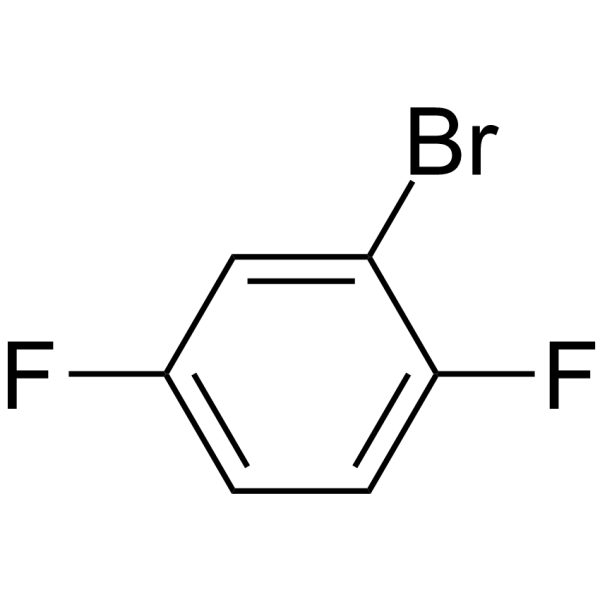
2-Bromo-1,4-difluorobenzeneBiochemical Reagent -

HY-W005717
2-Chloro-3-nitro-5-(trifluoromethyl)benzoic acidDrug Intermediate -
HY-W052234
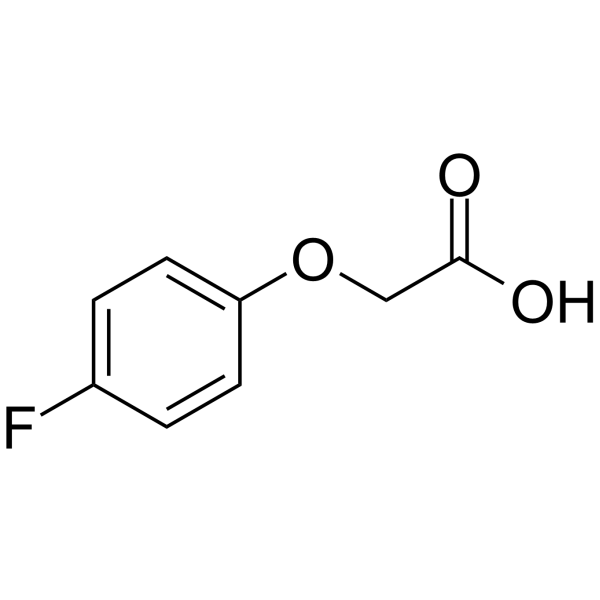
4-Fluorophenoxyacetic acidHerbicide -

HY-W018783R
3-Chloro-2-fluoroaniline (Standard)


Biological Activity
Description
In Vitro
Flupropanate (0.3-2200 g ai/ha; 12-15 days) reduces radicle growth of tested pasture and weed species in a dose-dependent manner, with ryegrass cultivars and Nassella spp. being highly susceptible, and broadleaf species including plantain, strawberry clover, chicory 'Chico', and lucerne being relatively tolerant[1].
MedChemExpress (MCE) has not independently confirmed the accuracy of these methods. They are for reference only. .


Chemical Information
-
CAS No. 756-09-2
-
Appearance Liquid
-
Molecular Weight 146.04
-
Formula C3H2F4O2
-
Color Colorless to light yellow
-
SMILES
O=C(O)C(F)(F)C(F)F
-
Synonyms
2,2,3,3-Tetrafluoropropionic acid; 3H-Tetrafluoropropionic acid
-
Shipping
Room temperature in continental US; may vary elsewhere.
-
Storage
Pure form -20°C 3 years 4°C 2 years In solvent -80°C 6 months -20°C 1 month


Solvent & Solubility
In Vitro:
DMSO : 200 mg/mL (1369.49 mM; Need ultrasonic; Hygroscopic DMSO has a significant impact on the solubility of product, please use newly opened DMSO)
Please refer to the solubility information to select the appropriate solvent. Once prepared, please aliquot and store the solution to prevent product inactivation from repeated freeze-thaw cycles.
Storage method and period of stock solution: -80°C, 6 months; -20°C, 1 month. When stored at -80°C, please use it within 6 months. When stored at -20°C, please use it within 1 month.
Please refer to the solubility information to select the appropriate solvent. Once prepared, please aliquot and store the solution to prevent product inactivation from repeated freeze-thaw cycles.
Storage method and period of stock solution: -80°C, 6 months; -20°C, 1 month. When stored at -80°C, please use it within 6 months. When stored at -20°C, please use it within 1 month.
Concentration (start) × Volume (start) = Concentration (final) × Volume (final)
In Vivo:
Select the appropriate dissolution method based on your experimental animal and administration route.
- For the following dissolution methods, please ensure to first prepare a clear stock solution using an In Vitro approach and then sequentially add co-solvents:
- To ensure reliable experimental results, the clarified stock solution can be appropriately stored based on storage conditions. As for the working solution for In Vivo experiments, it is recommended to prepare freshly and use it on the same day.
- The percentages shown for the solvents indicate their volumetric ratio in the final prepared solution. If precipitation or phase separation occurs during preparation, heat and/or sonication can be used to aid dissolution.
Add each solvent one by one: 10% DMSO 40% PEG300 5% Tween-80 45% Saline
Solubility: ≥ 5 mg/mL (34.24 mM); Clear solution
This protocol yields a clear solution of ≥ 5 mg/mL (saturation unknown).
Taking 1 mL working solution as an example, add 100 μL DMSO stock solution (50.0 mg/mL) to 400 μL PEG300, and mix evenly; then add 50 μL Tween-80 and mix evenly; then add 450 μL Saline to adjust the volume to 1 mL.
Preparation of Saline: Dissolve 0.9 g sodium chloride in ddH₂O and dilute to 100 mL to obtain a clear Saline solution.
Add each solvent one by one: 10% DMSO 90% (20% SBE-β-CD in Saline)
Solubility: ≥ 5 mg/mL (34.24 mM); Clear solution
This protocol yields a clear solution of ≥ 5 mg/mL (saturation unknown).
Taking 1 mL working solution as an example, add 100 μL DMSO stock solution (50.0 mg/mL) to 900 μL 20% SBE-β-CD in Saline, and mix evenly.
Preparation of 20% SBE-β-CD in Saline (4°C, storage for one week): 2 g SBE-β-CD powder is dissolved in 10 mL Saline, completely dissolve until clear.
In Vivo Dissolution Calculator
Please enter the basic information of animal experiments:
-
-
-
-
Recommended: Prepare an additional quantity of animals to account for potential losses during experiments.
Please enter your animal formula composition:
-
%DMSO +
Recommended: Keep the proportion of DMSO in working solution below 2% if your animal is weak.
-
%+
-
+%Tween-80 + +
-
%Saline +
The co-solvents required include: DMSO, . All of co-solvents are available by MedChemExpress (MCE). , Tween 80. All of co-solvents are available by MedChemExpress (MCE).
Working solution concentration: 0.22 mg/mL
Method for preparing stock solution: mg drug dissolved in μL DMSO. Stock solution concentration: mg/mL.
1. Take μL DMSO stock solution;
2. Add μL .
μL , mix evenly;
3. Then add μL Tween 80, mix evenly;
4. Then add μL
Please ensure that the stock solution in the first step is dissolved to a clear state, and add co-solvents in sequence. You can use ultrasonic heating (ultrasonic cleaner, recommended frequency 20-40 kHz), vortexing, etc. to assist dissolution.


Purity & Documentation
-
Data Sheet (271 KB)
-
SDS (417 KB)
- English - EN (417 KB)
- Français - FR (417 KB)
- Deutsch - DE (417 KB)
- Norwegian - NO (417 KB)
- Español - ES (417 KB)
- Swedish - SV (417 KB)
- Italian - IT (417 KB)
- Korean - KR (417 KB)
- Portuguese - PT (417 KB)
-
Handling Instructions (2659 KB)
References


Complete Stock Solution Preparation Table
Please refer to the solubility information to select the appropriate solvent. Once prepared, please aliquot and store the solution to prevent product inactivation from repeated freeze-thaw cycles.
Storage method and period of stock solution: -80°C, 6 months; -20°C, 1 month. When stored at -80°C, please use it within 6 months. When stored at -20°C, please use it within 1 month.
| Optional Solvent | Concentration Solvent Mass | 1 mg | 5 mg | 10 mg | 25 mg |
|---|---|---|---|---|---|
| DMSO | 1 mM | 6.8474 mL | 34.2372 mL | 68.4744 mL | 171.1860 mL |
| 5 mM | 1.3695 mL | 6.8474 mL | 13.6949 mL | 34.2372 mL | |
| 10 mM | 0.6847 mL | 3.4237 mL | 6.8474 mL | 17.1186 mL | |
| 15 mM | 0.4565 mL | 2.2825 mL | 4.5650 mL | 11.4124 mL | |
| 20 mM | 0.3424 mL | 1.7119 mL | 3.4237 mL | 8.5593 mL | |
| 25 mM | 0.2739 mL | 1.3695 mL | 2.7390 mL | 6.8474 mL | |
| 30 mM | 0.2282 mL | 1.1412 mL | 2.2825 mL | 5.7062 mL | |
| 40 mM | 0.1712 mL | 0.8559 mL | 1.7119 mL | 4.2796 mL | |
| 50 mM | 0.1369 mL | 0.6847 mL | 1.3695 mL | 3.4237 mL | |
| 60 mM | 0.1141 mL | 0.5706 mL | 1.1412 mL | 2.8531 mL | |
| 80 mM | 0.0856 mL | 0.4280 mL | 0.8559 mL | 2.1398 mL | |
| 100 mM | 0.0685 mL | 0.3424 mL | 0.6847 mL | 1.7119 mL |


Flupropanate Related Classifications
HY-121139 Related Classifications
 Powered by Bioz