1. Search Result
Search Result
Results for "

hTRPM8

" in MedChemExpress (MCE) Product Catalog:

6

Inhibitors & Agonists

2

Natural
Products

Cat. No. Product Name Target Research Areas Chemical Structure
  • HY-N7117

    Environmental Pollutants TRP Channel Neurological Disease
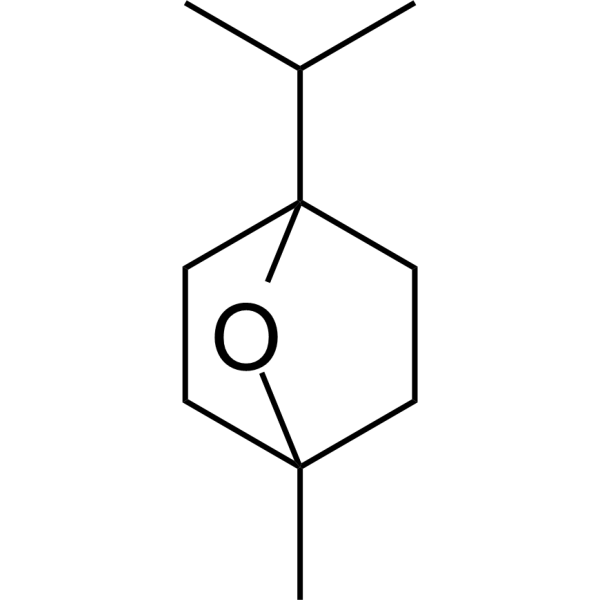
    1,4-Cineole is an oxygenated monoterpene found in eucalyptus oil. 1,4-Cineole is a hTRPM8 and hTRPA1 agonist. 1,4-Cineole can increase intracellular Ca 2+ concentration. 1,4-Cineole exhibits anti-anxiety and anti-depression effects. 1,4-Cineole can be used for the research of neurological disease, such as depression .
    1,4-Cineole
  • HY-117372

    TRP Channel Metabolic Disease
    DFL23448 is a selective transient receptor potential melastatin-8 (TRPM8) antagonist. DFL23448 shows IC50 values of 10 and 21 nM in hTRPM8 human embryonic kidney 293 cells activated by Cooling Agent 10 or cold. DFL23448 has limited activity (IC50 >10 μM) at transient receptor potential vanilloids TRPV1, TRPA1, or TRPV4 or at various G protein-coupled receptors. DFL23448 can modify bladder function and reduce bladder overactivity in awake rats .
    DFL23448
  • HY-N7117R

    Reference Standards TRP Channel Neurological Disease
    1,4-Cineole (Standard) is the analytical standard of 1,4-Cineole (HY-N7117). 1,4-Cineole is an oxygenated monoterpene found in eucalyptus oil. 1,4-Cineole is a hTRPM8 and hTRPA1 agonist. 1,4-Cineole can increase intracellular Ca 2+ concentration. 1,4-Cineole exhibits anti-anxiety and anti-depression effects. 1,4-Cineole can be used for the research of neurological disease, such as depression .
    1,4-Cineole (Standard)
  • HY-183281

    TRP Channel Others
    TRPV3 antagonist-1 is a selective TRPV3 channel antagonist with an IC50 of 11.97 μM. TRPV3 antagonist-1 shows selectivity over hTRPV1, hTRPV4, hTRPA1, and hTRPM8. TRPV3 antagonist-1 shows low cytotoxicity .
    TRPV3 antagonist-1
  • HY-175980

    TRP Channel Neurological Disease
    TRPA1 agonist-3 is a selective and orally active TRPA1 agonist, with EC50 values of 50.05 μM and 314.04 μM for human and mouse TRPA1, respectively. TRPA1 agonist-3 does not activate hTRPV1, mTRPV2, hTRPV3, hTRPV4, hTRPC6, or hTRPM8 channels. TRPA1 agonist-3 alleviates inflammatory pain in mice through a channel desensitization mechanism .
    TRPA1 agonist-3
  • HY-182517

    TRP Channel Inflammation/Immunology
    AG1529 is a TRPV1 inhibitor and capsaicinoid-based soft agent with a human TRPV1 IC50 of 0.9-0.93 μM. AG1529 reversibly blocks capsaicin-evoked TRPV1 activation, binds to the TRPV1 capsaicin binding site, moderately affects pH-induced TRPV1 gating, and does not alter voltage- or heat-mediated TRPV1 responses. AG1529 suppresses TRPV1-mediated neuronal excitability, reduces capsaicin- and pH-evoked neuronal firing, abolishes histaminergic and inflammation-mediated TRPV1 sensitization. AG1529 exhibits anti-nociceptive and antipruritic effects, attenuates in vivo hyperalgesia and pruritus, dose-dependently reduces acute histaminergic itch in rodents, and mildly blocks hTRPA1 and hTRPM8 channel activity. AG1529 undergoes hydrolysis and dermal deactivation, minimizes TRPV1-associated side reactions, does not evoke capsaicin-like burning sensation, and does not disrupt physiological thermal regulation. AG1529 can be used for the research of inflammatory cutaneous nociception and acute histaminergic pruritus .
    AG1529

Inquiry Online

Your information is safe with us. * Required Fields.

Salutation


Country or Region *

Applicant Name *


Organization Name *

Department *


Email Address *


Product Name *

Cat. No.


Requested quantity *

Phone Number *


Remarks

Inquiry Online

Inquiry Information

Product Name:
Cat. No.:
Quantity:
MCE Japan Authorized Agent:

