
5 Results for "

native protein structure

" in MedChemExpress (MCE) Product Catalog:
Products (5)

5 Results for "native protein structure" in MCE Product Catalog:

4
4 Cited Publications
Cat. No.: HY-15435
CAS No.: 75621-03-3
Purity:  99.91%
Research Areas:  

Others

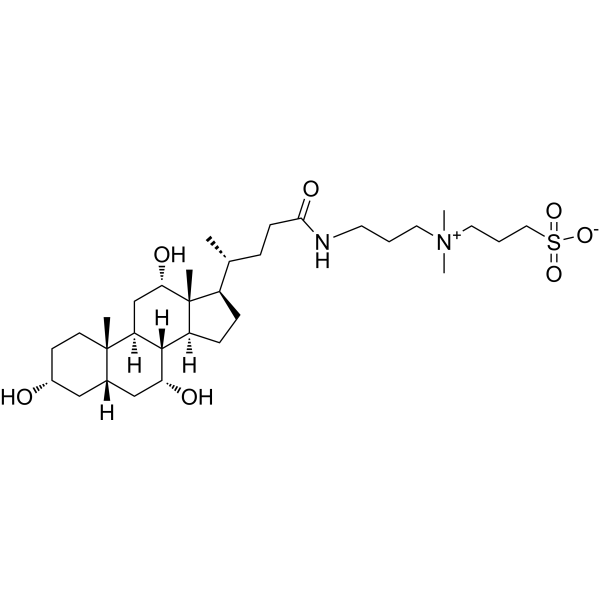
CHAPS is a cholic acid-derived, sulfobetaine-type zwitterionic detergent and micelle-forming agent. CHAPS exhibits properties of weak cationic or nonionic surfactants in different solution systems, undergoes micellization, and forms small, loose hydrophilic aggregates that are temperature-dependent. CHAPS stabilizes mononucleosomes under different ionic strengths, reduces nucleosome sequence specificity, promotes sliding of histone cores along DNA, solubilizes Tamm-Horsfall protein to reduce its interference with urinary exosome isolation, and maintains vesicle structure and the activity of related proteins at the same time. CHAPS is used to recover native folded fusion proteins, enhance the binding capacity of GST fusion proteins, and restore GST enzyme activity. However, CHAPS cannot refold proteins denatured by urea, guanidine hydrochloride or heat, nor can it construct the structure of intrinsically disordered proteins. CHAPS is commonly used in research on the separation and purification of membrane proteins .
loading...
    loading...
4
4 Cited Publications
Cat. No.: HY-15435A
CAS No.: 331717-45-4
Purity:  ≥98.0%
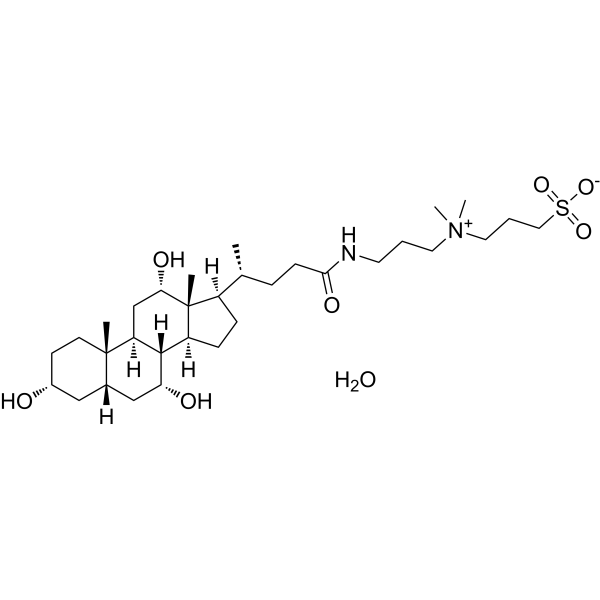
CHAPS hydrate is a cholic acid-derived, sulfobetaine-type zwitterionic detergent and micelle-forming agent. CHAPS hydrate exhibits properties of weak cationic or nonionic surfactants in different solution systems, undergoes micellization, and forms small, loose hydrophilic aggregates that are temperature-dependent. CHAPS hydrate stabilizes mononucleosomes under different ionic strengths, reduces nucleosome sequence specificity, promotes sliding of histone cores along DNA, solubilizes Tamm‑Horsfall protein to reduce its interference with urinary exosome isolation, and maintains vesicle structure and the activity of related proteins at the same time. CHAPS hydrate is used to recover native folded fusion proteins, enhance the binding capacity of GST fusion proteins, and restore GST enzyme activity. However, CHAPS hydrate cannot refold proteins denatured by urea, guanidine hydrochloride or heat, nor can it construct the structure of intrinsically disordered proteins. CHAPS hydrate is commonly used in research on the separation and purification of membrane proteins .
loading...
    loading...
Cat. No.: HY-NP008
CAS No.: 9045-23-2
β-Lactoglobulin, a major whey protein, is a small globular protein from the lipocalin family. β-Lactoglobulin is an important source of the essential and branched-chain amino acids (leucine, isoleucine, and valine). β-Lactoglobulin shows antioxidant properties, because it contains two disulfide bonds and one free thiol group. β-Lactoglobulin is a ligand transport agent. β-Lactoglobulin is one of the major allergens in milk and can be utilized in the research for developing safe hypoallergenic dairy products .
loading...
    loading...
Cat. No.: HY-W998680
CAS No.: 2228857-33-6
Synonyms: 5-FITC-Maleimide
Fluorescein-maleimide (5-FITC-Maleimide) is a thiol-reactive fluorescent derivatization reagent and non-specific protein labeling reagent. Fluorescein-maleimide covalently binds to protein thiol groups for protein labeling. Fluorescein-maleimide covalently binds to protein amino and imidazole groups under neutral pH conditions. Fluorescein-maleimide is used for fluorescent labeling of proteins, nucleic acids or other molecules containing one or more thiol groups (Ex/Em = 494/519 nm) .
loading...
    loading...
Cat. No.: HY-W414390
CAS No.: 260804-65-7
Synonyms: 2-Cyclohexylethyl-4-O-(alpha-D-glucopyranosyl)-beta-D-glucopyranoside, 98%
2-Cyclohexylethyl-4-O-(α-D-glucopyranosyl)-β-D-glucopyranoside, 98% (2-Cyclohexylethyl-4-O-(alpha-D-glucopyranosyl)-beta-D-glucopyranoside, 98%) is a detergent that can be used for the purification and crystallization of membrane-bound proteins in their native structure. It can self-assemble into micelles and vesicles in aqueous solution and can be used for the study of biomembrane models.
loading...
    loading...

