



β-Lactoglobulin

Based on 1 Customer Validation
β-Lactoglobulin, a major whey protein, is a small globular protein from the lipocalin family. β-Lactoglobulin is an important source of the essential and branched-chain amino acids (leucine, isoleucine, and valine). β-Lactoglobulin shows antioxidant properties, because it contains two disulfide bonds and one free thiol group. β-Lactoglobulin is a ligand transport agent. β-Lactoglobulin is one of the major allergens in milk and can be utilized in the research for developing safe hypoallergenic dairy products.
Nos produits utilisent uniquement pour la recherche. Nous ne vendons pas aux patients.
- Pureté : 98.00%
- CAS No.: 9045-23-2
-
Stockage:
Please store the product under the recommended conditions in the Certificate of Analysis.

To place orders, for customer services and technical support, please contact: MedChemExpress USA
Tel: 609-228-6898 E-mail: [email protected] [email protected]


-
 Activité biologique
-
Chemical Information
-
Solvant et solubilité
- Pureté et documentation
- Références
-
 Help & FAQs


-
HY-NP009
α-LactalbuminGlobular Whey Protein -

HY-D0842
BSA ProteinGlobular Protein -

HY-W250978
OvalbuminsAllergen -
HY-12451
FICZAhR Agonist -
HY-14648
DexamethasoneGR Agonist -
HY-D1055
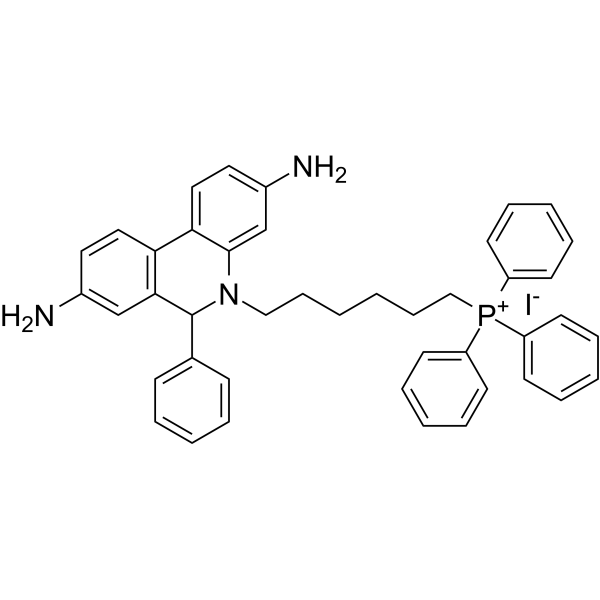
MitoSOX RedMitochondrial ROS Indicator -

HY-NP007
MyoglobinOxygen-binding Hemeprotein -
HY-P1791
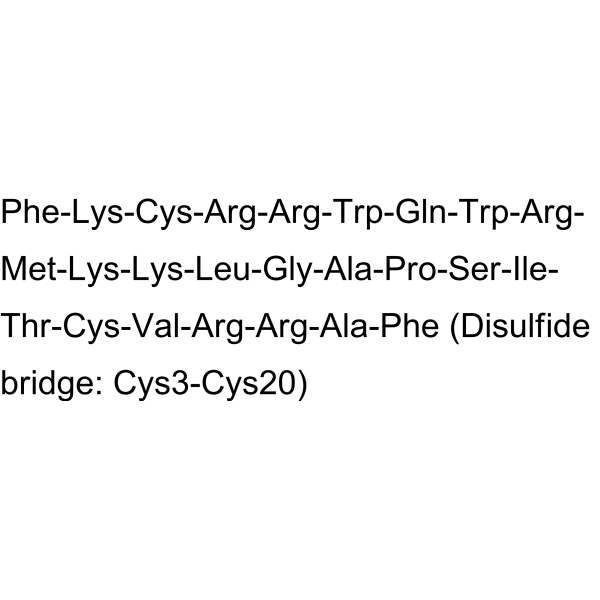
Lactoferrin (17-41)Antimicrobial/Antitumor Agent -
HY-139410
Sodium caseinatesInnate Immune System Activator -
HY-P3160
FibronectinTissue Injury Biomarker -

HY-D0842A
BSA Protein (Low Endotoxin,Fatty acid free)Oligonucleotide-binding Protein -

HY-P3160C
Fibronectin, bovine plasmaFibronectin Dderived From Bovine Plasma
Voir tous les produits spécifiques à Isoform Lipocalin Family
More

Activité biologique
Description
In Vitro
Heat treatment of bovine milk antigen bovine β-Lactoglobulin generates ligands for RAGE, Gal-3, CD-36 and SR-AI as a result of structural changes and glycation. Glycated BLG is less sensitive to digestion and maintains its binding to RAGE and Gal-3. Post-digestion retained immunogenicity of glycated BLG may be mediated via RAGE as a signaling pathway, and via Gal-3 facilitating internalization[1].
β-Lactoglobulin possesses antioxidant properties, because it contains two disulfide bonds (Cys-66 to Cys-160, Cys-106 to Cys-119) and one free thiol group (Cys-121)[2].
Structurally, β-Lactoglobulin has unique features, i.e. a rigid β-barrel core surrounded by one long and several short α-helices with two disulfide (SS) bonds and one free cysteinyl thiol (SH) buried in the core. There are two variants of β-Lactoglobulin (BLG). Variant A (BLGA) has Asp64 and Val118 in place of Gly64 and Ala118 of another variant, B (BLGB). These variants are in equilibrium with a hetero- or homo-dimer under physiological conditions[3].
β-Lactoglobulin is the building block of amyloid fibrils and has a variety of applications, including stabilizing gels or emulsions[4].
MedChemExpress (MCE) has not independently confirmed the accuracy of these methods. They are for reference only.


Chemical Information
-
CAS No. 9045-23-2
-
Appearance Solid
-
Color White to off-white
-
SMILES
[b-Lactoglobulin]
-
Livraison
Room temperature in continental US; may vary elsewhere.
-
Stockage
Please store the product under the recommended conditions in the Certificate of Analysis.


Solvant et solubilité
In Vitro:
H2O : ≥ 5 mg/mL
* "≥" means soluble, but saturation unknown.


Pureté et documentation
-
Fiche technique (270 KB)
-
SDS (251 KB)
- English - EN (251 KB)
- Français - FR (251 KB)
- Deutsch - DE (251 KB)
- Norwegian - NO (251 KB)
- Español - ES (251 KB)
- Swedish - SV (251 KB)
- Italian - IT (251 KB)
- Korean - KR (251 KB)
- Portuguese - PT (251 KB)
-
Instruction de manipulation (2659 KB)
Références
[1]. Teodorowicz M, et al. Enhanced Uptake of Processed Bovine β-Lactoglobulin by Antigen Presenting Cells: Identification of Receptors and Implications for Allergenicity. Mol Nutr Food Res. 2021;65(8):e2000834. [Content Brief]
[2]. Gołębiowski A, et al. Isolation and Self-Association Studies of Beta-Lactoglobulin. Int J Mol Sci. 2020;21(24):9711. Published 2020 Dec 19. [Content Brief]
[3]. Iwaoka M, et al. Oxidative folding pathways of bovine milk β-lactoglobulin with odd cysteine residues. FEBS Open Bio. 2019;9(8):1379-1391. [Content Brief]
[4]. Uttinger MJ, et al. Measurement of length distribution of beta-lactoglobulin fibrils by multiwavelength analytical ultracentrifugation. Eur Biophys J. 2020;49(8):745-760. [Content Brief]

Calculators
Concentration (start) × Volume (start) = Concentration (final) × Volume (final)


β-Lactoglobulin Related Classifications
HY-NP008 Related Classifications
 Powered by Bioz
Keywords
- β-Lactoglobulin
- 9045-23-2
- Lipocalin Family
- secretion
- signal sequence
- hydrophobic hole
- betaI-strand
- N- and C-terminal regions
- CD
- recombinant
- SDS/PAGE
- pico- to nanosecond time scale
- indirect Fourier transformation
- betaF
- Saccharomyces cerevisiae
- protein
- bovine beta-lactoglobulin A
- native PAGE
- \u03b2-lactoglobulin
- fluorescence spectroscopy
- glycation of β-lactoglobulin
- small-angle neutron scattering
- N-terminal sequencing
- Beta-lactoglobulin
- pH
- β-sheet protein
- disulphide bonds
- aggregation of β-lactoglobulin
- aggregation
- betaH strands
- oligomeric forms
- beta-lactoglobulin
- N-terminal methionine
- folding of β-lactoglobulin
- disulfide bond rearrangement
- non-native helix formation
- eight-stranded continuous antiparallel beta-barrel
- betaG
- loops
- NaCl concentration
- digestion of β-lactoglobulin
- monomeric native state
- Ligand binding
- denaturation
- yeast
- dynamics
- kinetic model
- major alpha-helix
- loop EF
- scattered light intensity
- association
- β-lactoglobulin (β-LG)
- Kluyveromyces lactis
- expression
- X-ray dimeric structure
- protein polymer particles
- Protein stability
- solution structure
- Inhibitor
- inhibitor
- inhibit