
10 Results for "

normal human keratinocytes

" in MedChemExpress (MCE) Product Catalog:
Products (10)

10 Results for "normal human keratinocytes" in MCE Product Catalog:

Cat. No.: HY-W089800
CAS No.: 18829-56-6
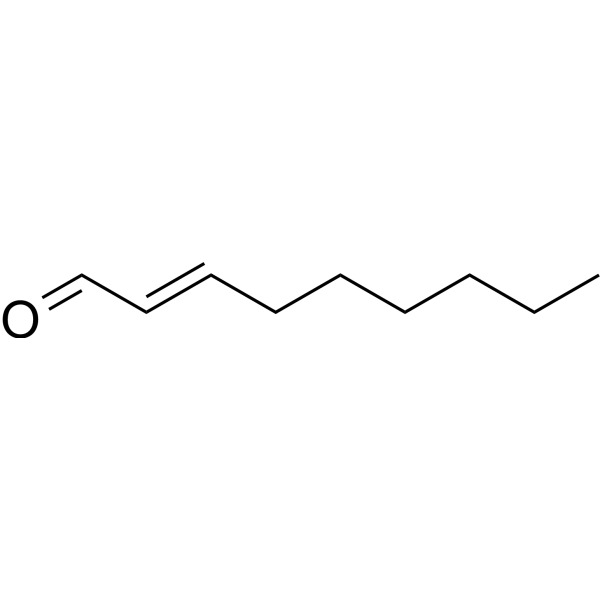
Synonyms: trans-2-Nonen-1-al
Category:  

Natural Products

Target:  

COX Lipoxygenase Apoptosis

trans-2-Nonenal (trans-2-Nonen-1-al) is an endogenous peroxidation product of polyunsaturated fatty acids, acting as an inhibitor of COX and 12-LOX, as well as an inducer of apoptosis. trans-2-Nonenal is also a malodorous compound secreted by the human body, and its content gradually increases with aging. trans-2-Nonenal inhibits the activities of multiple enzymes such as platelet membrane-bound PTPase, preferentially covalently modifies proteins at lysine residues to form immunogenic adducts, and regulates platelet Arachidonic acid (HY-109590) metabolism. trans-2-Nonenal also exhibits significant cytotoxicity, reduces the viability of keratinocytes, promotes their apoptosis, and effectively decreases the thickness of epidermal models and the number of proliferating cells. trans-2-Nonenal is commonly used in studies of thrombotic, atherosclerotic diseases, renal adenocarcinoma, etc. .
loading...
    loading...
Cat. No.: HY-P10233A
Target:  

Bacterial

Research Areas:  

Infection

SAAP 148 TFA is a synthetic antimicrobial peptide (bacteria) that interacts with and disrupts the lipid bilayer of bacterial cytoplasmic membranes, thereby inducing changes in membrane permeability and bacterial death. SAAP 148 TFA kills drug-resistant, multidrug-resistant and persister bacterial strains, inhibits biofilm formation, eliminates established biofilms, and blocks bacterial colonization on implant surfaces. SAAP 148 TFA retains its activity after modification or immobilization, exhibits variable cytotoxicity in different human cell models, and shows reduced efficacy in protein-rich environments. SAAP 148 TFA can be used in infection-related research .
loading...
    loading...
Cat. No.: HY-164826
CAS No.: 30881-23-3
Acetyl zingerone is an analog of Zingerone (HY-14621). Acetyl zingerone downregulates the expression of ROS metabolism-related genes, fibroblast senescence-related genes, keratinocyte differentiation-related genes, and IL-17A target genes. Acetyl zingerone inhibits the activities of MMP-1, MMP-3, and MMP-12, as well as the activation of NLRP3 inflammasome, pyroptosis (pyroptosis), ferroptosis (ferroptosis), cartilage destruction, and UVA-induced cyclobutane pyrimidine dimer formation. Acetyl zingerone upregulates the expression of collagen, proteoglycan, extracellular matrix glycoprotein, Notch pathway, and GPX4 gene, activates Nrf2 and HO-1, induces extracellular matrix synthesis and PINK1/Parkin-mediated mitophagy (mitophagy), and promotes chondrocyte survival. Acetyl zingerone alleviates the progression of osteoarthritis in mice . Acetyl zingerone can be used in research related to skin aging, inflammatory skin diseases, osteoarthritis, melanoma, and non-melanoma skin cancer .
loading...
    loading...
Cat. No.: HY-P5551
Target:  

Bacterial

Research Areas:  

Infection Inflammation/Immunology

TLN-58 is an antimicrobial peptide. TLN-58 has antibacterial activity against S. aureus, S. epidermidis, and group A Streptococcus. TLN-58 also induces inflammatory cytokine mRNAs upregulation in normal human keratinocytes and NCL-SG3 cells .
loading...
    loading...
Cat. No.: HY-P3395B
Target:  

Peptides

Research Areas:  

Others

Catestatin sCst TFA is a scrambled control peptide that serves as a negative control for Catestatin TFA (HY-P1271A) .
loading...
    loading...
Cat. No.: HY-P3395A
Target:  

Peptides

Research Areas:  

Others

Catestatin sCst is a scrambled control peptide that serves as a negative control for Catestatin (HY-P1271) .
loading...
    loading...
Cat. No.: HY-185840
CAS No.: 1478121-01-5
Target:  

Phosphorylase

Research Areas:  

Cancer

hUP1-IN-2 is a Urd-competitive and Pᵢ-noncompetitive hUP1 inhibitor with Ki values of 68 nM and 127 nM, respectively. hUP1-IN-2 reduces the toxicity of 5-fluorouracil (HY-90006) against colon cancer. hUP1-IN-2 can be used in the research of colon cancer .
loading...
    loading...
Cat. No.: HY-N12630
CAS No.: 65318-21-0
Synonyms: Mycosporine-Gly
Mycosporine glycine (Mycosporine-Gly) is a mycosporine-like amino acid derived from marine organisms, which possesses free radical scavenging, antioxidant, anti-inflammatory and photoprotective activities . Mycosporine glycine inhibits the UV-induced upregulation of COX-2 mRNA and gene expression levels, scavenges free radicals, ROS and peroxyl radicals, and inhibits free radical chain lipid peroxidation and phosphatidylcholine peroxidation. Mycosporine glycine restores PCOLCE and elastin levels suppressed by ultraviolet radiation, alleviates photooxidative stress and UV-mediated skin cell damage. Mycosporine glycine can be used in studies related to UV-induced skin inflammation, skin photoaging and skin damage .
loading...
    loading...
Cat. No.: HY-181694
Research Areas:  

Cancer

SeSA-HCPT is an orally active dual-target inhibitor integrating Topo I and HDAC inhibition. SeSA-HCPT induces potent DNA damage, apoptosis, S-phase arrest in prostate cancer cells. SeSA-HCPT inhibits cancer cells proliferation and migration. SeSA-HCPT impairs homologous recombination by suppressing KIF4A-RAD51 signaling. SeSA-HCPT markedly inhibits CRPC tumor growth with minimal systemic toxicity .
loading...
    loading...
Cat. No.: HY-P11891
Target:  

PD-1/PD-L1

Research Areas:  

Cancer

FM213 is a PD-L1 inhibitor with a human IC50 of 323 nM. FM213 blocks PD-1/PD-L1 protein-protein interactions, and promotes endocytosis and lysosome-dependent degradation of PD-L1 on the surface of cancer cells. FM213 binds to PD-L1 on cancer cells and exosomes, and enhances the recognition and killing of cancer cells by human PBMC. Combination of FM213 with the TIGIT inhibitor DTBP-3 (HY-P11903) enhances anti-tumor immunity. FM213 can be used in research related to non-small cell lung cancer .
loading...
    loading...

