6 Results for "

nystatin

" in MedChemExpress (MCE) Product Catalog:
Products (6)

6 Results for "nystatin" in MCE Product Catalog:

57
57 Cited Publications
Cat. No.: HY-17409
CAS No.: 1400-61-9
Nystatin is an orally active polyene antifungal antibiotic effective against yeast and mycoplasma. Nystatin increases the permeability of plasma membranes to small monovalent ions, including chloridion . Nystatin is a cholesterol-sequestering agent , partially prevents Oxaliplatin-induced lipid raft aggregation, DR4 and DR5 clustering, and thereby reduces apoptosis .
loading...
    loading...
Cat. No.: HY-159666
CAS No.: 34786-70-4
Target:  

Antibiotic Fungal

Research Areas:  

Infection

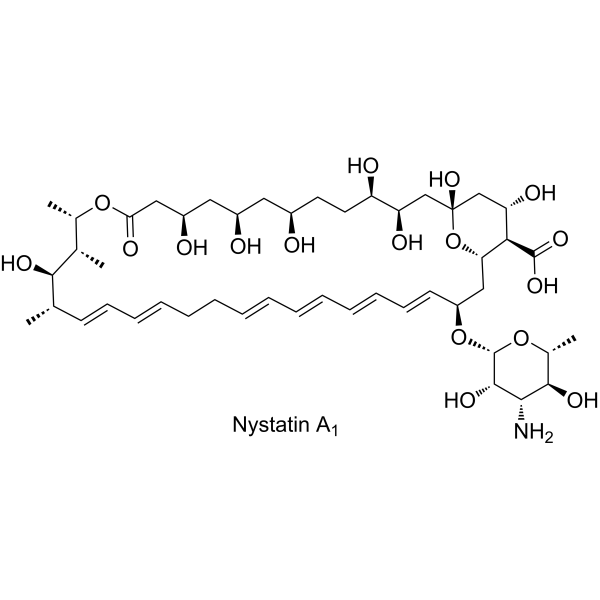
Nystatin A1 is a polyene macrolide antifungal antibiotic that can be isolated from Streptomyces noursei. Nystatin A1 binds to ergosterol on the fungal cell membrane, increasing the permeability of the cell membrane and causing leakage of cell contents, thereby inhibiting the growth and reproduction of fungi .
loading...
    loading...
Cat. No.: HY-152909
CAS No.: 65086-32-0
Nystatin A2 is an active component of antifungal agent, Nystatin (HY-17409). Nystatin is an orally active polyene antifungal antibiotic effective against yeast and mycoplasma .
loading...
    loading...
Cat. No.: HY-113819
CAS No.: 100-95-8
Synonyms: Dodecarbonium chloride
Research Areas:  

Infection

Metalkonium chloride (Dodecarbonium chloride) is a quaternary ammonium salt, surfactant, and transdermal penetration enhancer. Metalkonium chloride increases skin permeability to facilitate transdermal delivery. Metalkonium chloride enhances the growth inhibitory activity of Nystatin (HY-17409) ointment against C. monosa. Metalkonium chloride can be used in studies related to Candida monosa infections .
loading...
    loading...
Cat. No.: HY-D3117
CAS No.: 2146114-18-1
Target:  

Fluorescent Dye

Research Areas:  

Others

MBCB is a two-photon Fluorescent probe for dual-detection of mitochondrial SO₂ derivatives and viscosity. For SO₂ derivatives detection, the probe utilizes a Michael addition mechanism: nucleophilic addition of SO₂ derivatives to the C=C bond between the carbazole skeleton and 3-methylbenzothiazolium moiety destroys the strong intramolecular charge transfer (ICT) system between these groups, while enhancing the weak ICT system between the benzothiazole group and carbazole framework; this causes the red emission at 600 nm to decrease and the blue emission at 434 nm to increase, creating a ratiometric response based on the I₄₃₄ₙₘ/I₆₀₀ₙₘ intensity ratio. For viscosity detection, in low-viscosity environments, steric hindrance creates a twisted ICT (TICT) system with weak fluorescence, while in high-viscosity environments, intramolecular rotation is blocked, the TICT state is disrupted, and the strong ICT system is recovered, leading to a strong red emission at 567 nm with negligible change to the short-wavelength emission at 415 nm, creating a ratiometric response based on the I₅₆₇ₙₘ/I₄₁₅ₙₘ intensity ratio that has a logarithmic linear relationship with viscosity. The probe has excitation/emission wavelengths of Ex/Em = 351/434, 600 nm for SO₂ derivatives detection and Ex/Em = 351/567 nm for viscosity detection, with two-photon excitation at 740 nm for bioimaging; it also exhibits good mitochondrial targeting ability with a Pearson's colocalization coefficient of 0.93 when paired with Mito-Tracker Green. The probe shows high sensitivity and selectivity for SO₂ derivatives, has low cell cytotoxicity, and can be applied to detect exogenous/endogenous HSO₃⁻ in living cells and in vivo, as well as visualize mitochondrial viscosity changes induced by nystatin[1].
loading...
    loading...
Cat. No.: HY-D3108
CAS No.: 2569032-08-0
BV-1 is a fluorescent probe for detecting mitochondrial viscosity in living cells. The detection mechanism of BV-1 relies on a twisted intramolecular charge transfer (TICT) mechanism associated with environmental viscosity: in low-viscosity media, the unsaturated domain at the meso-position of the BODIPY fluorophore undergoes TICT, achieving efficient excited-state deactivation through molecular rotation, thereby quenching fluorescence; under high-viscosity conditions, such molecular rotation is restricted, TICT is inhibited, and the conjugated system of the probe extends, which leads to significant fluorescence enhancement accompanied by a red shift in emission wavelength. BV-1 exhibits low cytotoxicity. Its detection wavelengths include excitation wavelengths of 480 nm or 488 nm, with an emission wavelength of 545 nm in low-viscosity environments and 570 nm in high-viscosity environments; in addition, its absorption peak locates at 528 nm in ethanol and red-shifts to 531 nm in glycerol .
loading...
    loading...

