

1. Search Result
Search Result
Results for "

p-p53

" in MedChemExpress (MCE) Product Catalog:

13

Inhibitors & Agonists

1

Inhibitory Antibodies

Cat. No. Product Name Target Research Areas Chemical Structure
  • HY-139297
    SCR130
    1 Publications Verification

    DNA/RNA Synthesis Apoptosis Cancer
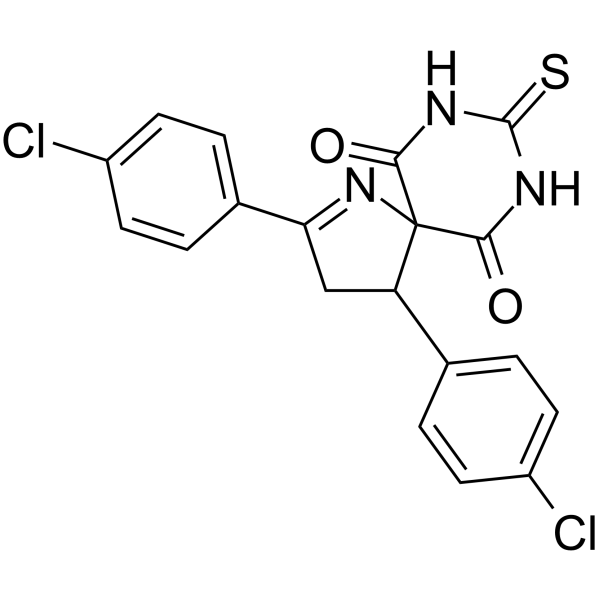
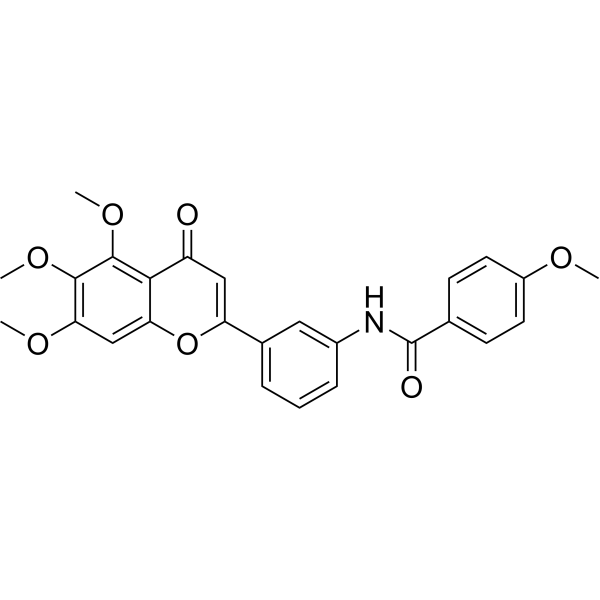
    SCR130 is a SCR7-based DNA nonhomologous end-joining (NHEJ) inhibitor. SCR130 inhibits the end-joining of DNA in a Ligase IV-dependent manner. SCR130 is specific to Ligase IV, and shows minimal or no effect on Ligase III and Ligase I mediated joining. SCR130 induces cell apoptosis and has anticancer activity .
    SCR130
  • HY-P99630

    MM-302 antibody

    EGFR Cancer
    Gancotamab antibody (MM-302) is a HER2-targeted antibody with antitumor activity .
    Gancotamab antibody
  • HY-153339

    Eukaryotic Initiation Factor (eIF) Cancer
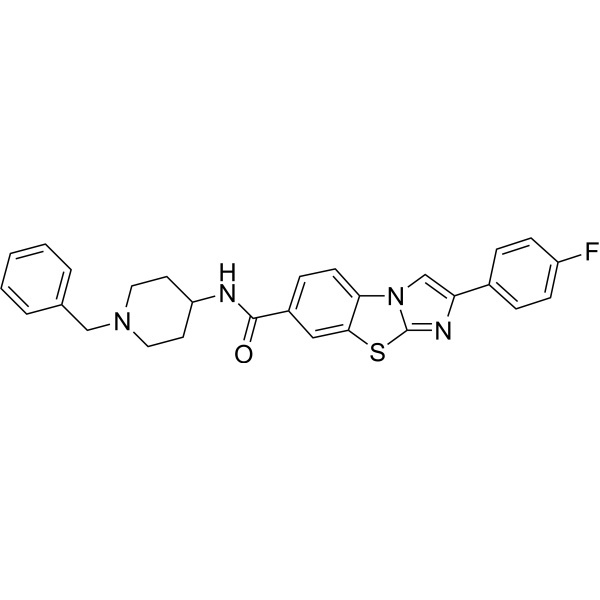
    E235 is an expression regulator of activates transcription factor 4 (ATF4). E235 reduces cell viability by activating integrated stress response (ISR) and DNA damage response signals. E235 has anti-proliferative activity and can be used for tumor research .
    E235
  • HY-120105

    DNA/RNA Synthesis Apoptosis MDM-2/p53 Bcl-2 Family Caspase PARP Cancer
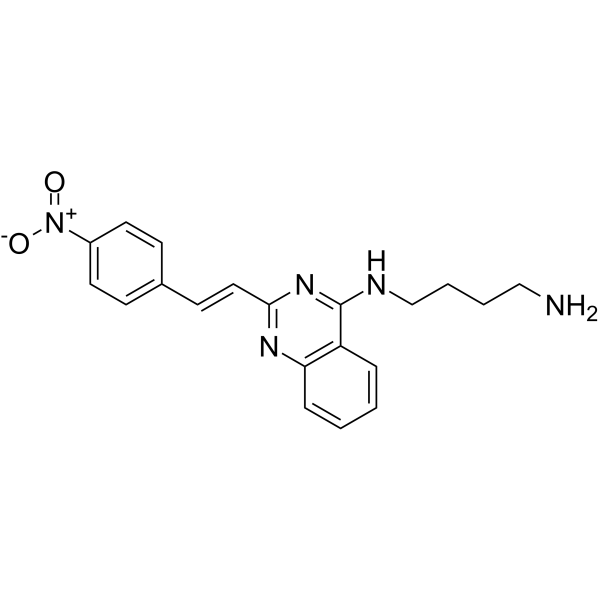
    NSC666715 is a DNA polymerase β (Pol-β) inhibitor. NSC666715 directly and specifically interacts with Pol-β, interferes with its binding to damaged DNA, blocks its dRP lyase activity, and inhibits Pol-β-mediated SN- and LP-BER. NSC666715 induces AP site accumulation and S-phase cell cycle arrest, and triggers senescence and apoptosis (apoptosis) via the p53/p21 pathway in colorectal cancer cells. NSC666715 enhances TMZ (HY-17364)-induced DNA damage, senescence and apoptosis, and potentiates the cytotoxicity of TMZ. NSC666715 inhibits tumor growth in colon cancer xenograft models. NSC666715 can be used in research related to colorectal cancer .
    NSC666715
  • HY-108433

    Carnitine palmitoyltransferase 2

    Apoptosis MDM-2/p53 Metabolic Disease Cancer
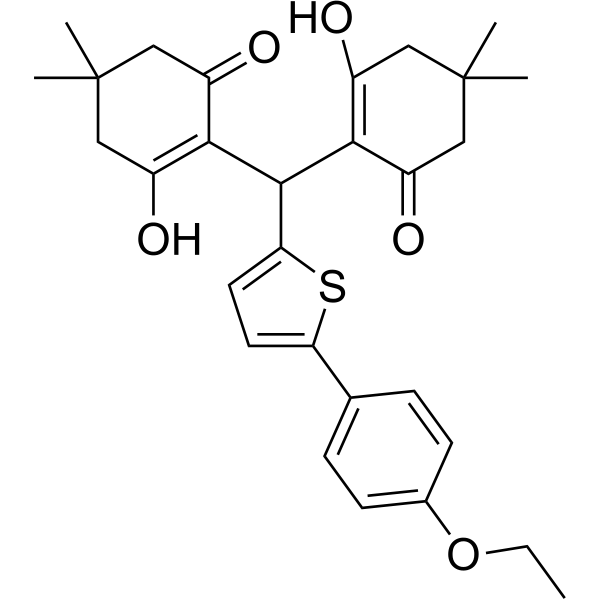
    CPT2 (Carnitine palmitoyltransferase 2), an enzyme that participates in fatty acid oxidation, also is a colorectal cancer (CRC) prognostic biomarker. CPT2 overexpression can activate p-p53 to increase p53 expression, thereby inhibiting tumor proliferation and promoting apoptosis. CPT2 deficiency results in the most common inherited disorder of long-chain fatty acid oxidation affecting skeletal muscle. Downregulation of CPT2 is also highly correlated with the progression of various cancers and has potential for cancer research .
    CPT2
  • HY-179520

    Topoisomerase DNA/RNA Synthesis MDM-2/p53 Bcl-2 Family Cancer
    XSJ151 is a topoisomerase I inhibitor, stabilizing the DNA-Topo I covalent complex and inducing DNA double-strand breaks. XSJ151-induces DNA damage activates the p53-p21 signaling pathway, specifically regulating the expression of cyclins, leading to G2/M phase cell cycle arrest and disrupting the dynamic homeostasis of Bcl-2 family proteins, thereby triggering apoptosis in gastric cancer cells. XSJ151 can be used for the study of gastric cancer .
    XSJ151
  • HY-146095

    MDM-2/p53 DNA/RNA Synthesis Apoptosis Cancer
    p53 Activator 2 (compound 10ah) intercalats into DNA and results in significant DNA double-strand break.p53 Activator 2 increases the expression of p53, p-p53, CDK4, p21 to cause cell cycle arrest at G2/M phase.p53 Activator 2 induce apoptosis and significantly down-regulates the anti-apoptosis proteins Bcl-2, Bcl-xL and the levels of cyclin B1.p53 Activator 2 has anti-proliferation activity against MGC-803 cells, with an IC50 of 1.73 µM. p53 Activator 2 displays potent anticancer efficiency against MGC-803 xenograft tumors models .
    p53 Activator 2
  • HY-157954

    DNA/RNA Synthesis Apoptosis Cancer
    WRN inhibitor 6 (compound 3ci) is a potent WRN inhibitor. WRN inhibitor 6 induces apoptosis. WRN inhibitor 6 increases the expression of p-p53, P-Chk2, γH2AX expression .
    WRN inhibitor 6
  • HY-174301

    Deubiquitinase DNA Methyltransferase MDM-2/p53 Cancer
    USP7-IN-18 is a naphthalene derivative. USP7-IN-18 is a selective USP7 inhibitor (IC50 : 130.9 nM), with no or very weak inhibition of the other 8 DUBs including USP47. USP7-IN-18 specifically binds to the catalytic domain of USP7, blocking its deubiquitinase activity. USP7-IN-18 causes degradation of the oncogenic proteins MDM2 and DNMT1, and also degrades the novel target PCLAF. USP7-IN-18 activates the p53-p21 pathway. USP7-IN-18 exerts anti-tumor effects in colon cancer animal models and reshapes the tumor immune microenvironment. USP7-IN-18 achieves both direct cytotoxic and immune-synergistic anti-tumor actions.
    USP7-IN-18
  • HY-158210

    Wnt β-catenin MDM-2/p53 Cancer
    Wnt/β-catenin-IN-3 (compound 17) is a Wnt/β-catenin inhibitor with low micromolarGI50s against various cancer cells. Wnt/β-catenin-IN-3triggers G2/M cell cycle arrest though activation of p53-p21 pathway as well as intrinsic and extrinsic apoptotic death of colon cancer cells .
    Wnt/β-catenin-IN-3
  • HY-162927

    MDM-2/p53 Apoptosis Cancer
    p53-MDM2-IN-6 (Compound 10a), a LSM-83177 hydrazone analog, is a potent p53-MDM2 inhibitor with an IC50 value of 11.08 µg/mL. p53-MDM2-IN-6 arrests the cell cycle in the S phase and induces early and late Apoptosis with antiproliferative activity against HT29 cell lines with an IC50 value of 10.44 µg/mL. p53-MDM2-IN-6 inhibits p53-MDM2 interaction with increment in p-53 level and decrease the expression of GST enzymes. p53-MDM2-IN-6 is promising for research of colorectal cancer .
    p53-MDM2-IN-6
  • HY-183073

    Cancer
    TZ1104 is a PROTAC-based CDK7 degrader, with a DC50 of 0.88 nM. TZ1104 forms a ternary complex with VHL E3 ligase and CDK7 to trigger proteasome-dependent CDK7 degradation, destabilizing the CDK7-cyclin H-MAT1 complex. TZ1104 suppresses phosphorylation of RNA polymerase II CTD Ser5, CDK1 Thr161, and CDK2 Thr160. TZ1104 activates the p53-p21 axis and suppresses oncogenic Myc signaling. TZ1104 induces cell cycle arrest, apoptosis, and differentiation of acute leukemia cells. TZ1104 can be used for the research of acute leukemia .

    TZ1104
  • HY-183070

    PROTACs CDK Apoptosis Cancer
    CXJ2080 is a selective PROTAC-based CDK7 degrader with a DC50 of 0.88 nM. CXJ2080 recruits VHL E3 ligase to induce ubiquitin-proteasome-dependent CDK7 degradation, disrupts the CDK7-cyclin H-MAT1 complex, suppresses CDK7-dependent phosphorylation of RNA polymerase II CTD Ser5, CDK1 Thr161, and CDK2 Thr160. CXJ2080 activates the p53-p21 axis, suppresses MYC-driven signaling, induces leukemia cell cycle arrest, apoptosis, and differentiation, reduces CD117 expression, spares platelets and normal PBMCs, maintains sustained CDK7 degradation post-washout. CXJ2080 can be used for the research of acute leukemia .
    CXJ2080

Inquiry Online

Your information is safe with us. * Required Fields.

Salutation


Country or Region *

Applicant Name *


Organization Name *

Department *


Email Address *


Product Name *

Cat. No.


Requested quantity *

Phone Number *


Remarks

Inquiry Online

Inquiry Information

Product Name:
Cat. No.:
Quantity:
MCE Japan Authorized Agent:

