
16 Results for "

pain perception

" in MedChemExpress (MCE) Product Catalog:
Products (16)

16 Results for "pain perception" in MCE Product Catalog:

2
2 Cited Publications
Cat. No.: HY-P0004
CAS No.: 50-57-7
Synonyms: Lysine vasopressin; [Lys8]-Vasopressin
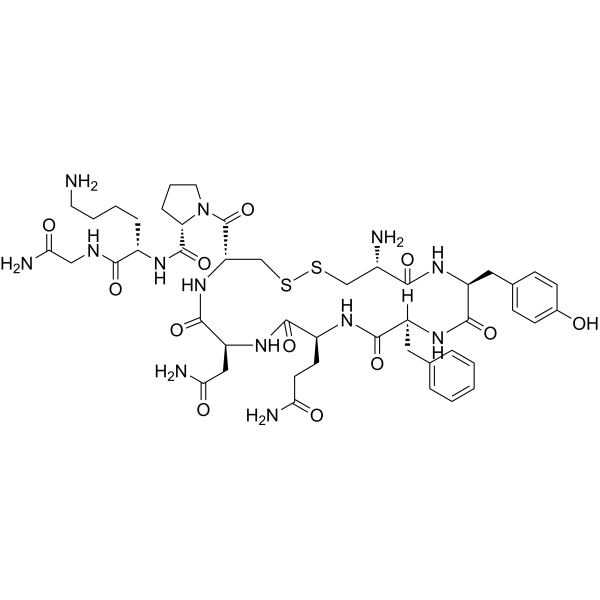
Lysipressin (Lysine vasopressin ; [Lys8]-Vasopressin ) is a neurohypophyseal nonapeptide with dual cardiovascular regulatory activities of peripheral pressor action and central hypotensive action, and it also regulates pain perception in the body. Lysipressin is an Oxytocin Receptor agonist, with a Ki value of 10.2 nM for porcine OT receptor. Lysipressin stimulates contraction of rabbit bladder smooth muscle via V1-vasopressin receptor. The central hypotensive effect of Lysipressin depends on the sympathetic tone pathway. Lysipressin dose-dependently prolongs tail-flick latency in rats, producing a stable central antinociceptive effect. Lysipressin can be used in studies related to cardiovascular regulation, hypertension and pain .
loading...
    loading...
2
2 Cited Publications
Cat. No.: HY-P0004A
CAS No.: 83968-49-4
Synonyms: Lysine vasopressin acetate; [Lys8]-Vasopressin acetate
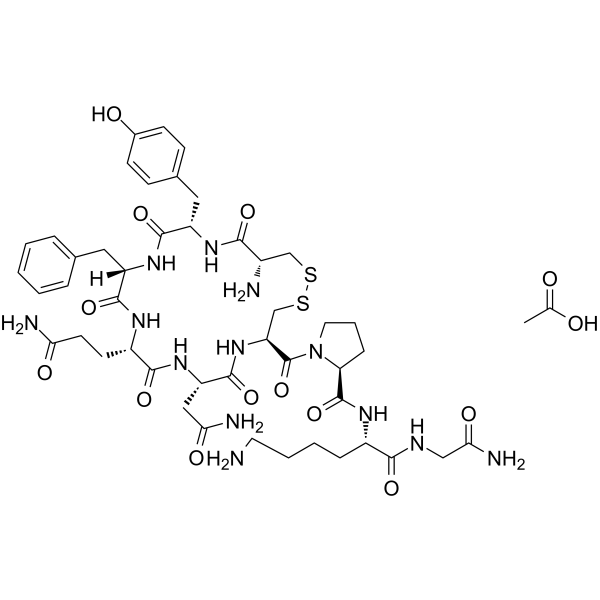
Lysipressin acetate (Lysine vasopressin acetate; [Lys8]-Vasopressin acetate) is a neurohypophyseal nonapeptide with dual cardiovascular regulatory activities of peripheral pressor action and central hypotensive action, and it also regulates pain perception in the body. Lysipressin acetate is an Oxytocin Receptor agonist, with a Ki value of 10.2 nM for porcine OT receptor. Lysipressin acetate stimulates contraction of rabbit bladder smooth muscle via V1-vasopressin receptor. The central hypotensive effect of Lysipressin acetate depends on the sympathetic tone pathway. Lysipressin acetate dose-dependently prolongs tail-flick latency in rats, producing a stable central antinociceptive effect. Lysipressin acetate can be used in studies related to cardiovascular regulation, hypertension and pain .
loading...
    loading...
1
1 Cited Publications
Cat. No.: HY-110004
CAS No.: 220556-69-4
Purity:  ≥96.0%
Synonyms: Arachidonyl-2-chloroethylamide
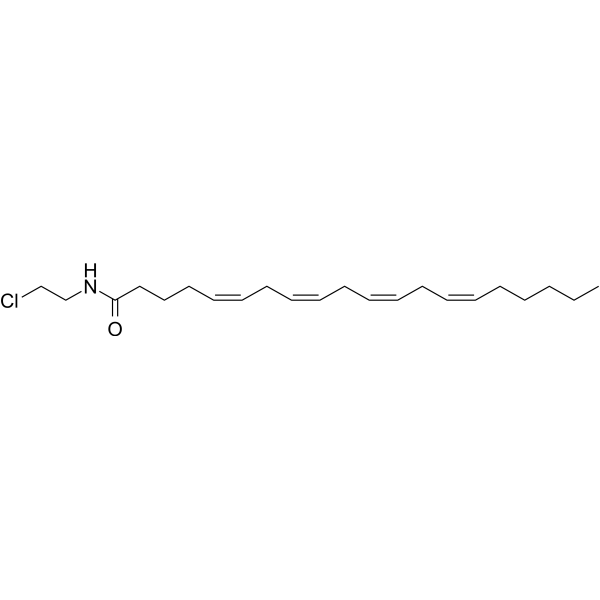
ACEA (short for arachidonyl-2'-chloroacetamide) is a synthetic organic compound that acts as an agonist of the cannabinoid receptor CB1. It is a chemical that affects the endocannabinoid system in the body, which regulates various physiological processes such as appetite, pain perception, mood, and memory .
loading...
    loading...
Cat. No.: HY-110302
CAS No.: 2410327-94-3
Target:  

Opioid Receptor

Research Areas:  

Neurological Disease

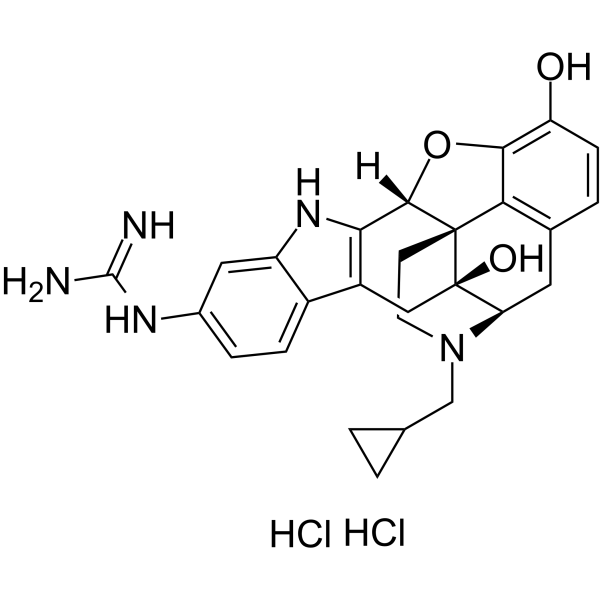
6'-GNTI dihydrochloride, a κ-opioid receptor (KOR) agonist, displays bias toward the activation of G protein-mediated signaling over β-arrestin2 recruitment. 6'-GNTI 6'-GNTI dihydrochloride only activates the Akt pathway in striatal neurons .
loading...
    loading...
Cat. No.: HY-P10654
CAS No.: 2861260-80-0
Target:  

TRP Channel

Research Areas:  

Neurological Disease

RhTx is a transient receptor potential vanillin-1 (TRPV1) activator. RhTx can be used to study pain perception .
loading...
    loading...
Cat. No.: HY-121947
CAS No.: 80749-33-3
Target:  

Cannabinoid Receptor

Research Areas:  

Neurological Disease

1'-Naphthoyl-2-methylindole (Compound 88) is a cannabinoid mimetics and an inhibitor for Win 55212-2, that inhibits 34% of [3H]Win 55212-2 binding to cannabinoid receptors at 3 μM .
loading...
    loading...
Cat. No.: HY-138985
CAS No.: 22913-17-3
Synonyms: Santinamide
CAY10568 is a compound based on QX-314 (HY-101350). CAY10568 is physically smaller and less hydrophobic than the QX-314. CAY10568 can be used in studies of inflammation and pain perception .
loading...
    loading...
Cat. No.: HY-14753
CAS No.: 861151-12-4
Rosonabant is a selective antagonist for cannabinoid receptor (CB1 receptor), which reduces body weight and improves improves the risk of obesity-related cardiovascular metabolic diseases. Rosonabant exhibits adverse side effect, such as nausea and mental disorder .
loading...
    loading...
Cat. No.: HY-167862
CAS No.: 2411412-36-5
Target:  

Endogenous Metabolite

Research Areas:  

Neurological Disease

UCM-05194 is a selective LPA1 receptor agonist with activity to improve neuropathic pain. UCM-05194 is a LPA1 agonist that exhibits potent and selective properties in its pharmacologically similar properties. UCM-05194 triggers LPA1-mediated cellular effects and leads to internalization of the receptor, resulting in functional inactivation in primary sensory neurons. UCM-05194 effectively reduces pain perception in in vivo models. UCM-05194 can be used to conduct research on progressive systemic diseases .
loading...
    loading...
Cat. No.: HY-141468
CAS No.: 67025-98-3
Synonyms: β-CNA dihydrochloride
Target:  

Opioid Receptor

Research Areas:  

Neurological Disease

β-Chlornaltrexamine dihydrochloride (β-CNA dihydrochloride) is a potent long-term opioid receptor blocker. β-Chlornaltrexamine dihydrochloride can effectively block the inhibitory effect of κ opioid receptor agonists on dopamine release. β-Chlornaltrexamine dihydrochloride can be used to study the mechanism of pain perception .
loading...
    loading...
Cat. No.: HY-163895
Research Areas:  

Neurological Disease

δ opioid receptor antagonist 1 (compound 6-Cy3) is a fluorescent antagonist probe with high selectivity for δ opioid receptor (DOR) (Ki=1.7 nM). δ opioid receptor antagonist 1 can be used to study the mechanism of pain perception .
loading...
    loading...
Cat. No.: HY-P3517
CAS No.: 77761-27-4
Synonyms: β-EP (6-31), human
Target:  

Opioid Receptor

Research Areas:  

Neurological Disease Endocrinology

β-Endorphin, an endogenous opioid neuropeptide, is an opioid receptor agonist. β-Endorphin binds preferentially to μ-opioid receptors and is produced in certain neurons of the central and peripheral nervous system and is one of three endorphins produced in humans. β-Endorphin can be used to reduce stress and maintain homeostasis in the body and is involved in neurological pain perception regulation .
loading...
    loading...
Cat. No.: HY-158362A
CAS No.: 9040-75-9
Monoglyceride lipase, Bacillus sp., is a key enzyme involved in lipid metabolism. It catalyzes the hydrolysis of monoglycerides (particularly 2-AG, or 2-arachidonoylglycerol) into glycerol and free fatty acids. By regulating the levels of 2-AG, Monoglyceride lipase, Bacillus sp., can influence neural signaling, pain perception, inflammatory responses, and metabolic processes .
loading...
    loading...
Cat. No.: HY-P0004R
CAS No.: 50-57-7
Synonyms: Lysine vasopressin (Standard); [Lys8]-Vasopressin (Standard)
Lysipressin (Standard) is the analytical standard of Lysipressin (HY-P0004). This product is intended for research and analytical applications. Lysipressin (Lysine vasopressin ; [Lys8]-Vasopressin ) is a neurohypophyseal nonapeptide with dual cardiovascular regulatory activities of peripheral pressor action and central hypotensive action, and it also regulates pain perception in the body. Lysipressin is an Oxytocin Receptor agonist, with a Ki value of 10.2 nM for porcine OT receptor. Lysipressin stimulates contraction of rabbit bladder smooth muscle via V1-vasopressin receptor. The central hypotensive effect of Lysipressin depends on the sympathetic tone pathway. Lysipressin dose-dependently prolongs tail-flick latency in rats, producing a stable central antinociceptive effect. Lysipressin can be used in studies related to cardiovascular regulation, hypertension and pain .
loading...
    loading...
Cat. No.: HY-W424876
CAS No.: 6034-68-0
Target:  

Adenosine Receptor

Research Areas:  

Inflammation/Immunology

N-(7H-Purin-6-yl)acetamide (Compound 25) is a selective adenosine receptor (AdeR) agonist with a Ki value of 0.515 μM for the human adenosine receptor and a Ki value of 2.85 μM for the rat adenosine receptor. N-(7H-Purin-6-yl)acetamide is promising for research of adenosine receptor function, pain perception, inflammatory responses, and renal function .
loading...
    loading...
Cat. No.: HY-L923
9000 compounds

Ion channels are key proteins on the cell membrane that regulate the flow of ions across membranes. They participate in nearly all physiological processes, including nerve conduction, muscle contraction, heart rhythm, and pain perception. Abnormalities in their function can lead to various serious diseases such as arrhythmia, epilepsy, hypertension, neuropathic pain, and cancer. Therefore, ion channels are highly valuable drug targets—over 15% of approved drugs target ion channels currently, demonstrating their irreplaceable therapeutic value in cardiovascular, neurological, and analgesic fields.

MCE has collected a library of over 5,000 reported ion channel-related bioactive compounds targeting major sites such as Na+ channels, K+ channels, Ca2+ channels, GABA receptors, iGluRs, and others. Using AI models, these compounds are characterized through both 2D representations (molecular fingerprints, pharmacophores) and 3D representations (3D conformation) to screen for a collection of lead-like compounds highly similar to known active molecules. Additionally, an hERG channel prediction algorithm integrating XGB and ISE mapping strategy is employed to assess and exclude potential cardiotoxicity in the library.. This step significantly reduces safety risks in subsequent screenings, particularly for ion channel drug development related to cardiovascular systems (e.g., Nav1.5, Cav1.2), effectively minimizing failures due to hERG inhibition and serving as a valuable tool for ion channel drug screening.

  • 1

