1. Search Result
Search Result
Results for "

polymer films

" in MedChemExpress (MCE) Product Catalog:

17

Inhibitors & Agonists

1

Screening Libraries

9

Biochemical Assay Reagents

1

Natural
Products

1

Isotope-Labeled Compounds

1

Oligonucleotides

Cat. No. Product Name Target Research Areas Chemical Structure
  • HY-Y1310A

    Environmental Pollutants Biochemical Assay Reagents Others
    Sodium alginate is an anionic straight chain polysaccharide. Sodium alginate can be obtained from different species of algae. Sodium alginate has different properties, such as pH-sensitivity, nontoxicity, nonimmunogenicity. Sodium alginate has weak gelation, viscosity, and film-forming properties. Sodium alginate can be utilized to prepare gels and film materials for food preservation. Sodium alginate is a versatile functional biomaterial for viscosity enhancement, stabilizer, matrixing agent, encapsulation polymer, bioadhesive and film former .
    Sodium alginate (Viscosity 200±20mpa.s)
  • HY-W115746

    Ethyl cellulose N-200

    Environmental Pollutants Biochemical Assay Reagents Infection Cancer
    Ethyl cellulose is a derivative of cellulose. Ethyl cellulose is a non-toxic, biodegradable polymer. Ethyl cellulose has unique properties such as oil gel formation, active ingredient delivery and film formation. Ethyl cellulose can be used as a pharmaceutical excipient, such as a coating agent, flavoring agent, tablet filler, etc. Ethyl cellulose can be used to prepare nanoparticles for active compound delivery .
    Ethyl cellulose
  • HY-W089777

    GPTMS

    Biochemical Assay Reagents Others
    3-Glycidyloxypropyltrimethoxysilane (GPTMS) is a silicon source for the preparation of inorganic-organic hybrid polymers. 3-Glycidyloxypropyltrimethoxysilane can be used to prepare hard coatings of organic polymers, such as contact lens materials in the optical industry, as well as related materials in the fields of electronics, thin films, sensors, nanoimprinting, waveguides, and biology .
    3-Glycidyloxypropyltrimethoxysilane
  • HY-W011875

    Biochemical Assay Reagents Others
    2-Isopropylthioxanthone is a photoinitiator that is widely used in printing ink of packaging materials. 2-Isopropylthioxanthone triggers the radical polymerization of the acrylic component of inks, thus causing the liquid ink film to dry .
    2-Isopropylthioxanthone
  • HY-Y0850U2

    Polyvinyl alcohol (Mw 130000, 87-89% hydrolyzed, ~2700 polymerization); Poly(Ethenol) (Mw 130000, 87-89% hydrolyzed, ~2700 polymerization)

    Biochemical Assay Reagents Others
    PVA (Mw 130000, 87-89% hydrolyzed, ~2700 polymerization) (Polyvinyl alcohol (Mw 130000, 87-89% hydrolyzed, ~2700 polymerization); Poly(Ethenol) (Mw 130000, 87-89% hydrolyzed, ~2700 polymerization)) is a biodegradable of polymer. PVA (Mw 130000, 87-89% hydrolyzed, ~2700 polymerization) can be used to blend with various biopolymers and hydrophilic synthetic polymers to improve mechanical properties of films .
    PVA (Mw 130000, 87-89% hydrolyzed, ~2700 polymerization)
  • HY-Y0850U1

    Polyvinyl alcohol (Mw 61000, 98-99% hydrolyzed, ~1400 polymerization); Poly(Ethenol) (Mw 61000, 98-99% hydrolyzed, ~1400 polymerization)

    Biochemical Assay Reagents Others
    PVA (Mw 61000, 98-99% hydrolyzed, ~1400 polymerization) (Polyvinyl alcohol (Mw 61000, 98-99% hydrolyzed, ~1400 polymerization); Poly(Ethenol) (Mw 61000, 98-99% hydrolyzed, ~1400 polymerization)) is a biodegradable of polymer. PVA (Mw 61000, 98-99% hydrolyzed, ~1400 polymerization) can be used to produce bio-composite films .
    PVA (Mw 61000, 98-99% hydrolyzed, ~1400 polymerization)
  • HY-23497

    Others Others
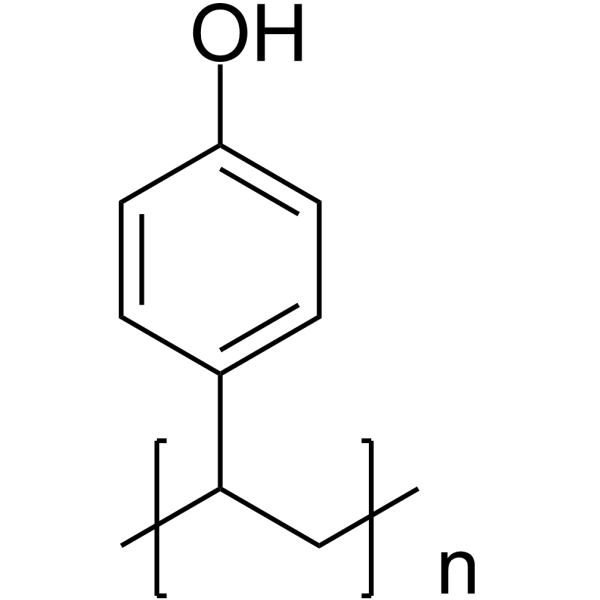
    Poly(4-vinylphenol) is a polymer cross-linking agent that can be used to prepare non-toxic films. Poly(4-vinylphenol) is a sensitizer of titania for visible light photocatalysis. Poly(4-vinylphenol) also can be used as a water resistive wood adhesive, as a gate dielectric insulator in organic field effect transistors, and as a responsive surface coating .
    Poly(4-vinylphenol)
  • HY-164070

    Biochemical Assay Reagents Others
    Dextran Hydroxypropyltrimonium Chloride is a cationic polymer with excellent antistatic, moisturizing, film-forming, foam-stabilizing and emulsifying abilities. Dextran Hydroxypropyltrimonium Chloride can be used in the research of pharmaceuticals and cosmetics .
    Dextran Hydroxypropyltrimonium Chloride
  • HY-W115746B

    Biochemical Assay Reagents Others
    Ethyl cellulose (viscosity 300 cP) serves as a non-toxic and biodegradable polymer, with unique properties such as oleogel formation, delivery of active component, and film-forming ability in the food and pharmaceutical sectors. Ethyl cellulose (viscosity 300 cP) can be used as an excipient, such as coating agent, flavoring agent, tablet filler .
    Ethyl cellulose (viscosity 300 cP)
  • HY-W115746A

    Biochemical Assay Reagents Others
    Ethyl cellulose (viscosity 10 cP) serves as a non-toxic and biodegradable polymer, with unique properties such as oleogel formation, delivery of active component, and film-forming ability in the food and pharmaceutical sectors. Ethyl cellulose (viscosity 10 cP) can be used as an excipient, such as coating agent, flavoring agent, tablet filler .
    Ethyl cellulose (viscosity 10 cP)
  • HY-W250194

    Biochemical Assay Reagents Others
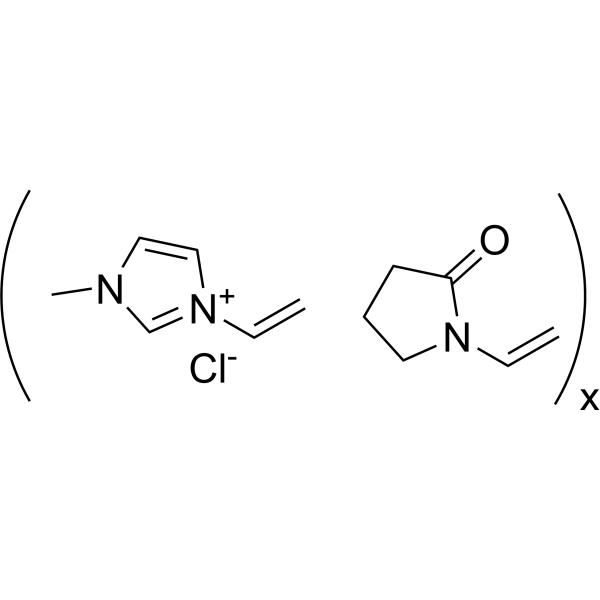
    Luviquat FC 550 is a cationic polymer commonly used in a variety of personal care and cosmetics. It is a viscous liquid containing quaternary ammonium groups which give it a positive charge. Luviquat FC 550 has a variety of properties suitable for these applications including its ability to provide conditioning, antistatic and film-forming properties to hair and skin. In addition, it is used as a binder in oral care products and as a flocculant in industrial water treatment.
    Luviquat FC 550
  • HY-W142308

    Biochemical Assay Reagents
    Diammonium dithiodiglycolate is a film-forming polymer used as a crosslinking agent, with the activity of promoting crosslinking of materials and enhancing their stability. Diammonium dithiodiglycolate plays a key role in biomedical applications, especially in the preparation of biocompatible materials. The unique chemical properties of Diammonium dithiodiglycolate make it an ideal choice to achieve high-performance polymer properties.
    Diammonium dithiodiglycolate
  • HY-W739372

    Biochemical Assay Reagents
    Poly (sodium 4-styrenesulfonate) is a cation exchange polyelectrolyte used to prepare highly mechanically stable and highly reproducible coatings. During the reduction of graphene oxide, Poly (sodium 4-styrenesulfonate) is used to synthesize polymer-coated graphite nanosheets. Furthermore, the interactions between Poly (sodium 4-styrenesulfonate) and metal ions have been studied, and it has been combined with Nafion for mixed coatings in bismuth film electrodes, showcasing its broad application potential in functional materials and electrochemical research .
    Polysodium 4-styrenesulfonate
  • HY-W391671

    Endogenous Metabolite Biochemical Assay Reagents Others
    Poly[bis(4-phenyl)(2,4,6-trimethylphenyl)amine] is a poly(triarylamine) that is an organic p-type semiconductor with hole mobilities ranging from 10 3 to 10 2 cm 2/V/s, which significantly improves carrier mobility. This stable, glassy polymer has an ionization potential suitable for thick film diodes. Committed to providing green alternatives that meet one or more of the 12 principles of green chemistry, this material falls into the enabling category of green alternatives, in line with the principle of "energy efficient design". In addition, while hole transport organic materials like these ensure optimal energy level alignment with the absorber layer for efficient charge collection, they can be susceptible to degradation under ambient conditions.
    Poly[bis(4-phenyl)(2,4,6-trimethylphenyl)amine]
  • HY-79587

    Biochemical Assay Reagents Others
    Benzil is a 1,2-diketone compound with multiple functions including photo-peroxidation initiator, crosslinking initiator and pattern-forming agent, and is commonly used as a precursor for photodegradable network crosslinkers. In oxygen-purged polymer films or glassy matrices, Benzil reacts with molecular oxygen under illumination at wavelengths greater than 370 nm or 400 nm, and converts to benzoyl peroxide in nearly quantitative yield. Subsequently, the generated benzoyl peroxide groups produce free radicals via thermal or photochemical decomposition, thereby enabling crosslinking of polymer chains, grafting of new monomers, and preparation of patterned polymers on solid surfaces using mask irradiation. Benzil also induces crosslinking of photodegradable poly (phenyl vinyl ketone) to form a stable photodegradable polymer network .
    Benzil
  • HY-W011875S

    Isotope-Labeled Compounds Biochemical Assay Reagents Others
    2-Isopropylthioxanthone-d7 is the deuterium labeled 2-Isopropylthioxanthone (HY-W011875). 2-Isopropylthioxanthone is a photoinitiator that is widely used in printing ink of packaging materials. 2-Isopropylthioxanthone triggers the radical polymerization of the acrylic component of inks, thus causing the liquid ink film to dry .
    2-Isopropylthioxanthone-d7
  • HY-185567

    Biochemical Assay Reagents Others
    Poly(vinyl alcohol-co-ethylene) ethylene 32 mol % is a non-toxic polymer with good hydrophilicity and biocompatibility. Poly(vinyl alcohol-co-ethylene) ethylene 32 mol % has high tensile strength and excellent film-forming property. Poly(vinyl alcohol-co-ethylene) ethylene 32 mol % can be used in research related to packaging materials .
    Poly(vinyl alcohol-co-ethylene) ethylene 32 mol %

Inquiry Online

Your information is safe with us. * Required Fields.

Salutation


Country or Region *

Applicant Name *


Organization Name *

Department *


Email Address *


Product Name *

Cat. No.


Requested quantity *

Phone Number *


Remarks

Inquiry Online

Inquiry Information

Product Name:
Cat. No.:
Quantity:
MCE Japan Authorized Agent:

