9 Results for "

rhlR

" in MedChemExpress (MCE) Product Catalog:
Products (9)

9 Results for "rhlR" in MCE Product Catalog:

Cat. No.: HY-W012572
CAS No.: 351-50-8
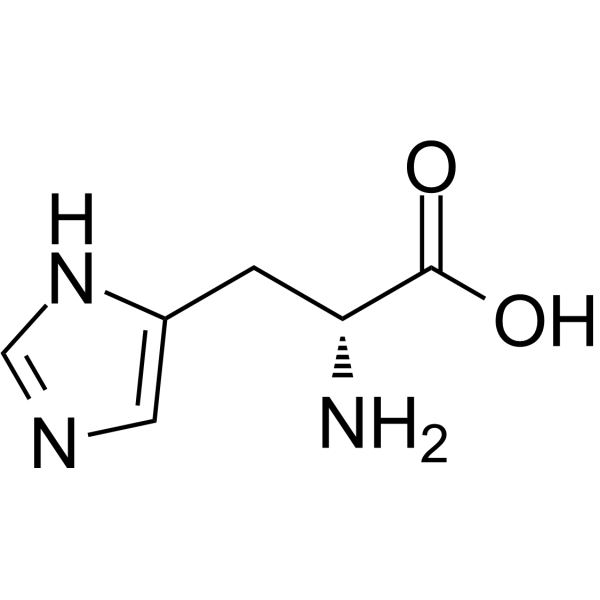
D-Histidine is an anti-biofilm agent that targets bacterial quorum sensing systems (such as RhlI/RhlR pathway) and has antibacterial activity. D-Histidine works by non-covalently binding to bacterial regulatory factors or copper ion complexes, selectively inhibiting bacterial biofilm formation and motility. D-Histidine downregulates quorum sensing-related gene expression, reduces the synthesis of virulence factors (such as alginate and proteases), and interferes with bacterial membrane stability, inhibiting biofilm formation, promoting the disintegration of mature biofilms, and enhancing antibiotic sensitivity. D-Histidine is also an efficient catalyst for the salt-induced peptide formation (SIPF) reaction, which promotes the condensation of amino acids to form dipeptides (such as dialanine and dilysine) by forming a complex with copper ions (Cu 2+) .
loading...
    loading...
Cat. No.: HY-135652
CAS No.: 1087-26-9
Purity:  99.75%
Synonyms: Hexyl 3,4,5-trihydroxybenzoate
Target:  

Bacterial Parasite

Research Areas:  

Infection

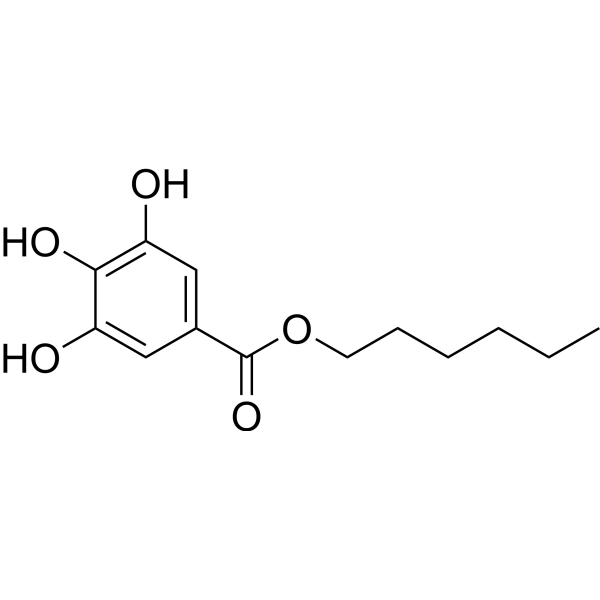
Hexyl gallates (Hexyl 3,4,5-trihydroxybenzoate) shows antibacterial activity and inhibits the production of rhamnolipid and pyocyanin by inhibiting RhlR . Hexyl gallate, a alkyl ester derivative of gallic acid, exhibits potent antimalarial activity against Plasmodium falciparum, with IC50 of 0.11 mM .
loading...
    loading...
Cat. No.: HY-W012572A
CAS No.: 328526-86-9
D-Histidine hydrochloride hydrate is an anti-biofilm agent that targets bacterial quorum sensing systems (such as RhlI/RhlR pathway) and has antibacterial activity. D-Histidine hydrochloride hydrate works by non-covalently binding to bacterial regulatory factors or copper ion complexes, selectively inhibiting bacterial biofilm formation and motility. D-Histidine hydrochloride hydrate downregulates quorum sensing-related gene expression, reduces the synthesis of virulence factors (such as alginate and proteases), and interferes with bacterial membrane stability, inhibiting biofilm formation, promoting the disintegration of mature biofilms, and enhancing antibiotic sensitivity. D-Histidine hydrochloride hydrate is also an efficient catalyst for the salt-induced peptide formation (SIPF) reaction, which promotes the condensation of amino acids to form dipeptides (such as dialanine and dilysine) by forming a complex with copper ions (Cu 2+) .
loading...
    loading...
Cat. No.: HY-131337
CAS No.: 2614320-29-3
Target:  

Bacterial

Research Areas:  

Infection

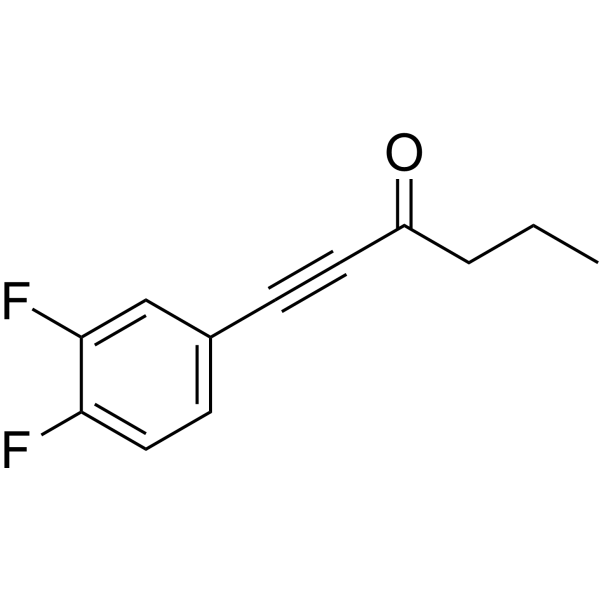
RhlR antagonist 1 is a potent RhlR antagonist with an IC50 of 26 μM. RhlR antagonist 1 displays selective RhlR antagonism over LasR and PqsR, strong inhibition of biofilm formation in static and dynamic settings, and reduces production of virulence factors such as rhamnolipid and pyocyanin in P. aeruginosa. RhlR antagonist 1 can be utilized for developing QS-modulating molecules in the control of P. aeruginosa infections . RhlR antagonist 1 is a click chemistry reagent, it contains an Alkyne group and can undergo copper-catalyzed azide-alkyne cycloaddition (CuAAc) with molecules containing Azide groups.
loading...
    loading...
Cat. No.: HY-133161
CAS No.: 1061591-41-0
Target:  

Bacterial

Research Areas:  

Infection

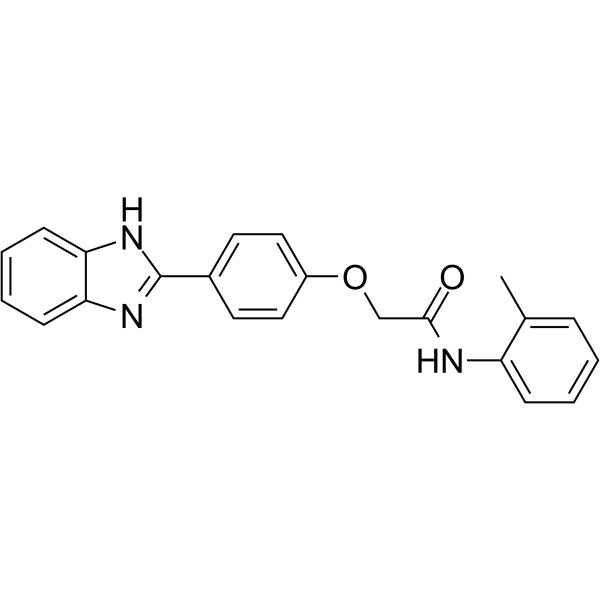
RhlR agonist-1 is a N-acylated L-homoserine lactone and is a selective quorum sensing receptor RhlR agonist. RhlR agonist-1 can be used for the research of bacterial infections .
loading...
    loading...
Cat. No.: HY-158193
CAS No.: 540796-75-6
Synonyms: C10-CPA
Target:  

Bacterial

Research Areas:  

Infection

N-Decanoyl cyclopentylamide (C10-CPA) is a potent inhibitor of quorum sensing in Pseudomonas aeruginosa. N-Decanoyl cyclopentylamide interferes with expression of Pseudomonas aeruginosa virulence factors regulated by the las and rhl quorum-sensing systems. N-Decanoyl cyclopentylamide inhibits production of elastase, pyocyanin, and rhamnolipid and biofilm formation .
loading...
    loading...
Cat. No.: HY-151165
CAS No.: 2810894-92-7
Purity:  99.57%
Target:  

Antibiotic Bacterial

Research Areas:  

Infection

LasR-IN-3 is a LasR inhibitor against Pseudomonas aeruginosa. LasR-IN-3 induces LasR structure instability and completely dissociates LasR functioning dimeric form .
loading...
    loading...
Cat. No.: HY-151165R
CAS No.: 2810894-92-7
Research Areas:  

Infection

Quinizarin (Standard) is the analytical standard of Quinizarin. This product is intended for research and analytical applications. Quinizarin (1,4-Dihydroxyanthraquinone), a part of the anticancer agents such as Doxorubicin, Daunorubicin, and Adriamycin, interacts with DNA by intercalating mode (Kd=86.1 μM). Quinizarin is used as a fungicide and pesticide chemical and has shown the ability to inhibit tumor cell growth .
loading...
    loading...
Cat. No.: HY-W012572R
CAS No.: 351-50-8
D-Histidine (Standard) is the analytical standard of D-Histidine (HY-W012572). This product is intended for research and analytical applications. D-Histidine is an anti-biofilm agent that targets bacterial quorum sensing systems (such as RhlI/RhlR pathway) and has antibacterial activity. D-Histidine works by non-covalently binding to bacterial regulatory factors or copper ion complexes, selectively inhibiting bacterial biofilm formation and motility. D-Histidine downregulates quorum sensing-related gene expression, reduces the synthesis of virulence factors (such as alginate and proteases), and interferes with bacterial membrane stability, inhibiting biofilm formation, promoting the disintegration of mature biofilms, and enhancing antibiotic sensitivity. D-Histidine is also an efficient catalyst for the salt-induced peptide formation (SIPF) reaction, which promotes the condensation of amino acids to form dipeptides (such as dialanine and dilysine) by forming a complex with copper ions (Cu 2+) .
loading...
    loading...

