4 Results for "

rough endoplasmic reticulum

" in MedChemExpress (MCE) Product Catalog:
Products (4)

4 Results for "rough endoplasmic reticulum" in MCE Product Catalog:

Cat. No.: HY-112749
CAS No.: 1374524-68-1
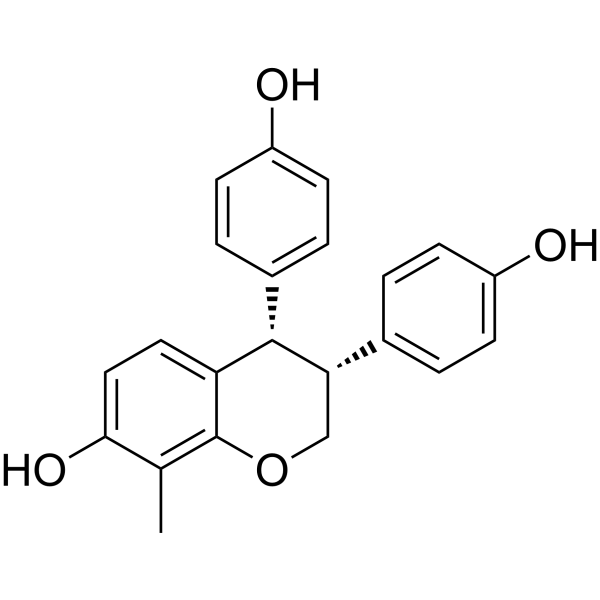
ME-344 is an Isoflavone. ME-344 increases mitochondrial ROS generation. ME-344 inhibits tubulin polymerization. ME-344 inhibits HO-1 and impacts its mitochondrial translocation. ME-344 induces Apoptosis through Caspase 3 activation. ME-344 synergizes with Vinblastine in leukemia cells. ME-344 displays anti-tumor activity against leukemia and lung tumor. ME-344 can be used in the research of lung cancer, acute myeloid leukemia, and HER2-negative breast cancer .
loading...
    loading...
Cat. No.: HY-111182
CAS No.: 901-93-9
Synonyms: Hogival; Oestrone-3-acetate; Puboestrene
Target:  

Estrogen Receptor/ERR

Research Areas:  

Endocrinology

Estrone acetate (Hogival) is an estrogen derivative and an estrogen receptor (ER) activator. It promotes mammary gland development, stimulates pituitary prolactin secretion, and induces the proliferation and activation of lactotrophs (e.g., by reducing prolactin storage granule size while increasing rough endoplasmic reticulum and Golgi apparatus volume density). Estrone acetate holds potential for endocrine research, particularly in studying estrogen's effects on pituitary function, prolactin regulation, and mammary tumor models .
loading...
    loading...
Cat. No.: HY-112749B
CAS No.: 1374524-84-1
(3S,4R)-ME-344 is the (3S,4R)-enantiomer of ME-344 (HY-112749). ME-344 is a mitochondrial Heme oxygenase 1 (HO-1) inhibitor. ME-344 specifically binds and alters HO-1 structure, and increases HO-1 translocation from the rough endoplasmic reticulum to mitochondria, but only in drug-sensitive cells (such as H460 and SHP-77 cells). ME-344 decreases mitochondrial ATP production and induces ROS, with subsequent disruption of redox homeostasis and mitochondrial function. ME-344 has significant antitumor activity, and can be used for cancers like breast cancer research .
loading...
    loading...
Cat. No.: HY-DY2027
Target:  

Fluorescent Dye

Research Areas:  

Others

Nissl Staining Solution (Thionin Method) is a neural tissue staining solution with thionin as the core component, which stains Nissl bodies purplish blue and nuclear chromatin blue. Nissl Staining Solution (Thionin Method) relies on positively charged thionin molecules to specifically bind to the negatively charged nucleic acid components in the rough endoplasmic reticulum inside Nissl bodies, and achieves differential staining by regulating pH through a buffer system. Nissl Staining Solution (Thionin Method) has pH-dependent staining selectivity; it exhibits the highest staining specificity for neuronal Nissl bodies under pH 3.65 conditions, and can efficiently label glial processes under pH 4.6 conditions .
loading...
    loading...

