



CCG215022
Based on 5 publication(s) in Google Scholar
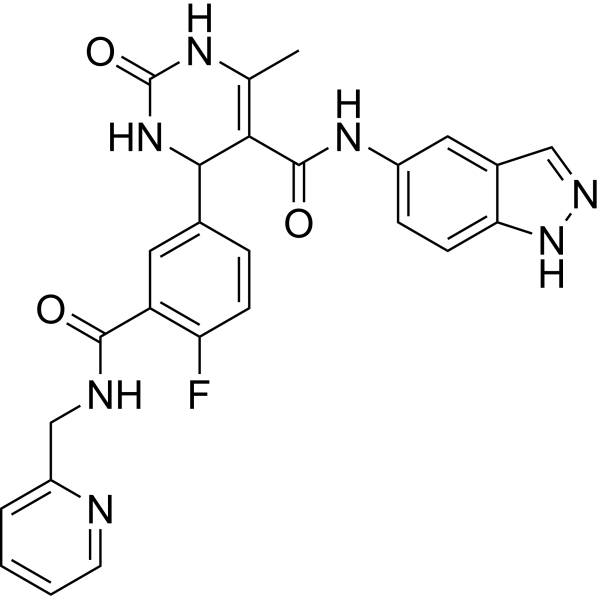
CCG215022 is a G protein-coupled receptor kinases (GRKs) inhibitor with IC50s of 0.15±0.07 μM, 0.38±0.06 μM and 3.9±1 μM for GRK2, GRK5 and GRK1, respectively.
For research use only. We do not sell to patients.
- Purity: 99.79%
- CAS No.: 1813527-81-9
- Formula: C26H22FN7O3
- Molecular Weight:499.50
-
Storage:Powder -20°C, 3 years , 4°C, 2 years ; In solvent -80°C, 2 years , -20°C, 1 year

To place orders, for customer services and technical support, please contact: MedChemExpress USA
Tel: 609-228-6898 E-mail: [email protected] [email protected]


-
 Biological Activity
-
Chemical Information
-
Solvent & Solubility
- Protocol
- Purity & Documentation
- References
-
 Help & FAQs
-

GPCR/G Protein Compound Library
HY-L006
-
Kinase Inhibitor Library
HY-L009
-
Stem Cell Signaling Compound Library
HY-L017
-
TGF-beta/Smad Compound Library
HY-L018
-
Anti-Cancer Compound Library
HY-L025
-
Anti-Aging Compound Library
HY-L034
-
Anti-Prostate Cancer Compound Library
HY-L124
-
Heterocyclic Compound Library
HY-L138
-
Pain-Related Compound Library
HY-L139
-
Antihypertensive Compound Library
HY-L145
-
Membrane Protein-targeted Compound Library
HY-L149
-
Serine/Threonine Kinase Inhibitor Library
HY-L164
-
Multi-Target Compound Library
HY-L176
-
Bioactive Compound Library Max
HY-L181
-
MCE Bioactive Compound Library
HY-L001V
-
Bioactive Compound Library
HY-L001
-
Protein Kinase Compound Library
HY-L196
-
High-Throughput Bioactive Compound Library
HY-L205
-
Posttranslational Modification Library
HY-L226
-
Lactylation Compound Library
HY-L249


Publications Citing Use of MedChemExpress (MCE) CCG215022
More Customer Validation & Images

-
WB


Biological Activity
|
GRK2 |
|
Cell Line

|
Type | Value | Description | References |
|---|---|---|---|---|
| BTI-TN-5B1-4 | IC50 |
0.15 μM
Compound: 12h
|
Inhibition of full length C-terminal hexahistidine tagged GRK2 (unknown origin) S670A mutant expressed in High Five cells using Bac to Bac insect cell expression system using tubulin as substrate by SDS-PAGE method
Inhibition of full length C-terminal hexahistidine tagged GRK2 (unknown origin) S670A mutant expressed in High Five cells using Bac to Bac insect cell expression system using tubulin as substrate by SDS-PAGE method
|
[PMID: 27050625] |
CCG215022 has nanomolar potency against both GRK2 and GRK5 and is at least 20-fold more potent than Paroxetine. In the course of a GRK2 structure-based drug design campaign, CCG215022 exhibits nanomolar IC50 values against both GRK2 and GRK5 and good selectivity against other closely related kinases such as GRK1 and PKA. Treatment of murine cardiomyocytes with CCG215022 results in significantly increases contractility at 20-fold lower concentrations than Paroxetine, an inhibitor with more modest selectivity for GRK2[1].
MedChemExpress (MCE) has not independently confirmed the accuracy of these methods. They are for reference only.


Chemical Information
-
CAS No. 1813527-81-9
-
Appearance Solid
-
Molecular Weight 499.50
-
Formula C26H22FN7O3
-
Color White to gray
-
SMILES
CC(N1)=C(C(NC2=CC=C(NN=C3)C3=C2)=O)C(C4=CC(C(NCC5=CC=CC=N5)=O)=C(F)C=C4)NC1=O
-
Shipping
Room temperature in continental US; may vary elsewhere.
-
Storage
Powder -20°C 3 years 4°C 2 years In solvent -80°C 2 years -20°C 1 year


Publications (5)
-
Journal Impact Factor
-
Most Recent
-
Nat Metab
2023 Mar;5(3):481-494. PMID: 36879120 -
Am J Hum Genet
A Platelet Function Modulator of Thrombin Activation Is Causally Linked to Cardiovascular Disease and Affects PAR4 Receptor Signaling. [Abstract]2020 Aug 6;107(2):211-221. PMID: 32649856 -
Commun Biol
Combinatorial allosteric modulation of agonist response in a self-interacting G-protein coupled receptor. [Abstract]2020 Jan 15;3(1):27. PMID: 31941999
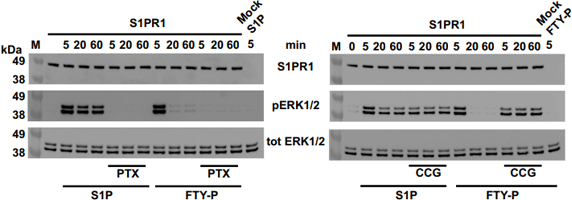
CCG215022 purchased from MedChemExpress. Usage Cited in: Commun Biol. 2020 Jan 15;3(1):27. [Abstract]
HEK293 cells expressing S1PR1 are S1P-starved for 24 h, with or without 300 ng/mL pertussis toxin (PTX) for 18 h and with 0.1% DMSO alone or with 50 µM CCG215022 (CCG) for 30 min prior of being stimulated with 0.1 µM S1P or FTY720-P for the indicated times. Protein extracts from cells treated for the indicated times are assayed by immunoblot for S1PR1, ERK1/2 and pERK1/2.
-
Mol Neurobiol
Microcystin-LR Exposure Damages Neurons by Inducing α-Syn Aggregation via MAPK4/GATA2/SNCA and PP2A/GRKs Pathways. [Abstract]2025 May;62(5):6195-6211. PMID: 39738876 -


Solvent & Solubility
DMSO : ≥ 28 mg/mL (56.06 mM; Hygroscopic DMSO has a significant impact on the solubility of product, please use newly opened DMSO)
* "≥" means soluble, but saturation unknown.
Please refer to the solubility information to select the appropriate solvent. Once prepared, please aliquot and store the solution to prevent product inactivation from repeated freeze-thaw cycles.
Storage method and period of stock solution: -80°C, 2 years; -20°C, 1 year. When stored at -80°C, please use it within 2 years. When stored at -20°C, please use it within 1 year.
Please refer to the solubility information to select the appropriate solvent. Once prepared, please aliquot and store the solution to prevent product inactivation from repeated freeze-thaw cycles.
Storage method and period of stock solution: -80°C, 2 years; -20°C, 1 year. When stored at -80°C, please use it within 2 years. When stored at -20°C, please use it within 1 year.
Concentration (start) × Volume (start) = Concentration (final) × Volume (final)
Select the appropriate dissolution method based on your experimental animal and administration route.
- For the following dissolution methods, please ensure to first prepare a clear stock solution using an In Vitro approach and then sequentially add co-solvents:
- To ensure reliable experimental results, the clarified stock solution can be appropriately stored based on storage conditions. As for the working solution for In Vivo experiments, it is recommended to prepare freshly and use it on the same day.
- The percentages shown for the solvents indicate their volumetric ratio in the final prepared solution. If precipitation or phase separation occurs during preparation, heat and/or sonication can be used to aid dissolution.
Add each solvent one by one: 10% DMSO 40% PEG300 5% Tween-80 45% Saline
Solubility: ≥ 2.5 mg/mL (5.01 mM); Clear solution
This protocol yields a clear solution of ≥ 2.5 mg/mL (saturation unknown).
Taking 1 mL working solution as an example, add 100 μL DMSO stock solution (25.0 mg/mL) to 400 μL PEG300, and mix evenly; then add 50 μL Tween-80 and mix evenly; then add 450 μL Saline to adjust the volume to 1 mL.
Preparation of Saline: Dissolve 0.9 g sodium chloride in ddH₂O and dilute to 100 mL to obtain a clear Saline solution.
Add each solvent one by one: 10% DMSO 90% (20% SBE-β-CD in Saline)
Solubility: 2.5 mg/mL (5.01 mM); Suspended solution; Need ultrasonic
This protocol yields a suspended solution of 2.5 mg/mL. Suspended solution can be used for oral and intraperitoneal injection.
Taking 1 mL working solution as an example, add 100 μL DMSO stock solution (25.0 mg/mL) to 900 μL 20% SBE-β-CD in Saline, and mix evenly.
Preparation of 20% SBE-β-CD in Saline (4°C, storage for one week): 2 g SBE-β-CD powder is dissolved in 10 mL Saline, completely dissolve until clear.
Please enter the basic information of animal experiments:
-
-
-
-
Recommended: Prepare an additional quantity of animals to account for potential losses during experiments.
Please enter your animal formula composition:
-
%DMSO +
Recommended: Keep the proportion of DMSO in working solution below 2% if your animal is weak.
-
%+
-
+%Tween-80 + +
-
%Saline +
The co-solvents required include: DMSO, . All of co-solvents are available by MedChemExpress (MCE). , Tween 80. All of co-solvents are available by MedChemExpress (MCE).
Working solution concentration: 0.22 mg/mL
Method for preparing stock solution: mg drug dissolved in μL DMSO. Stock solution concentration: mg/mL.
1. Take μL DMSO stock solution;
2. Add μL .
μL , mix evenly;
3. Then add μL Tween 80, mix evenly;
4. Then add μL
Please ensure that the stock solution in the first step is dissolved to a clear state, and add co-solvents in sequence. You can use ultrasonic heating (ultrasonic cleaner, recommended frequency 20-40 kHz), vortexing, etc. to assist dissolution.

Protocol
GRK5 and urea-washed bovine rod outer segments (ROS) are mixed in the dark in buffer containing 20 mM HEPES, pH 7.5, 4 mM MgCl2, and 2 mM EDTA and incubated for 35 min at room temperature. The reaction mixtures are exposed to ambient fluorescent light for 1 min prior to initiation of the reaction by addition of ATP (with [γ-32P]ATP) to a final concentration of 1 mM. Final concentration of GRK5 is 100 nM and ROS is between 0.75 and 24 μM. Reactions are initiated at room temperature, and samples are taken at 2-5 min and then quenched with SDS-PAGE loading dye. Proteins are separated using SDS-PAGE, gel is dried, and the incorporation of γ-32P is detected using a phosphor storage screen. Rates at 0 min are plotted against the ROS concentration, and Vmax and Kmvalues are determined using the Michaelis-Menten equation. Vmax of each curve is normalized to the Vmax of GRK5561 run in parallel. Melting point determinations in response to 200 μM CCG215022 are performed in 20 mM HEPES, pH 7.0, 5 mM MgCl2, 2 mM DTT, 1 mM CHAPS at a final GRK5 concentration of 0.2 mg/mL and 100 μM anilinonaphthalene-8-sulfonic acid using a ThermoFluor plate reader. Melting points of GRK5 variants are assayed in a buffer containing 20 mM HEPES, pH 8.0, 200 mM NaCl, 2 mM DTT, 2.5 mM MgCl2, and 0.1 mM anilinonaphthalene-8-sulfonic acid with or without 5 mM ATP. Final GRK5 concentration for these assays is 0.1 mg/mL[1].
MedChemExpress (MCE) has not independently confirmed the accuracy of these methods. They are for reference only.


Purity & Documentation
-
Data Sheet (280 KB)
-
SDS (393 KB)
- English - EN (393 KB)
- Français - FR (393 KB)
- Deutsch - DE (393 KB)
- Norwegian - NO (393 KB)
- Español - ES (393 KB)
- Swedish - SV (393 KB)
- Italian - IT (393 KB)
- Korean - KR (393 KB)
- Portuguese - PT (393 KB)
-
Handling Instructions (2659 KB)
References


Complete Stock Solution Preparation Table
Please refer to the solubility information to select the appropriate solvent. Once prepared, please aliquot and store the solution to prevent product inactivation from repeated freeze-thaw cycles.
Storage method and period of stock solution: -80°C, 2 years; -20°C, 1 year. When stored at -80°C, please use it within 2 years. When stored at -20°C, please use it within 1 year.
| Optional Solvent | Concentration Solvent Mass | 1 mg | 5 mg | 10 mg | 25 mg |
|---|---|---|---|---|---|
| DMSO | 1 mM | 2.0020 mL | 10.0100 mL | 20.0200 mL | 50.0501 mL |
| 5 mM | 0.4004 mL | 2.0020 mL | 4.0040 mL | 10.0100 mL | |
| 10 mM | 0.2002 mL | 1.0010 mL | 2.0020 mL | 5.0050 mL | |
| 15 mM | 0.1335 mL | 0.6673 mL | 1.3347 mL | 3.3367 mL | |
| 20 mM | 0.1001 mL | 0.5005 mL | 1.0010 mL | 2.5025 mL | |
| 25 mM | 0.0801 mL | 0.4004 mL | 0.8008 mL | 2.0020 mL | |
| 30 mM | 0.0667 mL | 0.3337 mL | 0.6673 mL | 1.6683 mL | |
| 40 mM | 0.0501 mL | 0.2503 mL | 0.5005 mL | 1.2513 mL | |
| 50 mM | 0.0400 mL | 0.2002 mL | 0.4004 mL | 1.0010 mL |


CCG215022 Related Classifications
HY-18991 Related Classifications
 Powered by Bioz