



Amdiglurax

Based on 1 Customer Validation
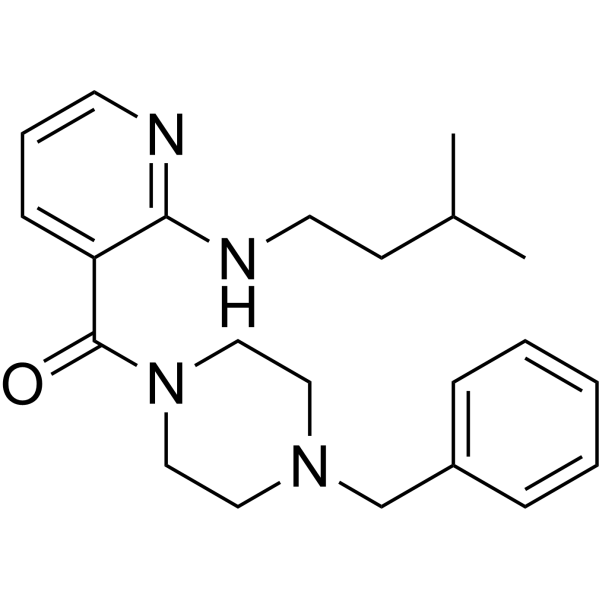
Amdiglurax (NSI-189) is an orally active chemical entity with enhanced neurogenic activity. Amdiglurax up-regulates neurogenic factors such as BDNF (brain derived-neurotrophic factor) and SCF. Amdiglurax exhibits anti-depressant effect. Amdiglurax enhances synaptic plasticity and reduces cognitive dysfunction. Amdiglurax holds potential for psychiatric disorder research.
For research use only. We do not sell to patients.
- Purity: 99.53%
- CAS No.: 1270138-40-3
- Formula: C22H30N4O
- Molecular Weight:366.50
-
Storage:Powder -20°C, 3 years , 4°C, 2 years ; In solvent -80°C, 6 months , -20°C, 1 month

To place orders, for customer services and technical support, please contact: MedChemExpress USA
Tel: 609-228-6898 E-mail: [email protected] [email protected]


-
 Biological Activity
-
Chemical Information
-
Solvent & Solubility
- Purity & Documentation
- References
-
 Help & FAQs




Biological Activity
Amdiglurax (NSI-189) enhances cell proliferation and neurogenesis in primary rat neurons (hippocampus) cells[2].
Amdiglurax significantly attenuates OGD (oxygen glucose deprivation) -mediated hippocampal cell death and increases Ki67 and MAP2 expression[2].
Amdiglurax up-regulates VEGF, GDNF, BDNF, SCF, BDNF and SCF levels in the hippocampal cells[2].
Amdiglurax (1.0-3.0 μM, 24 h) augments neurite outgrowth and mitochondrial function in adult rat DRG (Dorsal root ganglia) sensory neurons[3].
MedChemExpress (MCE) has not independently confirmed the accuracy of these methods. They are for reference only.
-
Cell Line:adult rat DRG sensory neurons cells
-
Concentration:1.0-3.0 μM
-
Incubation Time:24 h
-
Result:Significantly increased 24 h total neurite outgrowth in neurons from normal or diabetic rats.
Amdiglurax (10 mg/kg, p.o., daily, 16 weeks) prevents PNS (peripheral nervous system) and CNS (central nervous system) neuropathy in type 1 diabetic mice[3].
Amdiglurax (30 mg/kg, p.o., daily, 26 weeks) prevents peripheral neuropathy and ameliorates CNS and PNS neuropathy indb/db mice[3].
MedChemExpress (MCE) has not independently confirmed the accuracy of these methods. They are for reference only.
-
Animal Model:Adult Sprague-Dawley, male rats, 250 g, received experimental stroke surgery using the middle cerebral artery occlusion (MCAo) model[2].
-
Dosage:30 mg/kg
-
Administration:p.o., at 6 h after stroke, daily, 12 weeks
-
Result:Promoted robust behavioral effects at acute stage, which remained stable over chronic period.
Stroke animals displayed significant amelioration of stroke-induced motor and neurological deficits.
-
Animal Model:Adult female Swiss Webster mice, adult male C57/BLKS/J and C57BLKSjBKS.Cg-Dock7m+/+ Leprdb/J (also called db/db) mice and adult male Sprague-Dawley rats. Type 1 diabetes was induced by injection of STZ (streptozotocin) (HY-13753) (90 mg/kg). Type 2 diabetes was modeled using db/db mice[3].
-
Dosage:10 mg/kg (Female STZ-diabetic), 30 mg/kg (db/db mice, male control)
-
Administration:p.o., daily, 16 weeks (Female STZ-diabetic), 26 weeks (db/db mice, male control)
-
Result:Significantly protected long-term memory and attenuated reductions in the volume of the CA1 and DG regions in type 1 diabetic mice.
Significantly prevented or attenuated all deficits, such as paw tactile allodynia, paw heat hypoalgesia, reduced paw intraepidermal nerve fiber (IENF) density, and reduced corneal nerve density in the subbasal nerve plexus in type 1 diabetic mice.
Accelerated decline in nonfasted blood glucose of db/db mice in the terminal stages of the study.
Prevented loss of CA1 volume and increased BrdU-positive cell number in db/db mice.
Promoted a significant increase in corneal nerve density in the type2 diabetic mice.


Chemical Information
-
CAS No. 1270138-40-3
-
Appearance Solid
-
Molecular Weight 366.50
-
Formula C22H30N4O
-
Color White to yellow
-
SMILES
O=C(N1CCN(CC2=CC=CC=C2)CC1)C3=CC=CN=C3NCCC(C)C
-
Synonyms
NSI-189
-
Shipping
Room temperature in continental US; may vary elsewhere.
-
Storage
Powder -20°C 3 years 4°C 2 years In solvent -80°C 6 months -20°C 1 month


Solvent & Solubility
DMSO : 110 mg/mL (300.14 mM; Need ultrasonic; Hygroscopic DMSO has a significant impact on the solubility of product, please use newly opened DMSO)
Please refer to the solubility information to select the appropriate solvent. Once prepared, please aliquot and store the solution to prevent product inactivation from repeated freeze-thaw cycles.
Storage method and period of stock solution: -80°C, 6 months; -20°C, 1 month. When stored at -80°C, please use it within 6 months. When stored at -20°C, please use it within 1 month.
Please refer to the solubility information to select the appropriate solvent. Once prepared, please aliquot and store the solution to prevent product inactivation from repeated freeze-thaw cycles.
Storage method and period of stock solution: -80°C, 6 months; -20°C, 1 month. When stored at -80°C, please use it within 6 months. When stored at -20°C, please use it within 1 month.
Concentration (start) × Volume (start) = Concentration (final) × Volume (final)
Select the appropriate dissolution method based on your experimental animal and administration route.
- For the following dissolution methods, please ensure to first prepare a clear stock solution using an In Vitro approach and then sequentially add co-solvents:
- To ensure reliable experimental results, the clarified stock solution can be appropriately stored based on storage conditions. As for the working solution for In Vivo experiments, it is recommended to prepare freshly and use it on the same day.
- The percentages shown for the solvents indicate their volumetric ratio in the final prepared solution. If precipitation or phase separation occurs during preparation, heat and/or sonication can be used to aid dissolution.
Add each solvent one by one: 10% DMSO 40% PEG300 5% Tween-80 45% Saline
Solubility: 2.75 mg/mL (7.50 mM); Suspended solution; Need ultrasonic
This protocol yields a suspended solution of 2.75 mg/mL. Suspended solution can be used for oral and intraperitoneal injection.
Taking 1 mL working solution as an example, add 100 μL DMSO stock solution (27.5 mg/mL) to 400 μL PEG300, and mix evenly; then add 50 μL Tween-80 and mix evenly; then add 450 μL Saline to adjust the volume to 1 mL.
Preparation of Saline: Dissolve 0.9 g sodium chloride in ddH₂O and dilute to 100 mL to obtain a clear Saline solution.
Add each solvent one by one: 10% DMSO 90% (20% SBE-β-CD in Saline)
Solubility: ≥ 2.75 mg/mL (7.50 mM); Clear solution
This protocol yields a clear solution of ≥ 2.75 mg/mL (saturation unknown).
Taking 1 mL working solution as an example, add 100 μL DMSO stock solution (27.5 mg/mL) to 900 μL 20% SBE-β-CD in Saline, and mix evenly.
Preparation of 20% SBE-β-CD in Saline (4°C, storage for one week): 2 g SBE-β-CD powder is dissolved in 10 mL Saline, completely dissolve until clear.
Please enter the basic information of animal experiments:
-
-
-
-
Recommended: Prepare an additional quantity of animals to account for potential losses during experiments.
Please enter your animal formula composition:
-
%DMSO +
Recommended: Keep the proportion of DMSO in working solution below 2% if your animal is weak.
-
%+
-
+%Tween-80 + +
-
%Saline +
The co-solvents required include: DMSO, . All of co-solvents are available by MedChemExpress (MCE). , Tween 80. All of co-solvents are available by MedChemExpress (MCE).
Working solution concentration: 0.22 mg/mL
Method for preparing stock solution: mg drug dissolved in μL DMSO. Stock solution concentration: mg/mL.
1. Take μL DMSO stock solution;
2. Add μL .
μL , mix evenly;
3. Then add μL Tween 80, mix evenly;
4. Then add μL
Please ensure that the stock solution in the first step is dissolved to a clear state, and add co-solvents in sequence. You can use ultrasonic heating (ultrasonic cleaner, recommended frequency 20-40 kHz), vortexing, etc. to assist dissolution.


Purity & Documentation
-
Data Sheet (282 KB)
-
SDS (393 KB)
- English - EN (393 KB)
- Français - FR (393 KB)
- Deutsch - DE (393 KB)
- Norwegian - NO (393 KB)
- Español - ES (393 KB)
- Swedish - SV (393 KB)
- Italian - IT (393 KB)
- Korean - KR (393 KB)
- Portuguese - PT (393 KB)
-
Handling Instructions (2659 KB)
References
[1]. McIntyre RS, et al. The neurogenic compound, NSI-189 phosphate: a novel multi-domain treatment capable of pro-cognitive and antidepressant effects. Expert Opin Investig Drugs. 2017 Jun;26(6):767-770. [Content Brief]
[3]. Jolivalt CG, et al. Amelioration of Both Central and Peripheral Neuropathy in Mouse Models of Type 1 and Type 2 Diabetes by the Neurogenic Molecule NSI-189. Diabetes. 2019 Nov;68(11):2143-2154. [Content Brief]


Complete Stock Solution Preparation Table
Please refer to the solubility information to select the appropriate solvent. Once prepared, please aliquot and store the solution to prevent product inactivation from repeated freeze-thaw cycles.
Storage method and period of stock solution: -80°C, 6 months; -20°C, 1 month. When stored at -80°C, please use it within 6 months. When stored at -20°C, please use it within 1 month.
| Optional Solvent | Concentration Solvent Mass | 1 mg | 5 mg | 10 mg | 25 mg |
|---|---|---|---|---|---|
| DMSO | 1 mM | 2.7285 mL | 13.6426 mL | 27.2851 mL | 68.2128 mL |
| 5 mM | 0.5457 mL | 2.7285 mL | 5.4570 mL | 13.6426 mL | |
| 10 mM | 0.2729 mL | 1.3643 mL | 2.7285 mL | 6.8213 mL | |
| 15 mM | 0.1819 mL | 0.9095 mL | 1.8190 mL | 4.5475 mL | |
| 20 mM | 0.1364 mL | 0.6821 mL | 1.3643 mL | 3.4106 mL | |
| 25 mM | 0.1091 mL | 0.5457 mL | 1.0914 mL | 2.7285 mL | |
| 30 mM | 0.0910 mL | 0.4548 mL | 0.9095 mL | 2.2738 mL | |
| 40 mM | 0.0682 mL | 0.3411 mL | 0.6821 mL | 1.7053 mL | |
| 50 mM | 0.0546 mL | 0.2729 mL | 0.5457 mL | 1.3643 mL | |
| 60 mM | 0.0455 mL | 0.2274 mL | 0.4548 mL | 1.1369 mL | |
| 80 mM | 0.0341 mL | 0.1705 mL | 0.3411 mL | 0.8527 mL | |
| 100 mM | 0.0273 mL | 0.1364 mL | 0.2729 mL | 0.6821 mL |


Amdiglurax Related Classifications
HY-13999 Related Classifications
 Powered by Bioz