



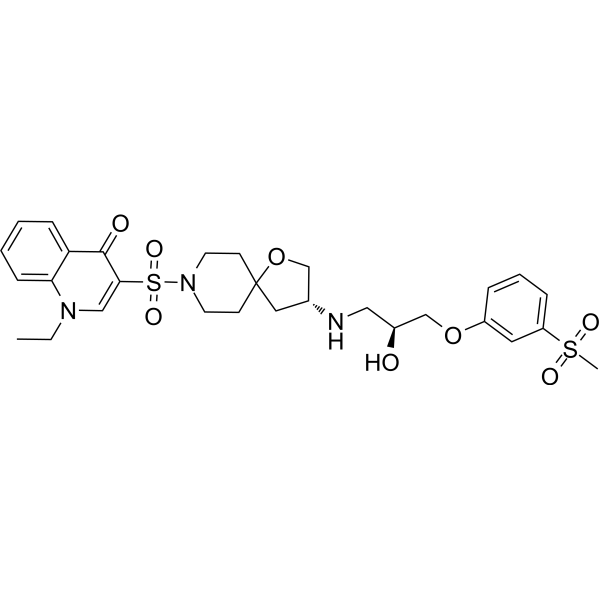
Vemtoberant

Based on 1 Customer Validation
Vemtoberant is a β3-adrenergic receptor inhibitor with a human Ki of 8.2 nM, and exhibits 400- to 600-fold selectivity over human β1-AR and β2-AR. Vemtoberant attenuates β3-AR-mediated cardiac inhibition. Vemtoberant can be used for the research of systolic heart failure.
For research use only. We do not sell to patients.
- Purity : 98.03%
- CAS No.: 2169905-68-2
- Formula: C29H37N3O8S2
- Molecular Weight:619.75
-
Storage:Powder -20°C, 3 years , 4°C, 2 years ; In solvent -80°C, 6 months , -20°C, 1 month

To place orders, for customer services and technical support, please contact: MedChemExpress USA
Tel: 609-228-6898 E-mail: [email protected] [email protected]


-
 Biological Activity
-
Chemical Information
-
Solvent & Solubility
- Protocols
- Purity & Documentation
- References
-
 Help & FAQs


All Adrenergic Receptor Isoforms
More

Biological Activity
Description
In Vivo
MedChemExpress (MCE) has not independently confirmed the accuracy of these methods. They are for reference only.
-
Animal Model:Mongrel dogs (healthy conditioned, weighing 19.9-30.6 kg, systolic heart failure model via serial intracoronary microembolizations)[1]
-
Dosage:0.35 mg/kg/h; 0.70 mg/kg/h (total 4.224 mg/kg); 1.4 mg/kg/h; 2.8 mg/kg/h; 5.6 mg/kg/h; 10.0 mg/kg/h; 15.0 mg/kg/h
-
Administration:i.v.; continuous infusion; 30 minutes; 60 minutes; 6 hours
-
Result:Increased LVEF from 34% to 38%, decreased LV ESV from 41 mL to 38 mL, increased FAS from 34% to 37%, increased Ei/Ai from 3.1 to 3.6 at 1.4 mg/kg/h.
Increased LVEF to 41%, decreased LV ESV to 36 mL, increased FAS to 41%, increased Ei/Ai to 4.3, increased CO to 2.14L/min, decreased LVEDP to 12 mm Hg at 5.6 mg/kg/h.
Caused modest significant decreases in SVR and increases in DCT at 0.35 mg/kg/h .
Increased LVEF from 32% to 38%, decreased LV ESV from 35 mL to 32 mL, increased FAS from 33% to 38%, increased CO from 1.36 L/min to 1.62 L/min, increased Ei/Ai from 3.5 to 4.7, decreased Tn-I from 0.36 ng/mL to 0.18 ng/mL, decreased SVR to 3292 dynes-s-cm-5, increased DCT to 1597 msec, decreased mAoP to 66 mm Hg at 5.6 mg/kg/h.


Chemical Information
-
CAS No. 2169905-68-2
-
Appearance Solid
-
Molecular Weight 619.75
-
Formula C29H37N3O8S2
-
Color Off-white to light yellow
-
SMILES
CS(C1=CC=CC(OC[C@@H](O)CN[C@@H]2CC3(OC2)CCN(CC3)S(=O)(C4=CN(CC)C5=CC=CC=C5C4=O)=O)=C1)(=O)=O
-
Synonyms
APD418
-
Shipping
Room temperature in continental US; may vary elsewhere.
-
Storage
Powder -20°C 3 years 4°C 2 years In solvent -80°C 6 months -20°C 1 month


Solvent & Solubility
In Vitro:
DMSO : 250 mg/mL (403.39 mM; Need ultrasonic; Hygroscopic DMSO has a significant impact on the solubility of product, please use newly opened DMSO)
Please refer to the solubility information to select the appropriate solvent. Once prepared, please aliquot and store the solution to prevent product inactivation from repeated freeze-thaw cycles.
Storage method and period of stock solution: -80°C, 6 months; -20°C, 1 month. When stored at -80°C, please use it within 6 months. When stored at -20°C, please use it within 1 month.
Please refer to the solubility information to select the appropriate solvent. Once prepared, please aliquot and store the solution to prevent product inactivation from repeated freeze-thaw cycles.
Storage method and period of stock solution: -80°C, 6 months; -20°C, 1 month. When stored at -80°C, please use it within 6 months. When stored at -20°C, please use it within 1 month.
Concentration (start) × Volume (start) = Concentration (final) × Volume (final)


Purity & Documentation
-
Data Sheet (273 KB)
-
SDS (254 KB)
- English - EN (254 KB)
- Français - FR (254 KB)
- Deutsch - DE (254 KB)
- Norwegian - NO (254 KB)
- Español - ES (254 KB)
- Swedish - SV (254 KB)
- Italian - IT (254 KB)
- Korean - KR (254 KB)
- Portuguese - PT (254 KB)
-
Handling Instructions (2659 KB)
References


Complete Stock Solution Preparation Table
Please refer to the solubility information to select the appropriate solvent. Once prepared, please aliquot and store the solution to prevent product inactivation from repeated freeze-thaw cycles.
Storage method and period of stock solution: -80°C, 6 months; -20°C, 1 month. When stored at -80°C, please use it within 6 months. When stored at -20°C, please use it within 1 month.
| Optional Solvent | Concentration Solvent Mass | 1 mg | 5 mg | 10 mg | 25 mg |
|---|---|---|---|---|---|
| DMSO | 1 mM | 1.6136 mL | 8.0678 mL | 16.1355 mL | 40.3388 mL |
| 5 mM | 0.3227 mL | 1.6136 mL | 3.2271 mL | 8.0678 mL | |
| 10 mM | 0.1614 mL | 0.8068 mL | 1.6136 mL | 4.0339 mL | |
| 15 mM | 0.1076 mL | 0.5379 mL | 1.0757 mL | 2.6893 mL | |
| 20 mM | 0.0807 mL | 0.4034 mL | 0.8068 mL | 2.0169 mL | |
| 25 mM | 0.0645 mL | 0.3227 mL | 0.6454 mL | 1.6136 mL | |
| 30 mM | 0.0538 mL | 0.2689 mL | 0.5379 mL | 1.3446 mL | |
| 40 mM | 0.0403 mL | 0.2017 mL | 0.4034 mL | 1.0085 mL | |
| 50 mM | 0.0323 mL | 0.1614 mL | 0.3227 mL | 0.8068 mL | |
| 60 mM | 0.0269 mL | 0.1345 mL | 0.2689 mL | 0.6723 mL | |
| 80 mM | 0.0202 mL | 0.1008 mL | 0.2017 mL | 0.5042 mL | |
| 100 mM | 0.0161 mL | 0.0807 mL | 0.1614 mL | 0.4034 mL |


Vemtoberant Related Classifications
HY-148804 Related Classifications
 Powered by Bioz