



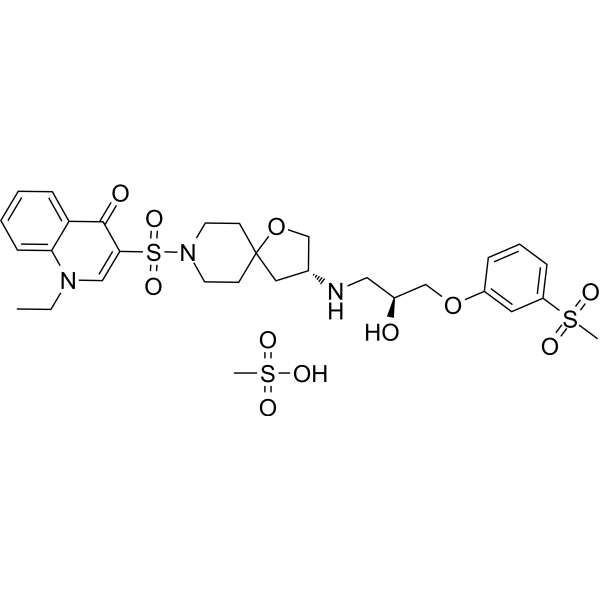
Vemtoberant mesylate
Vemtoberant (APD418) mesylate is a β3-adrenergic receptor (β3-AR) antagonist with a human Ki of 8.2 nM, and exhibits 400- to 600-fold selectivity over human β1-AR and β2-AR. Vemtoberant mesylate attenuates β3-AR-mediated cardiac inhibition. Vemtoberant mesylate can be used for the research of systolic heart failure.
For research use only. We do not sell to patients.
- CAS No.: 2169905-97-7
- Formula: C30H41N3O11S3
- Molecular Weight:715.86
-
Storage:
Please store the product under the recommended conditions in the Certificate of Analysis.

To place orders, for customer services and technical support, please contact: MedChemExpress USA
Tel: 609-228-6898 E-mail: [email protected] [email protected]


-
 Biological Activity
-
Chemical Information
- Protocols
- Purity & Documentation
- References
-
 Help & FAQs


All Adrenergic Receptor Isoforms
More

Biological Activity
Description
In Vivo
MedChemExpress (MCE) has not independently confirmed the accuracy of these methods. They are for reference only.
-
Animal Model:Mongrel dogs (healthy conditioned, weighing 19.9-30.6 kg, systolic heart failure model via serial intracoronary microembolizations)[1]
-
Dosage:0.35 mg/kg/h; 0.70 mg/kg/h; 1.4 mg/kg/h; 2.8 mg/kg/h; 5.6 mg/kg/h; 10.0 mg/kg/h; 15.0 mg/kg/h
-
Administration:i.v.; continuous infusion
-
Result:Increased LVEF from 34% to 38%, decreased LV ESV from 41 mL to 38 mL, increased FAS from 34% to 37%, increased Ei/Ai from 3.1 to 3.6 at 1.4 mg/kg/h.
Increased LVEF to 41%, decreased LV ESV to 36 mL, increased FAS to 41%, increased Ei/Ai to 4.3, increased CO to 2.14L/min, decreased LVEDP to 12 mm Hg at 5.6 mg/kg/h.
Caused modest significant decreases in SVR and increases in DCT at 0.35 mg/kg/h .
Increased LVEF from 32% to 38%, decreased LV ESV from 35 mL to 32 mL, increased FAS from 33% to 38%, increased CO from 1.36 L/min to 1.62 L/min, increased Ei/Ai from 3.5 to 4.7, decreased Tn-I from 0.36 ng/mL to 0.18 ng/mL, decreased SVR to 3292 dynes-s-cm-5, increased DCT to 1597 msec, decreased mAoP to 66 mm Hg at 5.6 mg/kg/h.


Chemical Information
-
CAS No. 2169905-97-7
-
Molecular Weight 715.86
-
Formula C30H41N3O11S3
-
SMILES
CS(C1=CC=CC(OC[C@@H](O)CN[C@@H]2CC3(OC2)CCN(CC3)S(=O)(C4=CN(CC)C5=CC=CC=C5C4=O)=O)=C1)(=O)=O.CS(O)(=O)=O
-
Synonyms
APD418 mesylate
-
Shipping
Room temperature in continental US; may vary elsewhere.
-
Storage
Please store the product under the recommended conditions in the Certificate of Analysis.

Protocols
-
Research Protocol for Cardiovascular Diseases
Cardiovascular disease can be modeled as maladaptive cardiac remodeling, where ischemic injury or pressure overload activates inflammatory signaling, fibroblast activation, extracellular-matrix deposition, cardiomyocyte hypertrophy, vascular remodeling, and progressive ventricular dysfunction. The TGF-β/SMAD axis is a central profibrotic pathway after myocardial injury and pressure overload, while innate immune and cytokine pathways regulate leukocyte recruitment, scar formation, and adverse remodeling. Key unresolved questions include which inflammatory signals are reparative versus harmful, when fibrosis is protective versus maladaptive, and whether pathway inhibition improves function without weakening necessary infarct healing or compensatory remodeling.


Purity & Documentation
References

Calculators
Concentration (start) × Volume (start) = Concentration (final) × Volume (final)


Vemtoberant mesylate Related Classifications
HY-148804A Related Classifications
 Powered by Bioz