



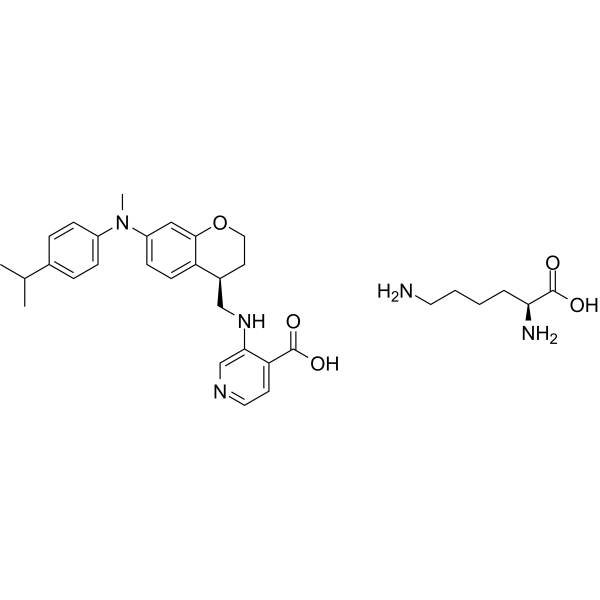
Zavondemstat L-lysine
Zavondemstat (QC8222; TACH 101) L-lysine is an orally active pan-KDM4 inhibitor, with a IC50 ≤ 0.08 μM against human KDM4A-D and a Kᵢ of 0.52 μM against human KDM4C. Zavondemstat L-lysine induces cell apoptosis, causes S-phase cell cycle arrest, reduces the population of tumor-initiating cells and inhibits cancer cell proliferation. Zavondemstat L-lysine suppresses tumor growth and induces tumor regression in mouse xenograft models. Zavondemstat L-lysine can be used for the research of various cancers including colorectal cancer, esophageal squamous cell carcinoma and triple-negative breast cancer.
For research use only. We do not sell to patients.
- CAS No.: 2908753-10-4
- Formula: C32H43N5O5
- Molecular Weight:577.71
-
Storage:
Please store the product under the recommended conditions in the Certificate of Analysis.

To place orders, for customer services and technical support, please contact: MedChemExpress USA
Tel: 609-228-6898 E-mail: [email protected] [email protected]


-
 Biological Activity
-
Chemical Information
- Purity & Documentation
- References
-
 Help & FAQs




Biological Activity
Description
In Vitro
Zavondemstat (24 h) L-lysine potently inhibits H3K36me3 demethylation in KYSE-150+KDM4C cells, with an IC50 value of 0.0004 μM in HTRF assays and 0.085 μM in Western blot assays[1].
Zavondemstat (168 h) L-lysine potently inhibits the proliferation of various cancer cell lines (Jurkat, MDA-MB-231, KYSE-150, MM.1s, HL-60, HT-29, MCF-7, Loucy) with IC50 values ranging from 0.0027 to 0.037 μM, while it exhibits low activity against normal IMR-90 fibroblasts[1].
Zavondemstat (144-168 h) L-lysine inhibits the viability of SU60, T002C, SU62 colon organoids and PA0165F pancreatic organoids, with IC50 values of < 0.15 μM and < 0.03 μM, respectively, but exhibits low activity against FS53 breast organoids and other non-responsive organoid models[1].
Zavondemstat (72 h) L-lysine induces apoptosis in KYSE-150, MDA-MB-231 and HT-29 cells, with EC50 values of 0.033, 0.132 and 0.092 μM, respectively[1].
Zavondemstat (0.01-0.1 μM; 48-72 h) L-lysine induces S-phase cell cycle arrest in MDA-MB-231 cells[1].
MedChemExpress (MCE) has not independently confirmed the accuracy of these methods. They are for reference only.
-
Cell Line:MDA-MB-231 (breast cancer cells)
-
Concentration:0.01, 0.1 μM
-
Incubation Time:48 and 72 h
-
Result:Caused S-phase arrest.
In Vivo
Zavondemstat (12.5-50 mg/kg; p.o.; once daily; for 36 consecutive days) L-lysine induces dose-dependent tumor growth inhibition in the COH70 triple-negative breast cancer PDX model[1].
Zavondemstat (5-50 mg/kg; p.o.; 3 consecutive days of administration followed by 4 days of withdrawal, or 2 consecutive days of administration followed by 5 days of withdrawal) L-lysine induces dose-dependent tumor growth inhibition in the GXA-3036 gastric cancer PDX model[1].
Zavondemstat (10-20 mg/kg; p.o.; once daily; for 21 consecutive days) L-lysine induces dose-dependent tumor growth inhibition in the KYSE-150 esophageal cancer CDX model[1].
Zavondemstat (5-50 mg/kg; p.o.; twice daily, 3 days on/4 days off) L-lysine induces dose-dependent tumor growth inhibition in the OCI-LY19 DLBCL CDX model[1].
Zavondemstat (40 mg/kg; p.o.; once daily for 21 days) L-lysine, administered via oral gavage at a dose of 40 mg/kg once daily for 21 days in the SU60 colorectal cancer PDX model, reduces tumorigenic cell populations and decreases the frequency of tumor-initiating cells[1].
MedChemExpress (MCE) has not independently confirmed the accuracy of these methods. They are for reference only.
-
Animal Model:NSG mice (female)[1]
-
Dosage:10 mg/kg; 20 mg/kg; 10 mg/kg (3 days on/4 days off); 10 mg/kg (5 days on/2 days off)
-
Administration:p.o.; once daily; 7 days; 3 days on/4 days off; 5 days on/2 days off
-
Result:Observed dose-dependent tumor growth inhibition (TGI): achieved 48% TGI at 10 mg/kg daily for 7 days, 71% TGI at 20 mg/kg daily for 7 days, 52% TGI at 10 mg/kg 3 days on/4 days off, and 42% TGI at 10 mg/kg 5 days on/2 days off.
-
Animal Model:NSG mice[1]
-
Dosage:12.5 mg/kg; 25 mg/kg; 40 mg/kg; 50 mg/kg
-
Administration:p.o.; once daily; 36 days
-
Result:Observed dose-dependent tumor growth inhibition (TGI): achieved 57% TGI at 12.5 mg/kg, 68% TGI at 25 mg/kg, 86% TGI at 40 mg/kg, and 86% TGI at 50 mg/kg.
-
Animal Model:NSG mice[1]
-
Dosage:5 mg/kg; 15 mg/kg; 22.5 mg/kg; 50 mg/kg
-
Administration:p.o.; 3 days on/4 days off; 2 days on/5 days off
-
Result:Observed dose-dependent tumor growth inhibition (TGI): achieved 43% TGI at 5 mg/kg, 69% TGI at 15 mg/kg, 52% TGI at 50 mg/kg, and 41% TGI at 22.5 mg/kg
-
Animal Model:NSG mice[1]
-
Dosage:10 mg/kg; 15 mg/kg; 20 mg/kg
-
Administration:p.o.; once daily; 21 days
-
Result:Observed dose-dependent tumor growth inhibition (TGI): achieved 54% TGI at 10 mg/kg, 76% TGI at 15 mg/kg, and 84% TGI at 20 mg/kg.
-
Animal Model:NSG mice[1]
-
Dosage:5 mg/kg; 15 mg/kg; 50 mg/kg; 25 mg/kg (twice daily)
-
Administration:p.o.; 3 days on/4 days off; twice daily (25 mg/kg group)
-
Result:Observed dose-dependent tumor growth inhibition (TGI): achieved 55% TGI at 5 mg/kg, 83% TGI at 15 mg/kg, 90% TGI at 50 mg/kg, and 102% TGI (with three of eight complete remissions) at 25 mg/kg twice daily.
-
Animal Model:NSG mice (female)[1]
-
Dosage:40 mg/kg
-
Administration:p.o.; daily; 21 days
-
Result:Reduced the proportion of tumorigenic CD44HighEpCAM+ cells by 2.5-fold and reduced tumor-initiating cell frequency by 4.4-fold compared to vehicle.


Chemical Information
-
CAS No. 2908753-10-4
-
Molecular Weight 577.71
-
Formula C32H43N5O5
-
SMILES
N[C@@H](CCCCN)C(O)=O.OC(C1=CC=NC=C1NC[C@H]2C3=CC=C(N(C4=CC=C(C=C4)C(C)C)C)C=C3OCC2)=O
-
Synonyms
QC8222; TACH 101
-
Shipping
Room temperature in continental US; may vary elsewhere.
-
Storage
Please store the product under the recommended conditions in the Certificate of Analysis.


Purity & Documentation
References

Calculators
Concentration (start) × Volume (start) = Concentration (final) × Volume (final)


Zavondemstat L-lysine Related Classifications
HY-148807A Related Classifications
 Powered by Bioz