



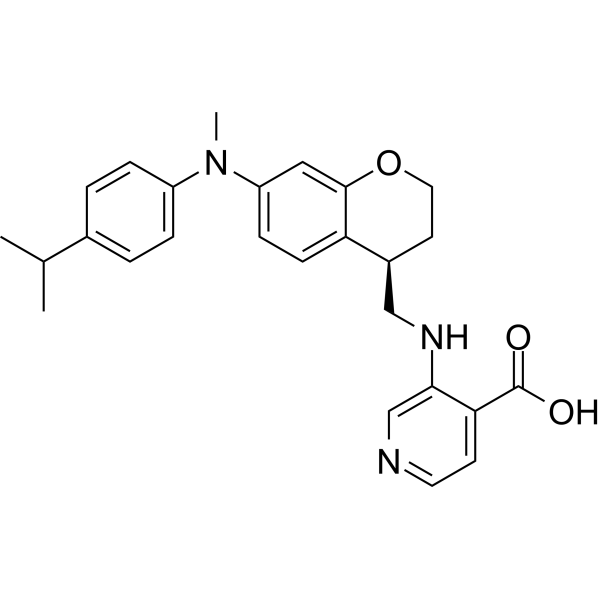
Zavondemstat
Based on 1 publication(s) in Google Scholar
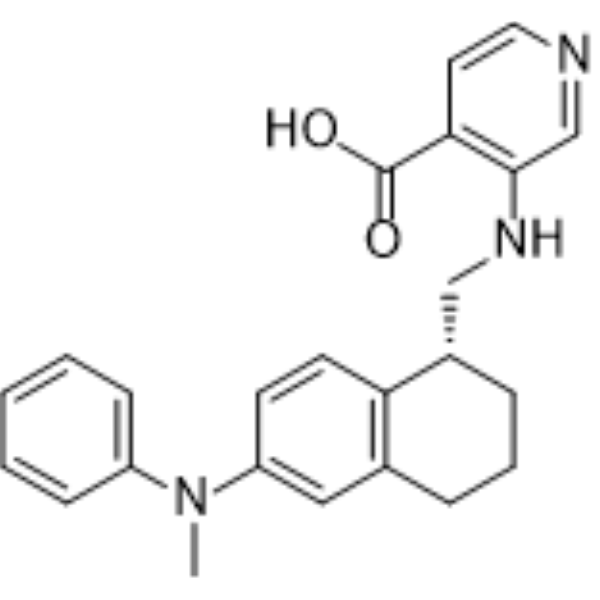
Zavondemstat (QC8222 free base; TACH 101 free base) is an orally active pan-KDM4 inhibitor, with a IC50 ≤ 0.08 μM against human KDM4A-D and a Kᵢ of 0.52 μM against human KDM4C. Zavondemstat induces cell apoptosis, causes S-phase cell cycle arrest, reduces the population of tumor-initiating cells and inhibits cancer cell proliferation. Zavondemstat suppresses tumor growth and induces tumor regression in mouse xenograft models. Zavondemstat can be used for the research of various cancers including colorectal cancer, esophageal squamous cell carcinoma and triple-negative breast cancer.
For research use only. We do not sell to patients.
- Purity : 99.29%
- CAS No.: 1851412-93-5
- Formula: C26H29N3O3
- Molecular Weight:431.53
-
Storage:
4°C, protect from light, stored under nitrogen
* In solvent : -80°C, 6 months; -20°C, 1 month (protect from light, stored under nitrogen)

To place orders, for customer services and technical support, please contact: MedChemExpress USA
Tel: 609-228-6898 E-mail: [email protected] [email protected]


-
 Biological Activity
-
Chemical Information
-
Solvent & Solubility
- Protocols
- Purity & Documentation
- References
-
 Help & FAQs


Publications Citing Use of MedChemExpress (MCE) Zavondemstat
More

Biological Activity
Description
IC50 & Target
[1]|
KDM4A ≤ 0.08 μM (IC50) |
KDM4B ≤ 0.08 μM (IC50) |
KDM4C ≤ 0.08 μM (IC50) |
KDM4D ≤ 0.08 μM (IC50) |
In Vitro
Zavondemstat (24 h) potently inhibits H3K36me3 demethylation in KYSE-150+KDM4C cells, with an IC50 value of 0.0004 μM in HTRF assays and 0.085 μM in Western blot assays[1].
Zavondemstat (168 h) potently inhibits the proliferation of various cancer cell lines (Jurkat, MDA-MB-231, KYSE-150, MM.1s, HL-60, HT-29, MCF-7, Loucy) with IC50 values ranging from 0.0027 to 0.037 μM, while it exhibits low activity against normal IMR-90 fibroblasts[1].
Zavondemstat (144-168 h) inhibits the viability of SU60, T002C, SU62 colon organoids and PA0165F pancreatic organoids, with IC50 values of < 0.15 μM and < 0.03 μM, respectively, but exhibits low activity against FS53 breast organoids and other non-responsive organoid models[1].
Zavondemstat (72 h) induces apoptosis in KYSE-150, MDA-MB-231 and HT-29 cells, with EC50 values of 0.033, 0.132 and 0.092 μM, respectively[1].
Zavondemstat (0.01-0.1 μM; 48-72 h) induces S-phase cell cycle arrest in MDA-MB-231 cells[1].
MedChemExpress (MCE) has not independently confirmed the accuracy of these methods. They are for reference only.
-
Cell Line:MDA-MB-231 (breast cancer cells)
-
Concentration:0.01, 0.1 μM
-
Incubation Time:48 h, 72 h
-
Result:Caused S-phase arrest.
In Vivo
Zavondemstat (12.5-50 mg/kg; p.o.; once daily; for 36 consecutive days) induces dose-dependent tumor growth inhibition in the COH70 triple-negative breast cancer PDX model[1].
Zavondemstat (5-50 mg/kg; p.o.; 3 consecutive days of administration followed by 4 days of withdrawal, or 2 consecutive days of administration followed by 5 days of withdrawal) induces dose-dependent tumor growth inhibition in the GXA-3036 gastric cancer PDX model[1].
Zavondemstat (10-20 mg/kg; p.o.; once daily; for 21 consecutive days) induces dose-dependent tumor growth inhibition in the KYSE-150 esophageal cancer CDX model[1].
Zavondemstat (5-50 mg/kg; p.o.; twice daily, 3 days on/4 days off) induces dose-dependent tumor growth inhibition in the OCI-LY19 DLBCL CDX model[1].
Zavondemstat (40 mg/kg; p.o.; once daily for 21 days), administered via oral gavage at a dose of 40 mg/kg once daily for 21 days in the SU60 colorectal cancer PDX model, reduces tumorigenic cell populations and decreases the frequency of tumor-initiating cells[1].
MedChemExpress (MCE) has not independently confirmed the accuracy of these methods. They are for reference only.
-
Animal Model:NSG mice (female)[1]
-
Dosage:10 mg/kg; 20 mg/kg; 10 mg/kg (3 days on/4 days off); 10 mg/kg (5 days on/2 days off)
-
Administration:p.o.; once daily; 7 days; 3 days on/4 days off; 5 days on/2 days off
-
Result:Observed dose-dependent tumor growth inhibition (TGI): achieved 48% TGI at 10 mg/kg daily for 7 days, 71% TGI at 20 mg/kg daily for 7 days, 52% TGI at 10 mg/kg 3 days on/4 days off, and 42% TGI at 10 mg/kg 5 days on/2 days off.
-
Animal Model:NSG mice[1]
-
Dosage:12.5 mg/kg; 25 mg/kg; 40 mg/kg; 50 mg/kg
-
Administration:p.o.; once daily; 36 days
-
Result:Observed dose-dependent tumor growth inhibition (TGI): achieved 57% TGI at 12.5 mg/kg, 68% TGI at 25 mg/kg, 86% TGI at 40 mg/kg, and 86% TGI at 50 mg/kg.
-
Animal Model:NSG mice[1]
-
Dosage:5 mg/kg; 15 mg/kg; 22.5 mg/kg; 50 mg/kg
-
Administration:p.o.; 3 days on/4 days off; 2 days on/5 days off
-
Result:Observed dose-dependent tumor growth inhibition (TGI): achieved 43% TGI at 5 mg/kg, 69% TGI at 15 mg/kg, 52% TGI at 50 mg/kg, and 41% TGI at 22.5 mg/kg
-
Animal Model:NSG mice[1]
-
Dosage:10 mg/kg; 15 mg/kg; 20 mg/kg
-
Administration:p.o.; once daily; 21 days
-
Result:Observed dose-dependent tumor growth inhibition (TGI): achieved 54% TGI at 10 mg/kg, 76% TGI at 15 mg/kg, and 84% TGI at 20 mg/kg.
-
Animal Model:NSG mice[1]
-
Dosage:5 mg/kg; 15 mg/kg; 50 mg/kg; 25 mg/kg (twice daily)
-
Administration:p.o.; 3 days on/4 days off; twice daily (25 mg/kg group)
-
Result:Observed dose-dependent tumor growth inhibition (TGI): achieved 55% TGI at 5 mg/kg, 83% TGI at 15 mg/kg, 90% TGI at 50 mg/kg, and 102% TGI (with three of eight complete remissions) at 25 mg/kg twice daily.
-
Animal Model:NSG mice (female)[1]
-
Dosage:40 mg/kg
-
Administration:p.o.; daily; 21 days
-
Result:Reduced the proportion of tumorigenic CD44HighEpCAM+ cells by 2.5-fold and reduced tumor-initiating cell frequency by 4.4-fold compared to vehicle.
- Somatic Cell Culture
- Breast Cancer Modeling
- Detection of Apoptosis
- TUNEL staining for apoptotic DNA fragmentation
- Flow cytometric DNA-content cell-cycle staining
- Apoptosis Solutions
- MTT Cell Proliferation Assay
- Annexin V plus membrane-impermeant dye apoptosis staining
- BrdU Incorporation Assay
- CFSE Dye Dilution Proliferation Assay
- Dye-dilution cell tracking and proliferation staining
- Patient-Derived Orthotopic Xenograft (PDOX)
- Protocol for Cell Cycle
- CCK-8/WST-8 Cell Proliferation Assay
- Cell Counting-Based Growth Curve Assay
- Colony Formation (Clonogenic) Assay
- Cell Viability Determination by MTT Colorimetric Assay
- EdU Incorporation Assay (Click Chemistry-Based DNA Synthesis Measurement)
- Ki-67 Immunostaining Proliferation Assay
- PCNA Immunodetection Proliferation Assay
- Protocol for Cell Counting and Cell Density Analysis
- Patient-Derived Xenograft (PDX)
- Splenic/Portal-Vein Liver Metastasis Xenograft
- Subcutaneous Cell-Line-Derived Xenograft
- Orthotopic Cell-Line Xenograft
- Intraperitoneal/Peritoneal Dissemination Xenograft


Chemical Information
-
CAS No. 1851412-93-5
-
Appearance Solid
-
Molecular Weight 431.53
-
Formula C26H29N3O3
-
Color Light yellow to yellow
-
SMILES
OC(C1=CC=NC=C1NC[C@H]2C3=CC=C(N(C4=CC=C(C=C4)C(C)C)C)C=C3OCC2)=O
-
Synonyms
QC8222 free base; TACH 101 free base
-
Shipping
Room temperature in continental US; may vary elsewhere.
-
Storage
4°C, protect from light, stored under nitrogen
* In solvent : -80°C, 6 months; -20°C, 1 month (protect from light, stored under nitrogen)


Publications (1)
-
Journal Impact Factor
-
Most Recent


Solvent & Solubility
In Vitro:
DMF : 10 mg/mL (23.17 mM; Need ultrasonic)
DMSO : 4.17 mg/mL (9.66 mM; Need ultrasonic; Hygroscopic DMSO has a significant impact on the solubility of product, please use newly opened DMSO)
Please refer to the solubility information to select the appropriate solvent. Once prepared, please aliquot and store the solution to prevent product inactivation from repeated freeze-thaw cycles.
Storage method and period of stock solution: -80°C, 6 months; -20°C, 1 month (protect from light, stored under nitrogen). When stored at -80°C, please use it within 6 months. When stored at -20°C, please use it within 1 month.
Please refer to the solubility information to select the appropriate solvent. Once prepared, please aliquot and store the solution to prevent product inactivation from repeated freeze-thaw cycles.
Storage method and period of stock solution: -80°C, 6 months; -20°C, 1 month (protect from light, stored under nitrogen). When stored at -80°C, please use it within 6 months. When stored at -20°C, please use it within 1 month.
Concentration (start) × Volume (start) = Concentration (final) × Volume (final)
In Vivo:
Select the appropriate dissolution method based on your experimental animal and administration route.
- For the following dissolution methods, please ensure to first prepare a clear stock solution using an In Vitro approach and then sequentially add co-solvents:
- To ensure reliable experimental results, the clarified stock solution can be appropriately stored based on storage conditions. As for the working solution for In Vivo experiments, it is recommended to prepare freshly and use it on the same day.
- The percentages shown for the solvents indicate their volumetric ratio in the final prepared solution. If precipitation or phase separation occurs during preparation, heat and/or sonication can be used to aid dissolution.
Add each solvent one by one: 10% DMF 90% Corn Oil
Solubility: ≥ 1 mg/mL (2.32 mM); Clear solution
In Vivo Dissolution Calculator
Please enter the basic information of animal experiments:
-
-
-
-
Recommended: Prepare an additional quantity of animals to account for potential losses during experiments.
Please enter your animal formula composition:
-
%DMSO +
Recommended: Keep the proportion of DMSO in working solution below 2% if your animal is weak.
-
%+
-
+%Tween-80 + +
-
%Saline +
The co-solvents required include: DMSO, . All of co-solvents are available by MedChemExpress (MCE). , Tween 80. All of co-solvents are available by MedChemExpress (MCE).
Working solution concentration: 0.22 mg/mL
Method for preparing stock solution: mg drug dissolved in μL DMSO. Stock solution concentration: mg/mL. * In solvent : -80°C, 6 months; -20°C, 1 month (protect from light, stored under nitrogen)
1. Take μL DMSO stock solution;
2. Add μL .
μL , mix evenly;
3. Then add μL Tween 80, mix evenly;
4. Then add μL
Please ensure that the stock solution in the first step is dissolved to a clear state, and add co-solvents in sequence. You can use ultrasonic heating (ultrasonic cleaner, recommended frequency 20-40 kHz), vortexing, etc. to assist dissolution.


Purity & Documentation
-
Data Sheet (278 KB)
-
SDS (252 KB)
- English - EN (252 KB)
- Français - FR (252 KB)
- Deutsch - DE (252 KB)
- Norwegian - NO (252 KB)
- Español - ES (252 KB)
- Swedish - SV (252 KB)
- Italian - IT (252 KB)
- Korean - KR (252 KB)
- Portuguese - PT (252 KB)
-
Handling Instructions (2659 KB)
References


Complete Stock Solution Preparation Table
Please refer to the solubility information to select the appropriate solvent. Once prepared, please aliquot and store the solution to prevent product inactivation from repeated freeze-thaw cycles.
Storage method and period of stock solution: -80°C, 6 months; -20°C, 1 month (protect from light, stored under nitrogen). When stored at -80°C, please use it within 6 months. When stored at -20°C, please use it within 1 month.
| Optional Solvent | Concentration Solvent Mass | 1 mg | 5 mg | 10 mg | 25 mg |
|---|---|---|---|---|---|
| DMSO / DMF | 1 mM | 2.3173 mL | 11.5867 mL | 23.1734 mL | 57.9334 mL |
| 5 mM | 0.4635 mL | 2.3173 mL | 4.6347 mL | 11.5867 mL | |
| DMF | 10 mM | 0.2317 mL | 1.1587 mL | 2.3173 mL | 5.7933 mL |
| 15 mM | 0.1545 mL | 0.7724 mL | 1.5449 mL | 3.8622 mL | |
| 20 mM | 0.1159 mL | 0.5793 mL | 1.1587 mL | 2.8967 mL |


Zavondemstat Related Classifications
HY-148807 Related Classifications
 Powered by Bioz