



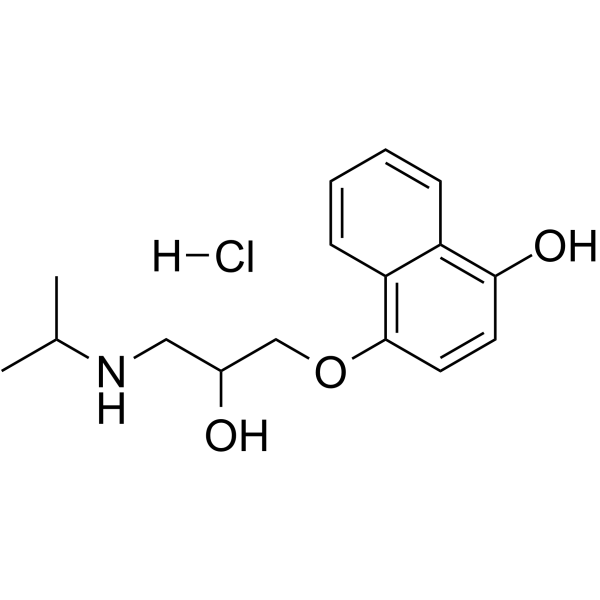
4-Hydroxypropranolol hydrochloride

Based on 1 Customer Validation
4-Hydroxypropranolol hydrochloride is a non-cardiac selective β-adrenergic receptor antagonist and a metabolite produced after oral administration of Propranolol (HY-B0573B). 4-Hydroxypropranolol hydrochloride also acts as a membrane stabilizer and possesses intrinsic sympathomimetic inhibitory activity. 4-Hydroxypropranolol hydrochloride blocks β-adrenergic receptors to antagonize the effects of catecholamines, acts as a partial β-adrenergic receptor agonist, and induces membrane stabilization. 4-Hydroxypropranolol hydrochloride alters heart rate, left ventricular contractility, and atrioventricular conduction time. 4-Hydroxypropranolol hydrochloride can be used in research related to cardiovascular and cerebrovascular diseases.
Para uso exclusivo en investigación. No vendemos a pacientes.
- Pureza : 99.73%
- No. CAS: 14133-90-5
- Fòrmula: C16H22ClNO3
- Peso molecular:311.80
-
Almacenamiento:Powder -20°C, 3 years , 4°C, 2 years ; In solvent -80°C, 6 months , -20°C, 1 month

To place orders, for customer services and technical support, please contact: MedChemExpress USA
Tel: 609-228-6898 E-mail: [email protected] [email protected]


-
 Actividad biológica
-
Chemical Information
-
Solvente y solubilidad
- Protocolo
- Pureza y Documentación
- Referencias
-
 Help & FAQs



Ver todos los productos específicos de isoformas Adrenergic Receptor
More

Actividad biológica
Descripciòn
IC50 & Target
|
β adrenergic receptor |
In Vivo
4-Hydroxypropranolol (10-80 μg/kg; i.v.) hydrochloride possesses intrinsic sympathomimetic activity, which causes a dose-dependent increase in heart rate in catecholamine-depleted rats[1].
4-Hydroxypropranolol (0.025-0.8 mg/kg, s.c.) hydrochloride antagonizes the protective effect of isoprenaline against histamine-induced bronchospasm in guinea pigs[1].
4-Hydroxypropranolol (0.09-13.25 mg/kg, i.v.) hydrochloride exerts β-adrenergic receptor blocking activity and membrane-stabilizing activity, thereby producing dose-dependent cardiovascular effects in normal anesthetized dogs, including decreased heart rate, reduced contractility, diminished aortic blood flow, and prolonged atrioventricular conduction time[1].
MedChemExpress (MCE) has not independently confirmed the accuracy of these methods. They are for reference only.
-
Animal Model:Cat (2-5 kg, anaesthetized with chloralose)[1]
-
Dosage:1 μg/kg/min; 2 μg/kg/min; 4 μg/kg/min; 54 μg/kg (50% tachycardia inhibition)
-
Administration:i.v.; 30 min
-
Result:Produced 50% reduction in isoprenaline-induced tachycardia at a total dose of 54 μg/kg.
Inhibited isoprenaline-induced vasodepression by 89% at this dose.
-
Animal Model:Rat (anaesthetized with pentobarbitone sodium, catecholamine-depleted via syrosingopine pretreatment)[1]
-
Dosage:10 μg/kg; 80 μg/kg
-
Administration:i.v.
-
Result:Produced a dose-dependent increase in heart rate in catecholamine-depleted rats, with mean resting heart rate of 300 beats/minute across 64 rats tested.
Blocked the heart rate increase in response to 10 and 80 μg/kg doses when rats were pretreated with 0.5 mg/kg propranolol.
-
Animal Model:(either sex, 250-400 g)[1]
-
Dosage:0.025 mg/kg; 0.05 mg/kg; 0.8 mg/kg
-
Administration:s.c.; 15 minutes before isoprenaline exposure
-
Result:Partially antagonized isoprenaline's protective effect at doses of 0.025 or 0.05 mg/kg, resulting in 50-70% survival from histamine bronchospasm.
Completely antagonized isoprenaline's protection at 0.8 mg/kg, resulting in 0% survival.
-
Animal Model:male beagle (12-16 kg, anaesthetized with pentobarbitone sodium)[1]
-
Dosage:0.09 mg/kg; 0.16 mg/kg; 1.0 mg/kg; 4.0 mg/kg; 8.0 mg/kg (cumulative doses: 0.09, 0.25, 1.25, 5.25, 13.25 mg/kg)
-
Administration:i.v.
-
Result:Produced a significant decrease in heart rate (-16.5%), dP/dt (-21.6%), and aortic flow (-10.9%), with no change in mean blood pressure at a cumulative dose of 0.09 mg/kg (unpaced).
Decreased heart rate an additional 6.5% at 0.25 mg/kg cumulative dose, stabilizing at ~-24% of control by 1.25 mg/kg cumulative dose, with no further decreases in dP/dt or aortic flow, and a slight increase in mean blood pressure.
Caused dose-dependent additional decreases in dP/dt (to -52.0% at 13.25 mg/kg), mean blood pressure, heart rate, and aortic flow at cumulative doses of 5.25 and 13.25 mg/kg.
Increased A-V conduction time by 4.8% (unpaced) and 11.9% (paced) at 0.09 mg/kg cumulative dose, remaining elevated until 5.25 and 13.25 mg/kg cumulative doses, which produced marked, dose-dependent additional increases.


Chemical Information
-
No. CAS 14133-90-5
-
Appearance Solid
-
Peso molecular 311.80
-
Fòrmula C16H22ClNO3
-
Color Light brown to brown
-
SMILES
OC1=C2C=CC=CC2=C(OCC(O)CNC(C)C)C=C1.Cl[H]
-
Synonyms
(±)-4-hydroxy Propranolol hydrochloride
-
Envío
Room temperature in continental US; may vary elsewhere.
-
Almacenamiento
Powder -20°C 3 years 4°C 2 years In solvent -80°C 6 months -20°C 1 month


Solvente y solubilidad
In Vitro:
DMSO : 100 mg/mL (320.72 mM; Need ultrasonic; Hygroscopic DMSO has a significant impact on the solubility of product, please use newly opened DMSO)
Please refer to the solubility information to select the appropriate solvent. Once prepared, please aliquot and store the solution to prevent product inactivation from repeated freeze-thaw cycles.
Storage method and period of stock solution: -80°C, 6 months; -20°C, 1 month. When stored at -80°C, please use it within 6 months. When stored at -20°C, please use it within 1 month.
Please refer to the solubility information to select the appropriate solvent. Once prepared, please aliquot and store the solution to prevent product inactivation from repeated freeze-thaw cycles.
Storage method and period of stock solution: -80°C, 6 months; -20°C, 1 month. When stored at -80°C, please use it within 6 months. When stored at -20°C, please use it within 1 month.
Concentration (start) × Volume (start) = Concentration (final) × Volume (final)
In Vivo:
Select the appropriate dissolution method based on your experimental animal and administration route.
- For the following dissolution methods, please ensure to first prepare a clear stock solution using an In Vitro approach and then sequentially add co-solvents:
- To ensure reliable experimental results, the clarified stock solution can be appropriately stored based on storage conditions. As for the working solution for In Vivo experiments, it is recommended to prepare freshly and use it on the same day.
- The percentages shown for the solvents indicate their volumetric ratio in the final prepared solution. If precipitation or phase separation occurs during preparation, heat and/or sonication can be used to aid dissolution.
Add each solvent one by one: 10% DMSO 40% PEG300 5% Tween-80 45% Saline
Solubility: ≥ 2.5 mg/mL (8.02 mM); Clear solution
This protocol yields a clear solution of ≥ 2.5 mg/mL (saturation unknown).
Taking 1 mL working solution as an example, add 100 μL DMSO stock solution (25.0 mg/mL) to 400 μL PEG300, and mix evenly; then add 50 μL Tween-80 and mix evenly; then add 450 μL Saline to adjust the volume to 1 mL.
Preparation of Saline: Dissolve 0.9 g sodium chloride in ddH₂O and dilute to 100 mL to obtain a clear Saline solution.
Add each solvent one by one: 10% DMSO 90% (20% SBE-β-CD in Saline)
Solubility: ≥ 2.5 mg/mL (8.02 mM); Clear solution
This protocol yields a clear solution of ≥ 2.5 mg/mL (saturation unknown).
Taking 1 mL working solution as an example, add 100 μL DMSO stock solution (25.0 mg/mL) to 900 μL 20% SBE-β-CD in Saline, and mix evenly.
Preparation of 20% SBE-β-CD in Saline (4°C, storage for one week): 2 g SBE-β-CD powder is dissolved in 10 mL Saline, completely dissolve until clear.
In Vivo Dissolution Calculator
Please enter the basic information of animal experiments:
-
-
-
-
Recommended: Prepare an additional quantity of animals to account for potential losses during experiments.
Please enter your animal formula composition:
-
%DMSO +
Recommended: Keep the proportion of DMSO in working solution below 2% if your animal is weak.
-
%+
-
+%Tween-80 + +
-
%Saline +
The co-solvents required include: DMSO, . All of co-solvents are available by MedChemExpress (MCE). , Tween 80. All of co-solvents are available by MedChemExpress (MCE).
Working solution concentration: 0.22 mg/mL
Method for preparing stock solution: mg drug dissolved in μL DMSO. Stock solution concentration: mg/mL.
1. Take μL DMSO stock solution;
2. Add μL .
μL , mix evenly;
3. Then add μL Tween 80, mix evenly;
4. Then add μL
Please ensure that the stock solution in the first step is dissolved to a clear state, and add co-solvents in sequence. You can use ultrasonic heating (ultrasonic cleaner, recommended frequency 20-40 kHz), vortexing, etc. to assist dissolution.

Protocolo
-
How to Select the Route of Administration for Mammals
Route-of-administration selection in mammals is a pharmacokinetic, pharmacodynamic, formulation, animal-welfare, and translational decision, not a default technical choice. The selected route should match the study goal: intravenous dosing is most useful when complete systemic exposure and rapid onset are required, oral dosing is most translational for orally intended medicines but is affected by absorption and first-pass metabolism, subcutaneous or intramuscular dosing can provide slower systemic exposure, and intraperitoneal dosing can be useful in rodent proof-of-concept studies but may have limited clinical translation. Published route-comparison studies show that the same compound can produce different exposure, onset, bioavailability, tissue distribution, and tolerability depending on route; therefore, route choice should be supported by pilot pharmacokinetic or pharmacodynamic evidence when the literature is insufficient. Unresolved questions include how to standardize route sel


Pureza y Documentación
-
Ficha de datos (277 KB)
-
SDS (252 KB)
- English - EN (252 KB)
- Français - FR (252 KB)
- Deutsch - DE (252 KB)
- Norwegian - NO (252 KB)
- Español - ES (252 KB)
- Swedish - SV (252 KB)
- Italian - IT (252 KB)
- Korean - KR (252 KB)
- Portuguese - PT (252 KB)
-
Instrucciones de manejo (2659 KB)
Referencias
[1]. Fitzgerald JD, et al. Pharmacology of 4-hydroxypropranolol, a metabolite of propranolol. Br J Pharmacol. 1971;43(1):222-235. [Content Brief]
[2]. Nand RA, et al. (S)-4'-hydroxypropranolol causes product inhibition and dose-dependent bioavailability of propranolol enantiomers in the isolated perfused rat liver and in rat liver microsomes. Xenobiotica. 1996;26(12):1249-1261. [Content Brief]


Complete Stock Solution Preparation Table
Please refer to the solubility information to select the appropriate solvent. Once prepared, please aliquot and store the solution to prevent product inactivation from repeated freeze-thaw cycles.
Storage method and period of stock solution: -80°C, 6 months; -20°C, 1 month. When stored at -80°C, please use it within 6 months. When stored at -20°C, please use it within 1 month.
| Optional Solvent | Concentration Solvent Mass | 1 mg | 5 mg | 10 mg | 25 mg |
|---|---|---|---|---|---|
| DMSO | 1 mM | 3.2072 mL | 16.0359 mL | 32.0718 mL | 80.1796 mL |
| 5 mM | 0.6414 mL | 3.2072 mL | 6.4144 mL | 16.0359 mL | |
| 10 mM | 0.3207 mL | 1.6036 mL | 3.2072 mL | 8.0180 mL | |
| 15 mM | 0.2138 mL | 1.0691 mL | 2.1381 mL | 5.3453 mL | |
| 20 mM | 0.1604 mL | 0.8018 mL | 1.6036 mL | 4.0090 mL | |
| 25 mM | 0.1283 mL | 0.6414 mL | 1.2829 mL | 3.2072 mL | |
| 30 mM | 0.1069 mL | 0.5345 mL | 1.0691 mL | 2.6727 mL | |
| 40 mM | 0.0802 mL | 0.4009 mL | 0.8018 mL | 2.0045 mL | |
| 50 mM | 0.0641 mL | 0.3207 mL | 0.6414 mL | 1.6036 mL | |
| 60 mM | 0.0535 mL | 0.2673 mL | 0.5345 mL | 1.3363 mL | |
| 80 mM | 0.0401 mL | 0.2004 mL | 0.4009 mL | 1.0022 mL | |
| 100 mM | 0.0321 mL | 0.1604 mL | 0.3207 mL | 0.8018 mL |


4-Hydroxypropranolol hydrochloride Related Classifications
HY-100634 Related Classifications
 Powered by Bioz
Keywords
- 4-Hydroxypropranolol
- 14133-90-5
- (±)-4-hydroxy Propranolol
- Adrenergic Receptor
- catecholamine-depleted rats
- guinea-pigs
- perfused rat liver
- β-adrenoceptor
- atrioventricular conduction time
- anaesthetized dogs
- rat liver microsomes
- histamine bronchospasm
- left ventricular contractility
- anaesthetized cats
- Inhibitor
- inhibitor
- inhibit