



Cefpirome sulfate
Based on 1 publication(s) in Google Scholar
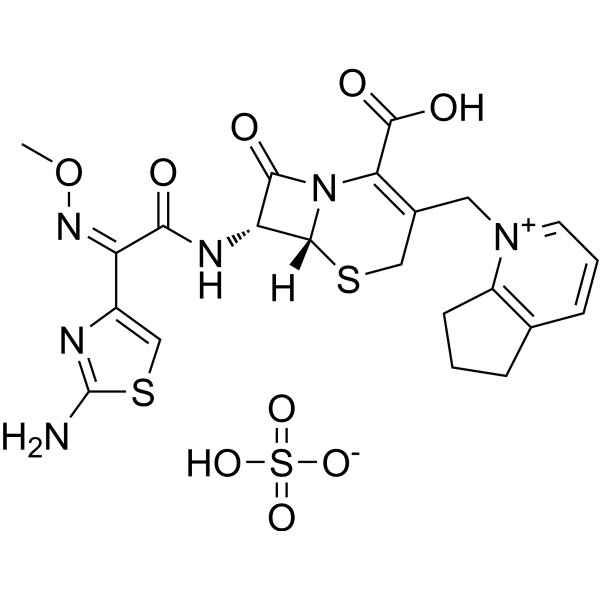
Cefpirome (HR-810) sulfate is a cephalosporin antibiotic that can cross cell membranes and the blood-brain barrier. Cefpirome sulfate binds to penicillin-binding proteins with high affinity, thereby inhibiting bacterial cell wall synthesis. Cefpirome sulfate exhibits bactericidal and growth-inhibitory activities against Gram-negative bacteria, Gram-positive bacteria, and susceptible anaerobic bacteria (including some β-lactamase-producing strains).
Nos produits utilisent uniquement pour la recherche. Nous ne vendons pas aux patients.
- Pureté : 99.49%
- CAS No.: 98753-19-6
- Formule: C22H24N6O9S3
- Masse moléculaire:612.66
-
Stockage:
4°C, sealed storage, away from moisture
* The compound is unstable in solutions, freshly prepared is recommended.

To place orders, for customer services and technical support, please contact: MedChemExpress USA
Tel: 609-228-6898 E-mail: [email protected] [email protected]


-
 Activité biologique
-
Chemical Information
-
Solvant et solubilité
- Protocole
- Pureté et documentation
- Références
-
 Help & FAQs



Publications Citing Use of MedChemExpress (MCE) Cefpirome sulfate
MoreVoir tous les produits spécifiques à Isoform Antibiotic
More

Activité biologique
Description
IC50 & Target
|
β-lactam |
In Vitro
Cefpirome sulfate exhibits excellent in vitro antibacterial activity against most Enterobacteriaceae (including strains resistant to third-generation cephalosporins), methicillin-sensitive staphylococci, and streptococci (including penicillin-resistant Streptococcus pneumoniae). It shows moderate activity against Pseudomonas aeruginosa, variable activity against anaerobes, and weak activity against methicillin-resistant staphylococci and Enterococcus faecalis[1].
Cefpirome sulfate is stable to most plasmid-mediated and chromosome-mediated β-lactamases, except for extended-spectrum SHV enzymes, and retains activity against β-lactamase-producing, third-generation cephalosporin-resistant *Enterobacteriaceae* strains[1].
Cefpirome sulfate exhibits rapid outer membrane permeability to Gram-negative bacteria, as well as high-affinity binding to key penicillin-binding proteins in both Gram-negative and Gram-positive bacteria, which endows it with broad-spectrum antibacterial activity[1].
Cefpirome (18 h) sulfate exhibits mutation prevention concentration (MPC) against Enterobacter cloacae of 1 μg/mL, which defines a narrow mutant selection window between its MIC (0.125 μg/mL) and MPC[2].
Cefpirome (0.06-32 μg/mL; 18-24 h) sulfate potently inhibits clinical isolates of Enterobacteriaceae (with MIC90 ≤ 0.5 μg/mL for most species), exhibits activity against non-glucose-fermenting Gram-negative bacilli, and shows activity against both oxacillin-susceptible and Oxacillin (HY-B0925A)-resistant staphylococci (the MIC90 is 1 μg/mL for Oxacillin-susceptible Staphylococcus aureus and 16 μg/mL for Oxacillin-resistant Staphylococcus aureus). Only the MIC against coagulase-negative staphylococci shows a slight salt-dependent increase[3].
MedChemExpress (MCE) has not independently confirmed the accuracy of these methods. They are for reference only.
Parmacokinetics
| Species | Dose | Route | Vss | T1/2 | CL |
|---|---|---|---|---|---|
| Rat[2] | 0.4, 0.8, 1.6, 3.1, 6.3, 12.5, 25, 50 mg/kg | i.m. | 0.36 L/kg | 1.22-1.63 h | 1.23-1.64 mL/min |
In Vivo
Cefpirome sulfate (0.025-1.56 mg/kg) demonstrates high in vivo efficacy against a range of bacterial systemic infections in mice, with ED50 values ranging from 0.025 to 1.56 mg/kg[1].
Cefpirome sulfate shows in vivo activity against Pseudomonas aeruginosa-induced systemic infection in mice, but is approximately 2-fold less potent than ceftazidime[1].
Cefpirome sulfate exhibits in vivo efficacy against Acinetobacter spp.-induced systemic infection in mice[1].
Cefpirome sulfate (15.4 mg/kg) is highly bactericidal against Klebsiella pneumoniae-induced pneumonia in mice, with an ED50 of 15.4 mg/kg at 18 hours[1].
Cefpirome (0.4-50 mg/kg b.i.d.; intramuscular injection; every 12 hours; 18 days) sulfate results in dose-dependent survival of rats with K. pneumoniae pneumonia and only minimal selection of stable derepressed ampD-mutated E. cloacae mutants from intestinal flora[2].
MedChemExpress (MCE) has not independently confirmed the accuracy of these methods. They are for reference only.
-
Animal Model:RP/AEur/RijHsd rats (male, 11-15 weeks old, 250-350 g, left-sided unilateral pneumonia induced via tracheal cannulation with Klebsiella pneumoniae ATCC 43816)[2]
-
Dosage:0.4 mg/kg b.i.d.; 0.8 mg/kg b.i.d.; 1.6 mg/kg b.i.d.; 3.1 mg/kg b.i.d.; 6.3 mg/kg b.i.d.; 12.5 mg/kg b.i.d.; 25 mg/kg b.i.d.; 50 mg/kg b.i.d.
-
Administration:intramuscular injection; every 12 hours; 18 days
-
Result:Achieved 45% survival rate at day 43 post-inoculation with 3.1 mg/kg b.i.d.
dose.
Achieved 60% survival rate at day 43 post-inoculation with 6.3 mg/kg b.i.d.
dose.
Achieved 100% survival rate at day 43 post-inoculation with 12.5 mg/kg b.i.d.
dose.
Resulted in 50% survival at 12.5 mg/kg/day dose and 90% survival at 25 mg/kg/day dose.
Reduced cefpirome-susceptible intestinal E.
cloacae counts in a dose-dependent manner, with significant reductions (p < 0.05) observed at day 36 for 25 and 50 mg/kg b.i.d., day 29 for 6.3 and 12.5 mg/kg b.i.d., and day 22 for 3.1 mg/kg b.i.d.
compared to pre-treatment levels.
Showed a significant negative correlation between %fT>MIC and log10 cfu counts of susceptible E.
cloacae at days 7, 14, 22, and 29, with each 1% increase in %fT>MIC correlating with a 0.056 reduction in log10 cfu (95% CI: -0.092 to -0.0202 at day 7).
Detected cefpirome-resistant E.
cloacae mutants (MIC ≥ 2 μg/mL, stable after 5 subcultures in antibiotic-free broth) in only 4 rats: 2 treated with 50 mg/kg b.i.d.
(550 cfu/g and 440 cfu/g at day 7, declining to 20 cfu/g and remaining at 400 cfu/g by day 43, respectively), 1 treated with 25 mg/kg b.i.d.
(180 cfu/g at day 7, increasing to 1×10³ cfu/g by day 43), and 1 treated with 12.5 mg/kg b.i.d.
(500 cfu/g at day 43).


Chemical Information
-
CAS No. 98753-19-6
-
Appearance Solid
-
Masse moléculaire 612.66
-
Formule C22H24N6O9S3
-
Color Light yellow to yellow
-
SMILES
O=C1[C@@H](NC(/C(C2=CSC(N)=N2)=N\OC)=O)[C@@]3([H])SCC(C[N+]4=CC=CC5=C4CCC5)=C(C(O)=O)N13.O=S(O)([O-])=O
-
Synonyms
HR-810 sulfate
-
Livraison
Room temperature in continental US; may vary elsewhere.
-
Stockage
4°C, sealed storage, away from moisture
* The compound is unstable in solutions, freshly prepared is recommended.


Publications (1)
-
Journal Impact Factor
-
Most Recent
-
Biomed Res Int
In Vitro Activity of β-Lactams in Combination with β-Lactamase Inhibitors against Mycobacterium tuberculosis Clinical Isolates. [Abstract]2018 Jul 2:2018:3579832. PMID: 30065936


Solvant et solubilité
In Vitro:
H2O : < 0.1 mg/mL (insoluble)
DMSO : < 1 mg/mL (insoluble or slightly soluble)


Pureté et documentation
-
Fiche technique (289 KB)
-
SDS (396 KB)
- English - EN (396 KB)
- Français - FR (396 KB)
- Deutsch - DE (396 KB)
- Norwegian - NO (396 KB)
- Español - ES (396 KB)
- Swedish - SV (396 KB)
- Italian - IT (396 KB)
- Korean - KR (396 KB)
- Portuguese - PT (396 KB)
-
Instruction de manipulation (2659 KB)
Références
[1].
Wiseman LR, et al. A review of its antibacterial activity, pharmacokinetic properties and clinical efficacy in the treatment of severe nosocomial infections and febrile neutropenia. Drugs. 1997 Jul;54(1):117-40.
[Content Brief]
[2].
Gautam V, et al. Cefpirome Treatment Results in Limited Selection of Stable Derepressed Enterobacter cloacae Mutants in the Intestinal Flora of Rats Treated for an Experimental Klebsiella pneumoniae Pulmonary Infection. Microb Drug Resist. 2020 Apr;26(4):341-348.
[Content Brief]
[3]. Bertram MA, et al. In vitro activity of HR 810, a new cephalosporin. Antimicrob Agents Chemother. 1984;26(2):277-279. [Content Brief]

Calculators
Concentration (start) × Volume (start) = Concentration (final) × Volume (final)


Cefpirome sulfate Related Classifications
HY-B1824 Related Classifications
 Powered by Bioz
Keywords
- Cefpirome
- 98753-19-6
- HR-810
- HR810
- HR 810
- Bacterial
- Antibiotic
- Enterobacter cloacae
- Gram-negative bacteria
- mouse models of pneumonia
- bacterial cell wall synthesis
- anaerobic bacteria
- mouse models of systemic infection
- Klebsiella pneumoniae
- penicillin binding proteins
- Pseudomonas aeruginosa
- Gram-positive bacteria
- Inhibitor
- inhibitor
- inhibit