



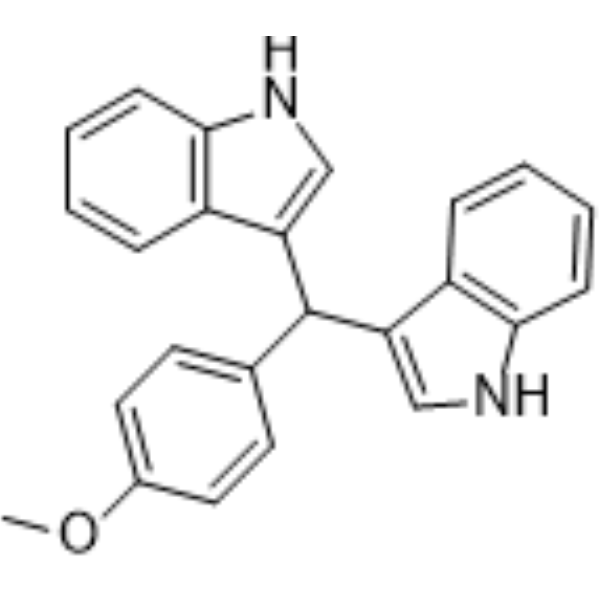
DIM-C-pPhOCH3
Based on 1 publication(s) in Google Scholar
DIM-C-pPhOCH3 is a Nur77 agonist. Nerve growth factor-induced Bα (NGFI-Bα, Nur77) is an orphan nuclear receptor.
For research use only. We do not sell to patients.
- Purity : 99.41%
- CAS No.: 33985-68-1
- Formula: C24H20N2O
- Molecular Weight:352.43
-
Storage:Powder -20°C, 3 years , 4°C, 2 years ; In solvent -80°C, 2 years , -20°C, 1 year

To place orders, for customer services and technical support, please contact: MedChemExpress USA
Tel: 609-228-6898 E-mail: [email protected] [email protected]


-
 Biological Activity
-
Chemical Information
-
Solvent & Solubility
- Protocol
- Purity & Documentation
- References
-
 Help & FAQs


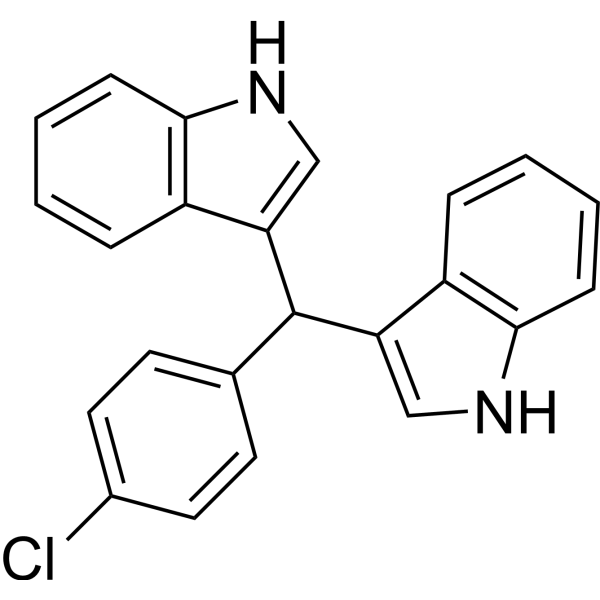

Publications Citing Use of MedChemExpress (MCE) DIM-C-pPhOCH3
MoreAll Nuclear Hormone Receptor 4A/NR4A Isoforms
More

Biological Activity
Description
IC50 & Target
|
Nur77/NR4A1 |
In Vitro
DIM-C-pPhOCH3 decreases survival and induces apoptosis in RKO colon cancer cells, and this is accompanied by induction of tumor necrosis factor–related apoptosis-inducing ligand (TRAIL) protein. DIM-C-pPhOCH3 also induces Nur77-independent apoptosis. DIM-C-pPhOCH3 (10 μM) inhibits cell growth after treatment for 24, 48, or 72 h, and the maximum inhibitory response is observed after 72 h, where there is considerable cell detachment and dead cells. The growth-inhibitory effects observed for DIM-C-pPhOCH3 after 72 h are also accompanied by several markers of apoptosis, including PARP cleavage and cleavage of caspase-3, caspase-9, and caspase-8. PARP cleavage is also observed after treatment of RKO cells for 48 h with DIM-C-pPhOCH3[1].
MedChemExpress (MCE) has not independently confirmed the accuracy of these methods. They are for reference only.
In Vivo
MedChemExpress (MCE) has not independently confirmed the accuracy of these methods. They are for reference only.


Chemical Information
-
CAS No. 33985-68-1
-
Appearance Solid
-
Molecular Weight 352.43
-
Formula C24H20N2O
-
Color White to off-white
-
SMILES
COC1=CC=C(C(C2=CNC3=C2C=CC=C3)C4=CNC5=C4C=CC=C5)C=C1
-
Shipping
Room temperature in continental US; may vary elsewhere.
-
Storage
Powder -20°C 3 years 4°C 2 years In solvent -80°C 2 years -20°C 1 year


Publications (1)
-
Journal Impact Factor
-
Most Recent
-
J Biol Chem
PPARγ and C/EBPα enable adipocyte differentiation upon inhibition of histone methyltransferase PRC2 in malignant tumors. [Abstract]2024 Oct;300(10):107765. PMID: 39276936


Solvent & Solubility
In Vitro:
DMSO : ≥ 33.3 mg/mL (94.49 mM; Hygroscopic DMSO has a significant impact on the solubility of product, please use newly opened DMSO)
* "≥" means soluble, but saturation unknown.
Please refer to the solubility information to select the appropriate solvent. Once prepared, please aliquot and store the solution to prevent product inactivation from repeated freeze-thaw cycles.
Storage method and period of stock solution: -80°C, 2 years; -20°C, 1 year. When stored at -80°C, please use it within 2 years. When stored at -20°C, please use it within 1 year.
Please refer to the solubility information to select the appropriate solvent. Once prepared, please aliquot and store the solution to prevent product inactivation from repeated freeze-thaw cycles.
Storage method and period of stock solution: -80°C, 2 years; -20°C, 1 year. When stored at -80°C, please use it within 2 years. When stored at -20°C, please use it within 1 year.
Concentration (start) × Volume (start) = Concentration (final) × Volume (final)
In Vivo:
Select the appropriate dissolution method based on your experimental animal and administration route.
- For the following dissolution methods, please ensure to first prepare a clear stock solution using an In Vitro approach and then sequentially add co-solvents:
- To ensure reliable experimental results, the clarified stock solution can be appropriately stored based on storage conditions. As for the working solution for In Vivo experiments, it is recommended to prepare freshly and use it on the same day.
- The percentages shown for the solvents indicate their volumetric ratio in the final prepared solution. If precipitation or phase separation occurs during preparation, heat and/or sonication can be used to aid dissolution.
Add each solvent one by one: 10% DMSO 40% PEG300 5% Tween-80 45% Saline
Solubility: ≥ 2.5 mg/mL (7.09 mM); Clear solution
This protocol yields a clear solution of ≥ 2.5 mg/mL (saturation unknown).
Taking 1 mL working solution as an example, add 100 μL DMSO stock solution (25.0 mg/mL) to 400 μL PEG300, and mix evenly; then add 50 μL Tween-80 and mix evenly; then add 450 μL Saline to adjust the volume to 1 mL.
Preparation of Saline: Dissolve 0.9 g sodium chloride in ddH₂O and dilute to 100 mL to obtain a clear Saline solution.
Add each solvent one by one: 10% DMSO 90% (20% SBE-β-CD in Saline)
Solubility: ≥ 2.5 mg/mL (7.09 mM); Clear solution
This protocol yields a clear solution of ≥ 2.5 mg/mL (saturation unknown).
Taking 1 mL working solution as an example, add 100 μL DMSO stock solution (25.0 mg/mL) to 900 μL 20% SBE-β-CD in Saline, and mix evenly.
Preparation of 20% SBE-β-CD in Saline (4°C, storage for one week): 2 g SBE-β-CD powder is dissolved in 10 mL Saline, completely dissolve until clear.
In Vivo Dissolution Calculator
Please enter the basic information of animal experiments:
-
-
-
-
Recommended: Prepare an additional quantity of animals to account for potential losses during experiments.
Please enter your animal formula composition:
-
%DMSO +
Recommended: Keep the proportion of DMSO in working solution below 2% if your animal is weak.
-
%+
-
+%Tween-80 + +
-
%Saline +
The co-solvents required include: DMSO, . All of co-solvents are available by MedChemExpress (MCE). , Tween 80. All of co-solvents are available by MedChemExpress (MCE).
Working solution concentration: 0.22 mg/mL
Method for preparing stock solution: mg drug dissolved in μL DMSO. Stock solution concentration: mg/mL.
1. Take μL DMSO stock solution;
2. Add μL .
μL , mix evenly;
3. Then add μL Tween 80, mix evenly;
4. Then add μL
Please ensure that the stock solution in the first step is dissolved to a clear state, and add co-solvents in sequence. You can use ultrasonic heating (ultrasonic cleaner, recommended frequency 20-40 kHz), vortexing, etc. to assist dissolution.

Protocol
Cell Assay[1]
RKO cells are treated with DMSO or 12.5 μM DIM-C-pPhOCH3 for 2 and 6 h. RNA is isolated for the reverse transcription-PCR (RT-PCR) experiment and analyzed for gene expression, and three replicates are determined for each time point and the DMSO control. The microarray data are analyzed[1].
MedChemExpress (MCE) has not independently confirmed the accuracy of these methods. They are for reference only.
Animal Administration[1]
Mice[1]
Male athymic nude mice (Foxn1nu, ages 7-8 weeks) are used. The mice are housed and maintained in laminar flow cabinets under specific pathogen-free conditions. A xenograft is established by s.c. injection of in vitro cultured RKO cells (5×10⁶ per 150 μL) into the flanks of individual mice. Tumors are allowed to grow for 4 days until tumors are palpable. Mice are then randomized into two groups of six mice per group and dosed by oral gavage with either corn oil or 25 mg/kg/d DIM-C-pPhOCH3 for 21 days. The mice are weighed, and tumor size is measured[1].
MedChemExpress (MCE) has not independently confirmed the accuracy of these methods. They are for reference only.


Purity & Documentation
-
Data Sheet (294 KB)
-
SDS (393 KB)
- English - EN (393 KB)
- Français - FR (393 KB)
- Deutsch - DE (393 KB)
- Norwegian - NO (393 KB)
- Español - ES (393 KB)
- Swedish - SV (393 KB)
- Italian - IT (393 KB)
- Korean - KR (393 KB)
- Portuguese - PT (393 KB)
-
Handling Instructions (2659 KB)
References


Complete Stock Solution Preparation Table
Please refer to the solubility information to select the appropriate solvent. Once prepared, please aliquot and store the solution to prevent product inactivation from repeated freeze-thaw cycles.
Storage method and period of stock solution: -80°C, 2 years; -20°C, 1 year. When stored at -80°C, please use it within 2 years. When stored at -20°C, please use it within 1 year.
| Optional Solvent | Concentration Solvent Mass | 1 mg | 5 mg | 10 mg | 25 mg |
|---|---|---|---|---|---|
| DMSO | 1 mM | 2.8374 mL | 14.1872 mL | 28.3744 mL | 70.9361 mL |
| 5 mM | 0.5675 mL | 2.8374 mL | 5.6749 mL | 14.1872 mL | |
| 10 mM | 0.2837 mL | 1.4187 mL | 2.8374 mL | 7.0936 mL | |
| 15 mM | 0.1892 mL | 0.9458 mL | 1.8916 mL | 4.7291 mL | |
| 20 mM | 0.1419 mL | 0.7094 mL | 1.4187 mL | 3.5468 mL | |
| 25 mM | 0.1135 mL | 0.5675 mL | 1.1350 mL | 2.8374 mL | |
| 30 mM | 0.0946 mL | 0.4729 mL | 0.9458 mL | 2.3645 mL | |
| 40 mM | 0.0709 mL | 0.3547 mL | 0.7094 mL | 1.7734 mL | |
| 50 mM | 0.0567 mL | 0.2837 mL | 0.5675 mL | 1.4187 mL | |
| 60 mM | 0.0473 mL | 0.2365 mL | 0.4729 mL | 1.1823 mL | |
| 80 mM | 0.0355 mL | 0.1773 mL | 0.3547 mL | 0.8867 mL |


DIM-C-pPhOCH3 Related Classifications
HY-111492 Related Classifications
 Powered by Bioz