



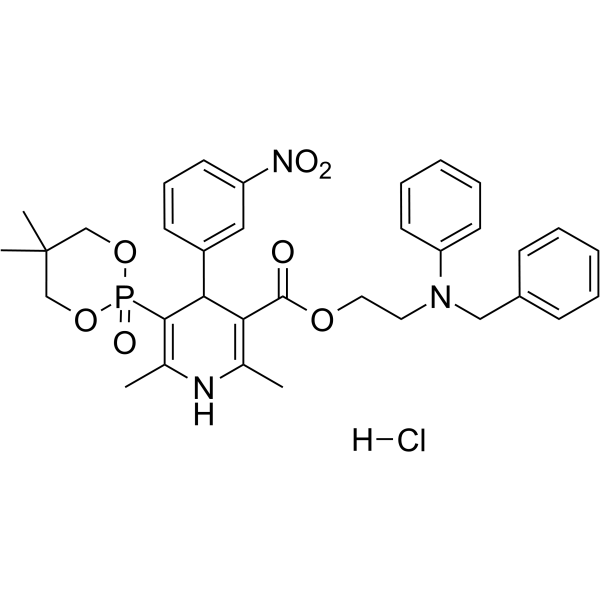
Efonidipine hydrochloride
Based on 1 publication(s) in Google Scholar
Efonidipine (NZ-105) hydrochloride is an orally active dual L-type and T-type calcium channel blocker (CCB) with IC50 values of 1.8 and 350 nM, respectively. Efonidipine hydrochloride inhibits SARS-CoV-2 main protease. Efonidipine hydrochloride modulates adrenal steroidogenesis by increasing the expression of steroidogenic acute regulatory protein (StAR), dbcAMP-or angiotensin II-induced StAR mRNA expression and DHEA-S production, while suppressing the biosynthesis of aldosterone and cortisol. Efonidipine hydrochloride reduces plasma aldosterone levels in vivo. Efonidipine hydrochloride improves cardiac function in heart failure models by inhibiting T-type calcium channels (via both tonic and use-dependent blockade), independently of blood pressure reduction. Efonidipine hydrochloride can be used for research in hypertension, heart failure, and disorders involving dysregulated steroid hormone synthesis.
Nos produits utilisent uniquement pour la recherche. Nous ne vendons pas aux patients.
- CAS No.: 111011-53-1
- Formule: C34H39ClN3O7P
- Masse moléculaire:668.12
-
Stockage:
Please store the product under the recommended conditions in the Certificate of Analysis.

To place orders, for customer services and technical support, please contact: MedChemExpress USA
Tel: 609-228-6898 E-mail: [email protected] [email protected]


-
 Activité biologique
-
Chemical Information
-
Solvant et solubilité
- Protocole
- Pureté et documentation
- Références
-
 Help & FAQs


Publications Citing Use of MedChemExpress (MCE) Efonidipine hydrochloride
MoreVoir tous les produits spécifiques à Isoform Calcium Channel
More

Activité biologique
Description
IC50 & Target
|
L-type calcium channel 1.8 nM (IC50) |
T-type calcium channel 350 nM (IC50) |
In Vitro
Efonidipine (10 μM, 24 h) hydrochloride induces an increase in StAR mRNA that is independent of extracellular Ca2+ in NCI-H295R human adrenocortical cells[2].
Efonidipine (1 μM, 24 h) hydrochloride significantly increases the production of DHEA-S in NCI-H295R human adrenocortical cells[2].
MedChemExpress (MCE) has not independently confirmed the accuracy of these methods. They are for reference only. Further protocols information, click here.
-
Cell Line:NCI-H295R human adrenocortical cells
-
Concentration:10 μM
-
Incubation Time:24 h
-
Result:Dose-dependently and significantly enhanced the dbcAMP-induced expression of StAR mRNA.
Enhanced the angiotensin II-induced expression of StAR mRNA.
-
Cell Line:NCI-H295R human adrenocortical cells
-
Concentration:10 μM
-
Incubation Time:24 h
-
Result:Significantly and dose-dependently enhanced the dbcAMP-induced expression of StAR protein.
In Vivo
MedChemExpress (MCE) has not independently confirmed the accuracy of these methods. They are for reference only.
-
Animal Model:UM-X7.1 hamsters and gold hamsters[1]
-
Dosage:0.1% in diet
-
Administration:p.o. 4 weeks
-
Result:Showed an increase in body weight with no remarkable increase in the biventricular-to-body weight ratio in UM-X7.1 hamsters but not affected the ratio of gold hamsters.
Did not affect the expression of TCCa1G mRNA in either the golden and UM-X7.1 hamster.
Increased left ventricular ejection fraction (LVEF) in UM-X7.1 hamster.
Did not significantly affect blood pressure in either UM X7.1 hamsters or golden hamsters.
Reduced heart rate by approximately 10%.
Significantly lowered the BNP level in UM X7.1 hamsters (from 35.2 pg/ml to 30.5 pg/ml), and the BNP level did not differ significantly in golden hamster group.


Chemical Information
-
CAS No. 111011-53-1
-
Masse moléculaire 668.12
-
Formule C34H39ClN3O7P
-
SMILES
CC1=C(P2(OCC(C)(C)CO2)=O)C(C3=CC([N+]([O-])=O)=CC=C3)C(C(OCCN(C4=CC=CC=C4)CC5=CC=CC=C5)=O)=C(C)N1.Cl
-
Synonyms
NZ-105 hydrochloride; (±)-Efonidipine hydrochloride
-
Livraison
Room temperature in continental US; may vary elsewhere.
-
Stockage
Please store the product under the recommended conditions in the Certificate of Analysis.


Publications (1)
-
Journal Impact Factor
-
Most Recent
-
Basic Clin Pharmacol Toxicol
A New Method for Antispastic Effect in Coronary Artery Bypass Grafts by Using a L- and T-Type Calcium Channel Blocker Efonidipine. [Abstract]2025 Aug;137(2):e70077. PMID: 40624735


Solvant et solubilité
In Vitro:
DMSO : 8.5 mg/mL (12.72 mM; Need ultrasonic and warming; Hygroscopic DMSO has a significant impact on the solubility of product, please use newly opened DMSO)
Concentration (start) × Volume (start) = Concentration (final) × Volume (final)

Protocole
-
RT-PCR
Reverse transcription technology uses RNA as a template to synthesize DNA. RT-PCR is simple, specific and sensitive, and can be used to detect gene expression levels and expression differences in cells; detect RNA virus content; clone cDNA sequences of specific genes.
-
RNA extraction experimental
By lysing cells, releasing RNA, and removing impurities such as proteins and DNA, high-purity RNA products are finally obtained. The commonly used traditional method is the guanidine isothiocyanate/phenol/chloroform method (Trizol), which is suitable for a variety of animal materials including animal tissues, microorganisms, cultured cells, etc., and most plant materials.
-
Cell Cytotoxicity Assay
Cytotoxicity assays are usually based on the assessment of cell membrane damage, which can also be indirectly detected by measuring cell viability. Detection methods include MTT assay, CKK-8 assay, LDH assay and ATP assay, etc.
-
Research Protocol for Endocrine Diseases
Endocrine diseases often arise from disrupted hormone production, hormone signaling, or target-tissue responsiveness; for diabetes-focused endocrine disease models, insulin signaling regulates glucose uptake, hepatic glucose output, lipid metabolism, and β-cell compensation. Type 2 diabetes develops through interacting defects in insulin resistance, β-cell dysfunction, adipose inflammation, hepatic glucose overproduction, altered incretin signaling, and ectopic lipid metabolism. A major unresolved question is whether endocrine dysfunction is driven primarily by target-tissue insulin resistance, intrinsic β-cell failure, immune/inflammatory stress, or combined multi-organ failure that differs by disease stage.
-
Research Protocol for Cardiovascular Diseases
Cardiovascular disease can be modeled as maladaptive cardiac remodeling, where ischemic injury or pressure overload activates inflammatory signaling, fibroblast activation, extracellular-matrix deposition, cardiomyocyte hypertrophy, vascular remodeling, and progressive ventricular dysfunction. The TGF-β/SMAD axis is a central profibrotic pathway after myocardial injury and pressure overload, while innate immune and cytokine pathways regulate leukocyte recruitment, scar formation, and adverse remodeling. Key unresolved questions include which inflammatory signals are reparative versus harmful, when fibrosis is protective versus maladaptive, and whether pathway inhibition improves function without weakening necessary infarct healing or compensatory remodeling.
-
Real Time qPCR (Q-PCR)
Real-time quantitative PCR (qPCR) quantifies an amplifiable nucleic-acid target by monitoring fluorescence during PCR cycling rather than measuring product only after amplification. The increase in fluorescence tracks accumulation of PCR product, and the quantification cycle (Cq; historically also Ct/CP) is related to the initial amount of target: samples containing more starting target generally reach the defined fluorescence threshold in fewer cycles.


Pureté et documentation
Références
[1]. Ikeda K, et al. Efonidipine, a Ca(2+)-channel blocker, enhances the production of dehydroepiandrosterone sulfate in NCI-H295R human adrenocortical carcinoma cells. Tohoku J Exp Med. 2011;224(4):263-71. [Content Brief]
[2]. Nakano N, et al. Effects of efonidipine, an L- and T-type calcium channel blocker, on the renin-angiotensin-aldosterone system in chronic hemodialysis patients. Int Heart J. 2010 May;51(3):188-92. [Content Brief]
[3]. Suzuki S, et al. Beneficial effects of the dual L- and T-type Ca2+ channel blocker efonidipine on cardiomyopathic hamsters. Circ J. 2007 Dec;71(12):1970-6. [Content Brief]
[4]. Lee TS, et al. Actions of mibefradil, efonidipine and nifedipine block of recombinant T- and L-type Ca channels with distinct inhibitory mechanisms. Pharmacology. 2006;78(1):11-20. [Content Brief]


Complete Stock Solution Preparation Table
| Optional Solvent | Concentration Solvent Mass | 1 mg | 5 mg | 10 mg | 25 mg |
|---|---|---|---|---|---|
| DMSO | 1 mM | 1.4967 mL | 7.4837 mL | 14.9674 mL | 37.4184 mL |
| 5 mM | 0.2993 mL | 1.4967 mL | 2.9935 mL | 7.4837 mL | |
| 10 mM | 0.1497 mL | 0.7484 mL | 1.4967 mL | 3.7418 mL |


Efonidipine hydrochloride Related Classifications
HY-12502B Related Classifications
 Powered by Bioz