



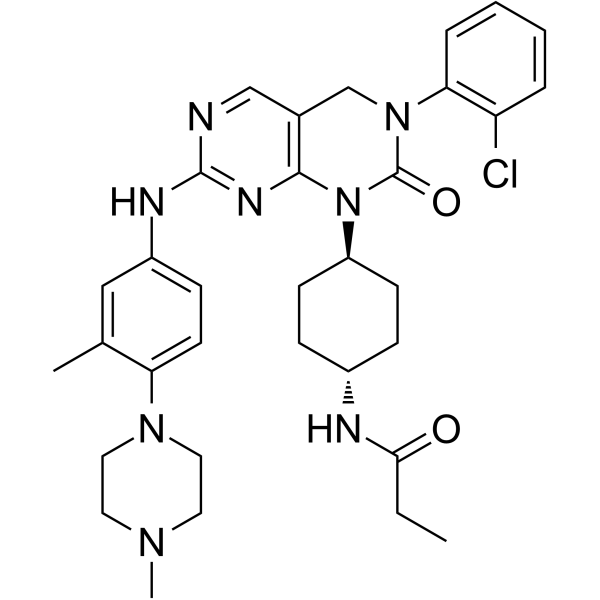
JND3229
Based on 1 publication(s) in Google Scholar
JND3229 is a reversible EGFRC797S inhibitor with IC50 values of 5.8, 6.8 and 30.5 nM for EGFRL858R/T790M/C797S, EGFRWT and EGFRL858R/T790M, respectively. JND3229 has good anti-proliferative activity and can effectively inhibit tumour growth in vivo. JND3229 can be used in cancer research, especially in non-small cell carcinoma.
For research use only. We do not sell to patients.
- Purity : 99.38%
- CAS No.: 2260886-64-2
- Formula: C33H41ClN8O2
- Molecular Weight:617.18
-
Storage:Powder -20°C, 3 years , 4°C, 2 years ; In solvent -80°C, 6 months , -20°C, 1 month

To place orders, for customer services and technical support, please contact: MedChemExpress USA
Tel: 609-228-6898 E-mail: [email protected] [email protected]


-
 Biological Activity
-
Chemical Information
-
Solvent & Solubility
- Protocols
- Purity & Documentation
- References
-
 Help & FAQs


Publications Citing Use of MedChemExpress (MCE) JND3229
MoreAll EGFR Isoforms
More

Biological Activity
Description
IC50 & Target
IC50: 5.8 nM (EGFRL858R/T790M/C797S), 6.8 nM (EGFRWT), 30.5 nM (EGFRL858R/T790M)[1].
Cellular Effect
|
Cell Line

|
Type | Value | Description | References |
|---|---|---|---|---|
| A-431 | IC50 |
0.27 μM
Compound: 6; JND3229
|
Antiproliferative activity against human A431 cells harboring wild type EGFR after 72 hrs by resazurin dye based assay
Antiproliferative activity against human A431 cells harboring wild type EGFR after 72 hrs by resazurin dye based assay
|
[PMID: 30429956] |
| BaF3 | IC50 |
0.32 μM
Compound: 6; JND3229
|
Antiproliferative activity against mouse BAF3 cells harboring EGFR 19D/T790M/C797S mutant after 72 hrs by resazurin dye based assay
Antiproliferative activity against mouse BAF3 cells harboring EGFR 19D/T790M/C797S mutant after 72 hrs by resazurin dye based assay
|
[PMID: 30429956] |
| BaF3 | IC50 |
0.51 μM
Compound: 6; JND3229
|
Antiproliferative activity against mouse BAF3 cells harboring EGFR L858R/T790M/C797S mutant after 72 hrs by resazurin dye based assay
Antiproliferative activity against mouse BAF3 cells harboring EGFR L858R/T790M/C797S mutant after 72 hrs by resazurin dye based assay
|
[PMID: 30429956] |
| BaF3 | IC50 |
320 nM
Compound: 41; JND3229
|
Inhibition of cell proliferation of mouse BaF3 cells expressing EGFR Del19/T790M/C797S mutant (unknown origin)
Inhibition of cell proliferation of mouse BaF3 cells expressing EGFR Del19/T790M/C797S mutant (unknown origin)
|
[PMID: 36417820] |
| BaF3 | IC50 |
510 nM
Compound: 41; JND3229
|
Cytotoxicity against mouse BaF3 cells harboring EGFR L858R/T790M/C797S mutant assessed as reduction in cell viability incubated for 96 hrs by CellTiter-Glo assay
Cytotoxicity against mouse BaF3 cells harboring EGFR L858R/T790M/C797S mutant assessed as reduction in cell viability incubated for 96 hrs by CellTiter-Glo assay
|
[PMID: 36417820] |
| NCI-H1975 | IC50 |
0.31 μM
Compound: 6; JND3229
|
Antiproliferative activity against human NCI-H1975 cells harboring EGFR L858R/T790M mutant after 72 hrs by resazurin dye based assay
Antiproliferative activity against human NCI-H1975 cells harboring EGFR L858R/T790M mutant after 72 hrs by resazurin dye based assay
|
[PMID: 30429956] |
| Sf9 | IC50 |
5.8 nM
Compound: 6; JND3229
|
Inhibition of human C-terminal His-tagged and N-terminal GST-tagged EGFR L858R/T790M/C797S triple mutant ( 668 to 1210 amino acids) expressed in baculovirus infected Sf9 insect cells using Poly(Glu,Tyr) 4:1 as substrate after 60 mins by ELISA
Inhibition of human C-terminal His-tagged and N-terminal GST-tagged EGFR L858R/T790M/C797S triple mutant ( 668 to 1210 amino acids) expressed in baculovirus infected Sf9 insect cells using Poly(Glu,Tyr) 4:1 as substrate after 60 mins by ELISA
|
[PMID: 31298540] |
In Vitro
JND3229 potently inhibits the proliferation of BaF3 cells (harboring the EGFRL858R/T790M/C797S and EGFR19D/T790M/C797Smutations), NCI-H1975 NSCLC cells (with EGFRT790M mutation) and A431 cancer cells (overexpressing EGFRWT) with IC50 values of 0.51, 0.32, 0.31 and 0.27 μM, respectively[1].
JND3229 (0.1, 0.3, 1, 3, 10 μM; 2 h) potently inhibits the phosphorylation of EGFRL858R/T790M/C797S and EGFR19D/T790M/C797S in engineering BaF3 cells[1].
MedChemExpress (MCE) has not independently confirmed the accuracy of these methods. They are for reference only. Further protocols information, click here.
-
Cell Line:BaF3 cells (overexpressing EGFRL858R/T790M/C797S or EGFR19D/T790M/C797S)
-
Concentration:0.1, 0.3, 1, 3, 10 µM
-
Incubation Time:2 h
-
Result:Significantly inhibited the phosphorylation of EGFRL858R/T790M/C797S and EGFR19D/T790M/C797S in a dose-dependent manner.
In Vivo
MedChemExpress (MCE) has not independently confirmed the accuracy of these methods. They are for reference only.
-
Animal Model:BALB/c mice (bearing established BaF3-EGFR19D/T790M/C797S mouse xenograft tumors model)[1].
-
Dosage:10 mg/kg
-
Administration:Intraperitoneal injection; twice daily for 10 days.
-
Result:Caused an obvious suppression of tumor growth with a Tumor Growth Inhibition (TGI) value of 42.2%.
Showed well tolerance without obvious body weight loss or other obvious toxic sign in the treated animals.
Significantly decreased the level of phosphorylated EGFR (p-EGFR) tin the tumor tissues.


Chemical Information
-
CAS No. 2260886-64-2
-
Appearance Solid
-
Molecular Weight 617.18
-
Formula C33H41ClN8O2
-
Color White to light yellow
-
SMILES
CC1=CC(NC2=NC(N([C@@H]3CC[C@@H](NC(CC)=O)CC3)C(N(C4=C(Cl)C=CC=C4)C5)=O)=C5C=N2)=CC=C1N6CCN(C)CC6
-
Shipping
Room temperature in continental US; may vary elsewhere.
-
Storage
Powder -20°C 3 years 4°C 2 years In solvent -80°C 6 months -20°C 1 month


Publications (1)
-
Journal Impact Factor
-
Most Recent
-
Arch Pharm (Weinheim)
Discovery of potent CSK inhibitors through integrated virtual screening and molecular dynamic simulation. [Abstract]2024 Sep;357(9):e2400066. PMID: 38809025


Solvent & Solubility
In Vitro:
DMSO : 12.5 mg/mL (20.25 mM; Need ultrasonic; Hygroscopic DMSO has a significant impact on the solubility of product, please use newly opened DMSO)
Please refer to the solubility information to select the appropriate solvent. Once prepared, please aliquot and store the solution to prevent product inactivation from repeated freeze-thaw cycles.
Storage method and period of stock solution: -80°C, 6 months; -20°C, 1 month. When stored at -80°C, please use it within 6 months. When stored at -20°C, please use it within 1 month.
Please refer to the solubility information to select the appropriate solvent. Once prepared, please aliquot and store the solution to prevent product inactivation from repeated freeze-thaw cycles.
Storage method and period of stock solution: -80°C, 6 months; -20°C, 1 month. When stored at -80°C, please use it within 6 months. When stored at -20°C, please use it within 1 month.
Concentration (start) × Volume (start) = Concentration (final) × Volume (final)
In Vivo:
Select the appropriate dissolution method based on your experimental animal and administration route.
- For the following dissolution methods, please ensure to first prepare a clear stock solution using an In Vitro approach and then sequentially add co-solvents:
- To ensure reliable experimental results, the clarified stock solution can be appropriately stored based on storage conditions. As for the working solution for In Vivo experiments, it is recommended to prepare freshly and use it on the same day.
- The percentages shown for the solvents indicate their volumetric ratio in the final prepared solution. If precipitation or phase separation occurs during preparation, heat and/or sonication can be used to aid dissolution.
Add each solvent one by one: 10% DMSO 40% PEG300 5% Tween-80 45% Saline
Solubility: ≥ 1.25 mg/mL (2.03 mM); Clear solution
This protocol yields a clear solution of ≥ 1.25 mg/mL (saturation unknown).
Taking 1 mL working solution as an example, add 100 μL DMSO stock solution (12.5 mg/mL) to 400 μL PEG300, and mix evenly; then add 50 μL Tween-80 and mix evenly; then add 450 μL Saline to adjust the volume to 1 mL.
Preparation of Saline: Dissolve 0.9 g sodium chloride in ddH₂O and dilute to 100 mL to obtain a clear Saline solution.
Add each solvent one by one: 10% DMSO 90% (20% SBE-β-CD in Saline)
Solubility: ≥ 1.25 mg/mL (2.03 mM); Clear solution
This protocol yields a clear solution of ≥ 1.25 mg/mL (saturation unknown).
Taking 1 mL working solution as an example, add 100 μL DMSO stock solution (12.5 mg/mL) to 900 μL 20% SBE-β-CD in Saline, and mix evenly.
Preparation of 20% SBE-β-CD in Saline (4°C, storage for one week): 2 g SBE-β-CD powder is dissolved in 10 mL Saline, completely dissolve until clear.
In Vivo Dissolution Calculator
Please enter the basic information of animal experiments:
-
-
-
-
Recommended: Prepare an additional quantity of animals to account for potential losses during experiments.
Please enter your animal formula composition:
-
%DMSO +
Recommended: Keep the proportion of DMSO in working solution below 2% if your animal is weak.
-
%+
-
+%Tween-80 + +
-
%Saline +
The co-solvents required include: DMSO, . All of co-solvents are available by MedChemExpress (MCE). , Tween 80. All of co-solvents are available by MedChemExpress (MCE).
Working solution concentration: 0.22 mg/mL
Method for preparing stock solution: mg drug dissolved in μL DMSO. Stock solution concentration: mg/mL.
1. Take μL DMSO stock solution;
2. Add μL .
μL , mix evenly;
3. Then add μL Tween 80, mix evenly;
4. Then add μL
Please ensure that the stock solution in the first step is dissolved to a clear state, and add co-solvents in sequence. You can use ultrasonic heating (ultrasonic cleaner, recommended frequency 20-40 kHz), vortexing, etc. to assist dissolution.

Protocols
-
Cell Viability Determination by MTT Colorimetric Assay
The following protocol uses the MTT colorimetric assay as a classic literature-established method for assessing cell viability/metabolic activity in cultured mammalian cells. MTT[3-(4,5-dimethylthiazol-2-yl)-2,5-diphenyltetrazolium bromide] is reduced by metabolically active cells to a colored formazan product; the amount of formazan is quantified spectrophotometrically and provides an indirect measure of metabolically active viable cells. Importantly, MTT reduction reflects cellular oxidoreductase/metabolic activity rather than an absolute direct count of living cells, so changes in cellular metabolism can alter the signal independently of cell number.


Purity & Documentation
-
Data Sheet (280 KB)
-
SDS (393 KB)
- English - EN (393 KB)
- Français - FR (393 KB)
- Deutsch - DE (393 KB)
- Norwegian - NO (393 KB)
- Español - ES (393 KB)
- Swedish - SV (393 KB)
- Italian - IT (393 KB)
- Korean - KR (393 KB)
- Portuguese - PT (393 KB)
-
Handling Instructions (2659 KB)
References


Complete Stock Solution Preparation Table
Please refer to the solubility information to select the appropriate solvent. Once prepared, please aliquot and store the solution to prevent product inactivation from repeated freeze-thaw cycles.
Storage method and period of stock solution: -80°C, 6 months; -20°C, 1 month. When stored at -80°C, please use it within 6 months. When stored at -20°C, please use it within 1 month.
| Optional Solvent | Concentration Solvent Mass | 1 mg | 5 mg | 10 mg | 25 mg |
|---|---|---|---|---|---|
| DMSO | 1 mM | 1.6203 mL | 8.1014 mL | 16.2027 mL | 40.5068 mL |
| 5 mM | 0.3241 mL | 1.6203 mL | 3.2405 mL | 8.1014 mL | |
| 10 mM | 0.1620 mL | 0.8101 mL | 1.6203 mL | 4.0507 mL | |
| 15 mM | 0.1080 mL | 0.5401 mL | 1.0802 mL | 2.7005 mL | |
| 20 mM | 0.0810 mL | 0.4051 mL | 0.8101 mL | 2.0253 mL |


JND3229 Related Classifications
HY-119944 Related Classifications
 Powered by Bioz