



Aminopeptidase Substrate
- 1
-
L-Leucyl-4-nitroanilide
 0 Images
L-Leucyl-4-nitroanilide is a chromogenic substrate suitable for activity assays of leucine aminopeptidase, and it can be used in studies related to the enzymatic properties of aminopeptidases.
-
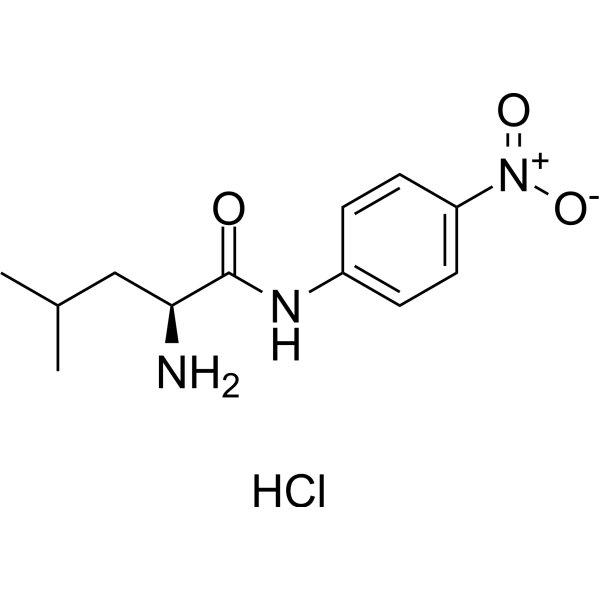
L-Leucyl-4-nitroanilide hydrochloride
 0 Images
L-Leucyl-4-nitroanilide hydrochloride is a chromogenic substrate suitable for activity assays of leucine aminopeptidase, and it can be used in studies related to the enzymatic properties of aminopeptidases.
-
H-Glu(4MβNA)-OH
 0 ImagesSynonyms: H-Glu(4MbetaNA)-OH; L-Glutamic acid γ-(4-methoxy-β-naphthylamide)
H-Glu(4MβNA)-OH is a substrate of aminopeptidases (APs).
-
Trilysine TFA
 0 ImagesSynonyms: Lys-Lys-Lys TFA; H-Lys-Lys-Lys-OH TFA
Trilysine TFA is a tripeptide and also a substrate for specific peptidases. Trilysine TFA serves as a hydrolytic substrate for the tripeptide-specific aminopeptidase TP and the oligopeptidase OP.
-
DTS-201
 0 ImagesCat. No.: HY-106154CAS No.: 274912-87-7
DTS-201 (CPI-0004) is a peptidic prodrug of Doxorubicin (HY-15142A). DTS-201, comprising the tetrapeptide portion, is cleaved by endopeptidases in the tumor environment to produce metabolites that subsequently enter the cell and are converted to active Doxorubicin. DTS-201 shows antitumoral efficacy in tumor xenograft models of prostate, breast, and lung cancer.
-
H-Ala-Pro-Ala-OH
 0 ImagesCat. No.: HY-W794670CAS No.: 61430-14-6
H-Ala-Pro-Ala-OH, tripeptide, is a substrate for Escherichia coli PepP (Xaa-Pro aminopeptidase). H-Ala-Pro-Ala-OH acts as a nitrogen source for wild-type Escherichia coli.
-
Met-AMC
 0 ImagesCat. No.: HY-184777CAS No.: 94367-34-7
Met-AMC is a fluorescent substrate used to detect the activity of methionine aminopeptidase (MetAP). Hydrolysis of the substrate releases the fluorophore AMC, with detection performed at an excitation wavelength of 360 nm and an emission wavelength of 460 nm. Met-AMC can distinguish the effects of different metal cofactors on the substrate preference of MetAP1: Zn (II)-MetAP1 barely hydrolyzes Met-AMC, while Co (II)-, Mn (II)-, and Ni (II)-MetAP1 can stably cleave this substrate. Met-AMC can be used to establish an intracellular MetAP activity cell-based assay system, which quantifies the intracellular MetAP inhibition level by monitoring the fluorescence signal from substrate hydrolysis in living cells.
-
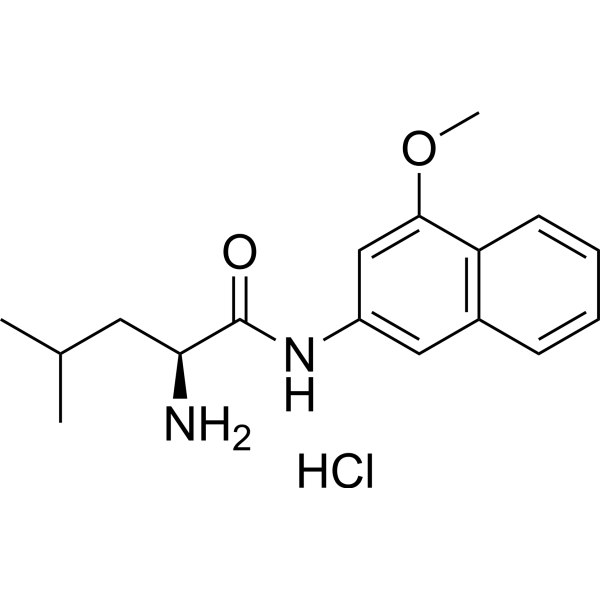
L-Leucine 4-methoxy-β-naphthylamide hydrochloride
 0 Images
L-Leucine 4-methoxy-β-naphthylamide hydrochloride is an aminopeptidase M and leucine aminopeptidase substrate.
-
L-Alanine-2-naphthylamide
 0 Images
L-Alanine-2-naphthylamide (Alanine β-naphthylamide) is an Aminopeptidase (E.C. 3.4.11.) substrate and detection reagent. L-Alanine-2-naphthylamide detects the functional activity of aminopeptidase in the intestine of larval whitefish (Coregonus lavaretus). L-Alanine-2-naphthylamide serves as an initiator in the N-carboxyanhydride (NCA) method for synthesizing poly (β-benzyl-L-aspartate) polymers with a terminal 2-naphthyl energy donor group.
-
L-Pyroglutamic acid 7-amido-4-methylcoumarin
 0 ImagesCat. No.: HY-W286423CAS No.: 66642-36-2
L-Pyroglutamic acid 7-amido-4-methylcoumarin is a fluorogenic substrate for pyroglutamate aminopeptidase 1 (PGP-1).
-
DTS-201 sodium
 0 ImagesCat. No.: HY-P10759CAS No.: 372491-73-1
DTS-201 sodium (CPI-0004Na) is a peptidic prodrug of Doxorubicin (HY-15142A). DTS-201, comprising the tetrapeptide portion, is cleaved by endopeptidases in the tumor environment to produce metabolites that subsequently enter the cell and are converted to active Doxorubicin. DTS-201 shows antitumoral efficacy in tumor xenograft models of prostate, breast, and lung cancer.
-
L&M-D-MR
 0 ImagesCat. No.: HY-D3191
L&M-D-MR is a highly specific fluorescent "AND" logic probe with response moieties for leucine aminopeptidase (LAP) and monoamine oxidase (MAO). The coexistence of both LAP and MAO is required for L&M-D-MR to trigger intramolecular cyclization, release fluorophores and activate fluorescence. In the presence of only a single enzyme, L&M-D-MR generates only an extremely weak signal. L&M-D-MR enables bioimaging in living cells and mouse models, and can effectively distinguish different subtypes of liver diseases via blood samples or test strips. L&M-D-MR is widely used in studies related to liver cirrhosis, hepatitis B and drug-induced liver injury.

-
Suc-Ala-Ala-Pro-Leu-pNA
 0 ImagesSynonyms: N-Succinyl-AAPL-p-nitroanilide
Suc-Ala-Ala-Pro-Leu-pNA (N-Succinyl-AAPL-p-nitroanilide) is a tripeptidyl p-nitroanilide substrate that can be catalytically hydrolyzed by acyl amidase-like leucine aminopeptidase in seminal plasma. Amastatin (HY-129298) and Actinonin (HY-113952) exert potent inhibitory effects on this hydrolytic activity. Suc-Ala-Ala-Pro-Leu-pNA can be used for the research of diseases such as azoospermia.
- 1



