



DYRK3
DYRK3 (dual-specificity tyrosine phosphorylation-regulated kinase 3) functions as a serine/threonine and tyrosine kinase involved in cellular stress responses and proteostasis[1]. Mechanistically, DYRK3 phosphorylates components of stress granules and liquid-liquid phase separation structures, thereby regulating protein solubility and phase transition during nutrient deprivation or hypoxic stress[1]. In disease models, DYRK3 activity influences tumor cell survival by controlling proteasome function and modulating key transcription factors, including heat-shock factor 1 and c-Myc[1]. Compared with related isoforms such as DYRK1A and DYRK2, DYRK3 exhibits a distinct cytoplasmic localization and preferential engagement with stress granule substrates rather than nuclear transcriptional regulators[1][2]. Small-molecule inhibitors of DYRK3, characterized by high selectivity within the CMGC kinase family, have demonstrated the ability to disrupt stress-mediated proteostasis and reduce tumor cell proliferation in preclinical studies[3][4]. These inhibitors, often based on pyrimidine or imidazopyridazine scaffolds, facilitate mechanistic studies and provide a foundation for experimental applications targeting DYRK3-dependent pathways[3][4]. Overall, DYRK3 serves as a regulatory kinase coordinating cellular adaptation to environmental stress, distinguishing itself from other DYRK isoforms through substrate specificity and cytoplasmic function, with emerging potential for therapeutic intervention[2][1].
References:
- [1]. Tandon V, et al. Emerging roles of DYRK2 in cancer. J Biol Chem. 2021 Jan-Jun;296:100233. [Content Brief]
- [2]. Lindberg MF, et al. Dual-Specificity, Tyrosine Phosphorylation-Regulated Kinases (DYRKs) and cdc2-Like Kinases (CLKs) in Human Disease, an Overview. Int J Mol Sci. 2021 Jun 3;22(11):6047. [Content Brief]
- [3]. Coombs TC, et al. Small-molecule pyrimidine inhibitors of the cdc2-like (Clk) and dual specificity tyrosine phosphorylation-regulated (Dyrk) kinases: development of chemical probe ML315. Bioorg Med Chem Lett. 2013 Jun 15;23(12):3654-61. [Content Brief]
- [4]. Henderson SH, et al. Imidazo[1,2-b]pyridazines as inhibitors of DYRK kinases. Eur J Med Chem. 2024 Apr 5;269:116292. [Content Brief]
All Product Categories
-
DYRK3 Related Products (5)
Related Products (5)

-
Leucettine L41
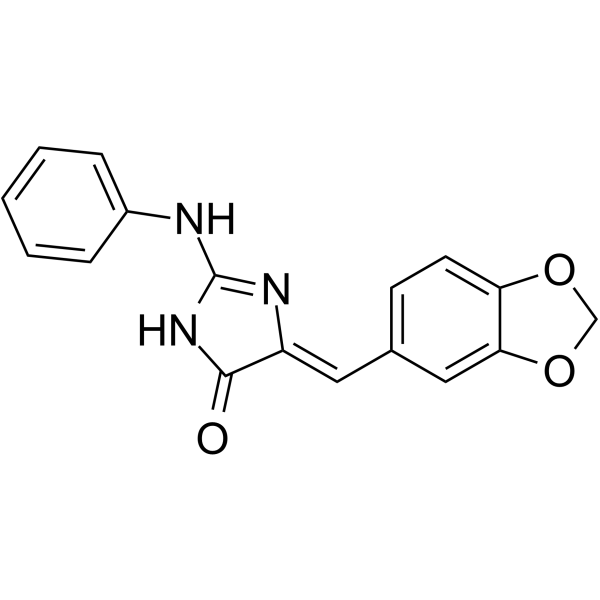 0 ImagesLeucettine L41 is a potent inhibitor of dual-specificity tyrosine phosphorylation-regulated kinases (DYRKs) and CDC-like kinases (CLKs). Leucettine L41 can also inhibit GSK-3 singnaling. Leucettine L41 can inhibit cell apoptosis and ROS production. Leucettine L41 can promote β-cell cell cycle progression, cell proliferation and increase insulin secretion. Leucettine L41 can be used for the researches of neurological disease and metabolic disease, such as Alzheimer’s disease (AD) and diabetes.
-
ZJCK-6-46
 0 ImagesZJCK-6-46 (32) is a potential and orally activeDYRK1A inhibitor (IC50 = 0.68 nM) with high BBB permeability (CNS+). ZJCK-6-46 (32) reduces tau phosphorylation. ZJCK-6-46 (32) ameliorates cognitive dysfunction by obviously reducing the expression of phosphorylated tau and neuronal loss in vivo.
-
DYRK2-IN-2
 0 ImagesCat. No.: HY-402805CAS No.: 2416195-65-6DYRK2-IN-2 (Compound C17) is a selective inhibitor of DYRK2, with its IC50 value being 40.3 nM. The inhibitory activity of DYRK2-IN-2 on DYRK1A (IC50 = 1842 nM), DYRK1B (IC50 = 1335 nM), DYRK4 (IC50 = 1931 nM), DYRK3 (IC50 = 112 nM), and CLKs (IC50 = 540-6496 NM) is relatively low. DYRK2-IN-2 inhibits the phosphorylation of Tau protein at Thr212 and shows moderate cytotoxicity in HT22 cells. DYRK2-IN-2 can be used in cancer research.
-
DYRK2-IN-2 hydrochloride
 0 ImagesCat. No.: HY-402805ADYRK2-IN-2 hydrochloride is a selective DYRK2 inhibitor with an IC50 of 40.3 nM. DYRK2-IN-2 hydrochloride shows weaker inhibitory activity against DYRK1A (IC50 = 1842 nM), DYRK1B (IC50 = 1335 nM), DYRK4 (IC50 = 1931 nM), DYRK3 (IC50 = 112 nM) and CLK (IC50 = 540-6496 nM). DYRK2-IN-2 hydrochloride inhibits the phosphorylation of Thr212 in Tau protein. DYRK2-IN-2 hydrochloride is applicable for neuronal research.



