



NTPDase3
Nucleoside triphosphate diphosphohydrolase 3 (NTPDase3) is a membrane-bound ectonucleotidase that hydrolyzes extracellular ATP and ADP, thereby modulating purinergic signaling in diverse tissues[1][2]. In pancreatic β-cells, NTPDase3 regulates glucose-induced insulin secretion by controlling the availability of ATP to P2 purinergic receptors, impacting insulinotropic responses under varying glucose conditions[2][3]. Mechanistically, NTPDase3 activity affects the balance between ATP, ADP, and AMP, influencing downstream P1 and P2 receptor signaling[4]. Distinct from related isoforms such as NTPDase1 and NTPDase2, NTPDase3 exhibits a unique expression profile, being abundant in pancreatic islets, digestive epithelial cells, and enteric neurons, while other isoforms localize primarily to vasculature or glial cells[3][4][5]. Structural analyses have revealed five conserved disulfide bonds critical for enzymatic activity, proper folding, and trafficking to the plasma membrane, and NTPDase3 shares limited homology with bacterial exopolyphosphatases, providing a framework for structural modeling[6]. Functionally, selective inhibition of NTPDase3 by ectonucleotidase blockers such as ARL67156 enhances insulin secretion, illustrating its potential as a modulatory target in experimental studies of purinergic signaling and metabolic regulation[2][3]. In disease models, global deletion of NTPDase3 confers protection against diet-induced obesity, mediated through increased basal energy metabolism and enhanced thermogenic gene expression, highlighting its role beyond pancreatic β-cells[7].
References:
- [1]. Batool A, et al. Eukaryotic initiation factor 4E is a novel effector of mTORC1 signaling pathway in cross talk with Mnk1. Mol Cell Biochem. 2020 Feb;465(1-2):13-26. [Content Brief]
- [2]. Crawford PA, et al. Characterization of an alternative splice variant of human nucleoside triphosphate diphosphohydrolase 3 (NTPDase3): a possible modulator of nucleotidase activity and purinergic signaling. Arch Biochem Biophys. 2007 Jan 1;457(1):7-15. [Content Brief]
- [3]. Syed SK, et al. Ectonucleotidase NTPDase3 is abundant in pancreatic β-cells and regulates glucose-induced insulin secretion. Am J Physiol Endocrinol Metab. 2013 Nov 15;305(10):E1319-26. [Content Brief]
- [4]. Sandhu B, et al. Global deletion of NTPDase3 protects against diet-induced obesity by increasing basal energy metabolism. Metabolism. 2021 May;118:154731. [Content Brief]
- [5]. Lavoie EG, et al. Identification of the ectonucleotidases expressed in mouse, rat, and human Langerhans islets: potential role of NTPDase3 in insulin secretion. Am J Physiol Endocrinol Metab. 2010 Oct;299(4):E647-56. [Content Brief]
- [6]. Grubišić V, et al. NTPDase1 and -2 are expressed by distinct cellular compartments in the mouse colon and differentially impact colonic physiology and function after DSS colitis. Am J Physiol Gastrointest Liver Physiol. 2019 Sep 1;317(3):G314-G332. [Content Brief]
- [7]. Lavoie EG, et al. Ectonucleotidases in the digestive system: focus on NTPDase3 localization. Am J Physiol Gastrointest Liver Physiol. 2011 Apr;300(4):G608-20. [Content Brief]
- [8]. Ivanenkov VV, et al. Characterization of disulfide bonds in human nucleoside triphosphate diphosphohydrolase 3 (NTPDase3): implications for NTPDase structural modeling. Biochemistry. 2005 Jun 28;44(25):8998-9012. [Content Brief]
All Product Categories
-
NTPDase3 Related Products (1)
Related Products (1)

-
NF279
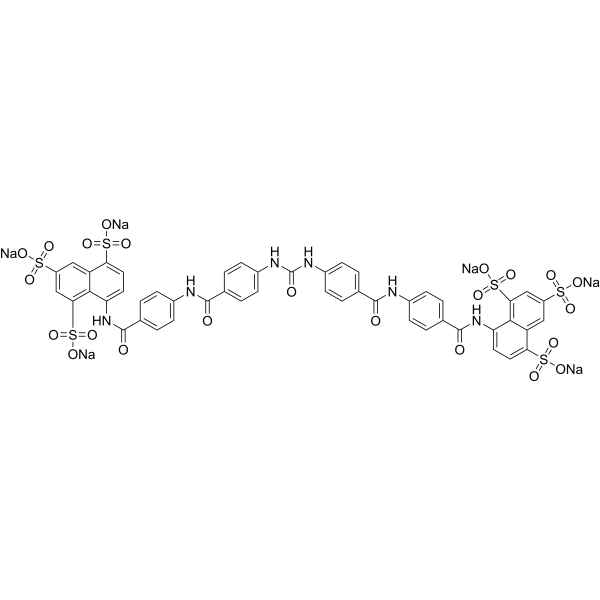 0 ImagesNF279 is a selective P2X1 receptor antagonist and NTPDase inhibitor, with a P2X1 IC50 value of 19 nM. NF279 suppresses GABA-evoked currents, reduces ATP-excited respiratory activity, alters hypoglossal nerve burst parameters, and blocks CXCR4, CCR5, CXCR3, and CXCR7-mediated calcium responses. NF279 arrests HIV-1 fusion downstream of CD4 binding, inhibits R5- and X4-tropic HIV-1 strains. NF279 can be used for the research of HIV-1 infection.



