



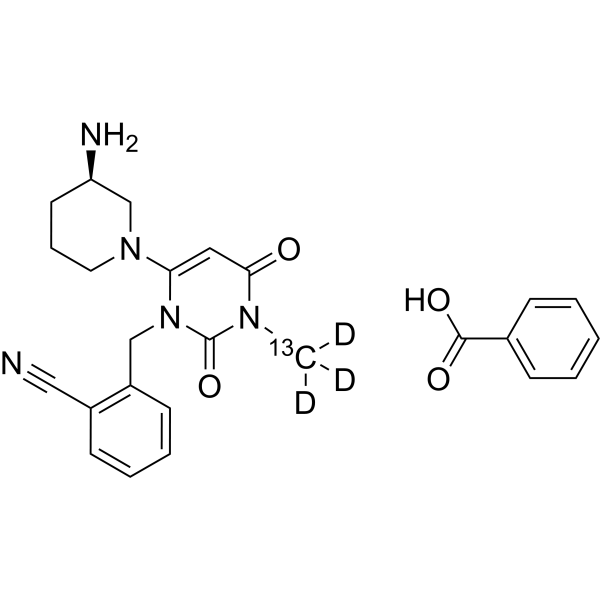
Alogliptin-13C,d3 benzoate

Based on 1 Customer Validation
Alogliptin-13C,d3 (SYR-322-13C,d3) benzoate is deuterium labeled Alogliptin Benzoate (HY-A0023). Alogliptin Benzoate (SYR-322) is a potent, selective and orally active inhibitor of DPP-4 with an IC50 of <10 nM, and exhibits greater than 10,000-fold selectivity over DPP-8 and DPP-9. Alogliptin Benzoate can be used for the research of type 2 diabetes.
For research use only. We do not sell to patients.
- Purity : 98.77%
- Formula: C2413CH24D3N5O4
- Molecular Weight:465.52
-
Storage:
-20°C, sealed storage, away from moisture
* In solvent : -80°C, 6 months; -20°C, 1 month (sealed storage, away from moisture)

To place orders, for customer services and technical support, please contact: MedChemExpress USA
Tel: 609-228-6898 E-mail: [email protected] [email protected]


-
 Biological Activity
-
Chemical Information
-
Solvent & Solubility
- Protocols
- Purity & Documentation
- References
-
 Help & FAQs




Biological Activity
Description
In Vitro
Stable heavy isotopes of hydrogen, carbon, and other elements have been incorporated into drug molecules, largely as tracers for quantitation during the drug development process. Deuteration has gained attention because of its potential to affect the pharmacokinetic and metabolic profiles of drugs.
MedChemExpress (MCE) has not independently confirmed the accuracy of these methods. They are for reference only. Further protocols information, click here.
Application
1. This compound can be used as a tracer
2. This compound can be used as an internal standard for quantitative analysis by NMR, GC-MS, or LC-MS.


Chemical Information
-
Unlabeled CAS 850649-61-5
-
Appearance Solid
-
Molecular Weight 465.52
-
Formula C2413CH24D3N5O4
-
Color White to off-white
-
SMILES
O=C(C=C(N1C[C@H](N)CCC1)N(C2=O)CC3=C(C#N)C=CC=C3)N2[13C]([2H])([2H])[2H].O=C(O)C4=CC=CC=C4
-
Synonyms
SYR-322-13C,d3 benzoate
-
Shipping
Room temperature in continental US; may vary elsewhere.
-
Storage
-20°C, sealed storage, away from moisture
* In solvent : -80°C, 6 months; -20°C, 1 month (sealed storage, away from moisture)


Solvent & Solubility
In Vitro:
DMSO : 100 mg/mL (214.81 mM; Need ultrasonic; Hygroscopic DMSO has a significant impact on the solubility of product, please use newly opened DMSO)
H2O : 10 mg/mL (21.48 mM; ultrasonic and warming and heat to 60°C)
Please refer to the solubility information to select the appropriate solvent. Once prepared, please aliquot and store the solution to prevent product inactivation from repeated freeze-thaw cycles.
Storage method and period of stock solution: -80°C, 6 months; -20°C, 1 month (sealed storage, away from moisture). When stored at -80°C, please use it within 6 months. When stored at -20°C, please use it within 1 month.
* Note: If you choose water as the stock solution, please dilute it to the working solution, then filter and sterilize it with a 0.22 μm filter before use.
Please refer to the solubility information to select the appropriate solvent. Once prepared, please aliquot and store the solution to prevent product inactivation from repeated freeze-thaw cycles.
Storage method and period of stock solution: -80°C, 6 months; -20°C, 1 month (sealed storage, away from moisture). When stored at -80°C, please use it within 6 months. When stored at -20°C, please use it within 1 month.
* Note: If you choose water as the stock solution, please dilute it to the working solution, then filter and sterilize it with a 0.22 μm filter before use.
Concentration (start) × Volume (start) = Concentration (final) × Volume (final)

Protocols
-
Cell Cytotoxicity Assay
Cytotoxicity assays are usually based on the assessment of cell membrane damage, which can also be indirectly detected by measuring cell viability. Detection methods include MTT assay, CKK-8 assay, LDH assay and ATP assay, etc.
-
Research Protocol for Metabolic Diseases
AMP-activated protein kinase, AMPK, is a conserved cellular energy sensor that responds to reduced cellular energy status and coordinates metabolism by increasing ATP-generating catabolic pathways while suppressing ATP-consuming anabolic processes. In metabolic disease research, the AMPK pathway is experimentally relevant because it regulates hepatic lipid synthesis, fatty acid oxidation, glucose production, skeletal-muscle glucose disposal, mTORC1-linked biosynthesis, autophagy, mitochondrial homeostasis, and whole-body energy balance. The central pathway logic is that energy stress, metformin, exercise-like stimulation, or direct AMPK activators increase AMPKα Thr172 phosphorylation and downstream substrate phosphorylation, including ACC and RAPTOR. Phosphorylation of ACC suppresses lipogenesis and supports fatty acid oxidation, whereas phosphorylation of RAPTOR suppresses mTORC1 signaling and links cellular energy status to growth and protein synthesis control. The pathway is linked


Purity & Documentation
-
Data Sheet (275 KB)
-
SDS (252 KB)
- English - EN (252 KB)
- Français - FR (252 KB)
- Deutsch - DE (252 KB)
- Norwegian - NO (252 KB)
- Español - ES (252 KB)
- Swedish - SV (252 KB)
- Italian - IT (252 KB)
- Korean - KR (252 KB)
- Portuguese - PT (252 KB)
-
Handling Instructions (2659 KB)
References
[1]. Russak EM, et al. Impact of Deuterium Substitution on the Pharmacokinetics of Pharmaceuticals. Ann Pharmacother. 2019;53(2):211-216. [Content Brief]
[2]. Feng J, et al. Discovery of alogliptin: a potent, selective, bioavailable, and efficacious inhibitor of dipeptidyl peptidase IV. J Med Chem. 2007 May 17;50(10):2297-300. [Content Brief]
[3]. Ta NN, et al. DPP-4 (CD26) inhibitor alogliptin inhibits TLR4-mediated ERK activation and ERK-dependent MMP-1 expression by U937 histiocytes. Atherosclerosis. 2010 Dec;213(2):429-35. [Content Brief]
[4]. Hao FL, et, al. The neurovascular protective effect of alogliptin in murine MCAO model and brain endothelial cells. Biomed Pharmacother. 2019 Jan;109:181-187. [Content Brief]
[5]. Asakawa T, et al. A novel dipeptidyl peptidase-4 inhibitor, alogliptin (SYR-322), is effective in diabetic rats with sulfonylurea-induced secondary failure. Life Sci. 2009 Jul 17;85(3-4):122-6. [Content Brief]
[6]. Moritoh Y, et al. The dipeptidyl peptidase-4 inhibitor alogliptin in combination with pioglitazone improves glycemic control, lipid profiles, and increases pancreatic insulin content in ob/ob mice. Eur J Pharmacol. 2009 Jan 14;602(2-3):448-54. [Content Brief]


Complete Stock Solution Preparation Table
Please refer to the solubility information to select the appropriate solvent. Once prepared, please aliquot and store the solution to prevent product inactivation from repeated freeze-thaw cycles.
Storage method and period of stock solution: -80°C, 6 months; -20°C, 1 month (sealed storage, away from moisture). When stored at -80°C, please use it within 6 months. When stored at -20°C, please use it within 1 month.
| Optional Solvent | Concentration Solvent Mass | 1 mg | 5 mg | 10 mg | 25 mg |
|---|---|---|---|---|---|
| H2O / DMSO | 1 mM | 2.1481 mL | 10.7407 mL | 21.4814 mL | 53.7034 mL |
| 5 mM | 0.4296 mL | 2.1481 mL | 4.2963 mL | 10.7407 mL | |
| 10 mM | 0.2148 mL | 1.0741 mL | 2.1481 mL | 5.3703 mL | |
| 15 mM | 0.1432 mL | 0.7160 mL | 1.4321 mL | 3.5802 mL | |
| 20 mM | 0.1074 mL | 0.5370 mL | 1.0741 mL | 2.6852 mL | |
| DMSO | 25 mM | 0.0859 mL | 0.4296 mL | 0.8593 mL | 2.1481 mL |
| 30 mM | 0.0716 mL | 0.3580 mL | 0.7160 mL | 1.7901 mL | |
| 40 mM | 0.0537 mL | 0.2685 mL | 0.5370 mL | 1.3426 mL | |
| 50 mM | 0.0430 mL | 0.2148 mL | 0.4296 mL | 1.0741 mL | |
| 60 mM | 0.0358 mL | 0.1790 mL | 0.3580 mL | 0.8951 mL | |
| 80 mM | 0.0269 mL | 0.1343 mL | 0.2685 mL | 0.6713 mL | |
| 100 mM | 0.0215 mL | 0.1074 mL | 0.2148 mL | 0.5370 mL |
* Note: If you choose water as the stock solution, please dilute it to the working solution, then filter and sterilize it with a 0.22 μm filter before use.


Alogliptin-13C,d3 benzoate Related Classifications
HY-A0023AS2 Related Classifications
 Powered by Bioz