



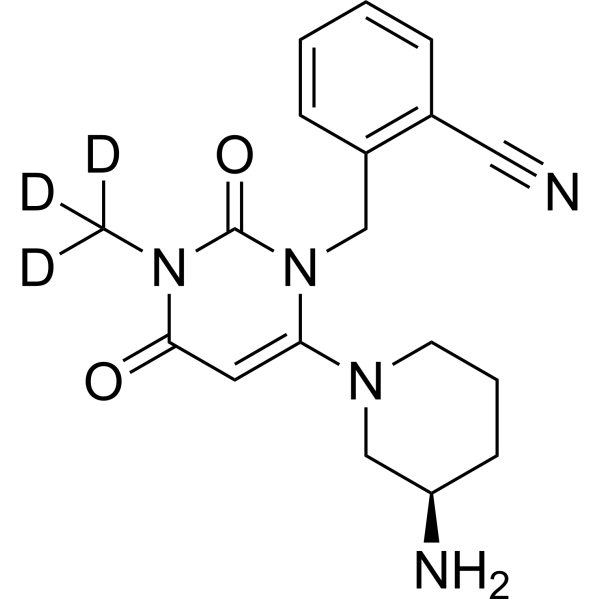
Alogliptin-d3

Based on 1 Customer Validation
Alogliptin-d3 is the deuterium labeled Alogliptin. Alogliptin (SYR-322 free base) is a potent, selective and orally active inhibitor of DPP-4 with an IC50 of <10 nM, and exhibits greater than 10,000-fold selectivity over DPP-8 and DPP-9. Alogliptin can be used for the research of type 2 diabetes.
Nur für Forschungszwecke. Wir verkaufen nicht an Patienten.
- Reinheit : 99.61%
- CAS. Nr.: 1133421-35-8
- Formel: C18H18D3N5O2
- Molecular Weight:342.41
-
Speicherung:Powder -20°C, 3 years , 4°C, 2 years ; In solvent -80°C, 6 months , -20°C, 1 month

To place orders, for customer services and technical support, please contact: MedChemExpress USA
Tel: 609-228-6898 E-mail: [email protected] [email protected]


-
 Biologische Aktivität
-
Chemical Information
-
Lösungsmittel & Löslichkeit
- Protokoll
- Reinheit & Dokumentation
- Verweise
-
 Help & FAQs




Biologische Aktivität
Beschreibung
IC50 & Target
|
DPP-4 |
In Vitro
Stable heavy isotopes of hydrogen, carbon, and other elements have been incorporated into drug molecules, largely as tracers for quantitation during the drug development process. Deuteration has gained attention because of its potential to affect the pharmacokinetic and metabolic profiles of drugs[1].
MedChemExpress (MCE) has not independently confirmed the accuracy of these methods. They are for reference only.
Anwendung
1. This compound can be used as a tracer
2. This compound can be used as an internal standard for quantitative analysis by NMR, GC-MS, or LC-MS.


Chemical Information
-
CAS. Nr. 1133421-35-8
-
Unlabeled CAS 850649-61-5
-
Appearance Solid
-
Molecular Weight 342.41
-
Formel C18H18D3N5O2
-
Color White to off-white
-
SMILES
O=C(N(C1=O)C([2H])([2H])[2H])C=C(N2C[C@@H](CCC2)N)N1CC3=C(C=CC=C3)C#N
-
Synonyms
SYR-322-d3 free base
-
Versand
Room temperature in continental US; may vary elsewhere.
-
Speicherung
Powder -20°C 3 years 4°C 2 years In solvent -80°C 6 months -20°C 1 month


Lösungsmittel & Löslichkeit
In Vitro:
DMSO : 100 mg/mL (292.05 mM; Need ultrasonic; Hygroscopic DMSO has a significant impact on the solubility of product, please use newly opened DMSO)
H2O : 10 mg/mL (29.20 mM; ultrasonic and warming and heat to 60°C)
Please refer to the solubility information to select the appropriate solvent. Once prepared, please aliquot and store the solution to prevent product inactivation from repeated freeze-thaw cycles.
Storage method and period of stock solution: -80°C, 6 months; -20°C, 1 month. When stored at -80°C, please use it within 6 months. When stored at -20°C, please use it within 1 month.
* Note: If you choose water as the stock solution, please dilute it to the working solution, then filter and sterilize it with a 0.22 μm filter before use.
Please refer to the solubility information to select the appropriate solvent. Once prepared, please aliquot and store the solution to prevent product inactivation from repeated freeze-thaw cycles.
Storage method and period of stock solution: -80°C, 6 months; -20°C, 1 month. When stored at -80°C, please use it within 6 months. When stored at -20°C, please use it within 1 month.
* Note: If you choose water as the stock solution, please dilute it to the working solution, then filter and sterilize it with a 0.22 μm filter before use.
Konzentration (Stammlösung) × Volumen (Stammlösung) = Konzentration (Ziellösung) × Volumen (Ziellösung)


Reinheit & Dokumentation
-
Data Sheet (278 KB)
-
SDS (252 KB)
- English - EN (252 KB)
- Français - FR (252 KB)
- Deutsch - DE (252 KB)
- Norwegian - NO (252 KB)
- Español - ES (252 KB)
- Swedish - SV (252 KB)
- Italian - IT (252 KB)
- Korean - KR (252 KB)
- Portuguese - PT (252 KB)
-
Handling Instructions (2659 KB)
Verweise
[1]. Russak EM, et al. Impact of Deuterium Substitution on the Pharmacokinetics of Pharmaceuticals. Ann Pharmacother. 2019;53(2):211-216. [Content Brief]
[2]. Feng J, et al. Discovery of alogliptin: a potent, selective, bioavailable, and efficacious inhibitor of dipeptidyl peptidase IV. J Med Chem. 2007 May 17;50(10):2297-300. [Content Brief]
[3]. Ta NN, et al. DPP-4 (CD26) inhibitor alogliptin inhibits TLR4-mediated ERK activation and ERK-dependent MMP-1 expression by U937 histiocytes. Atherosclerosis. 2010 Dec;213(2):429-35. [Content Brief]
[4]. Hao FL, et, al. The neurovascular protective effect of alogliptin in murine MCAO model and brain endothelial cells. Biomed Pharmacother. 2019 Jan;109:181-187. [Content Brief]
[5]. Asakawa T, et al. A novel dipeptidyl peptidase-4 inhibitor, alogliptin (SYR-322), is effective in diabetic rats with sulfonylurea-induced secondary failure. Life Sci. 2009 Jul 17;85(3-4):122-6. [Content Brief]
[6]. Moritoh Y, et al. The dipeptidyl peptidase-4 inhibitor alogliptin in combination with pioglitazone improves glycemic control, lipid profiles, and increases pancreatic insulin content in ob/ob mice. Eur J Pharmacol. 2009 Jan 14;602(2-3):448-54. [Content Brief]


Complete Stock Solution Preparation Table
Please refer to the solubility information to select the appropriate solvent. Once prepared, please aliquot and store the solution to prevent product inactivation from repeated freeze-thaw cycles.
Storage method and period of stock solution: -80°C, 6 months; -20°C, 1 month. When stored at -80°C, please use it within 6 months. When stored at -20°C, please use it within 1 month.
| Optional Solvent | Concentration Solvent Mass | 1 mg | 5 mg | 10 mg | 25 mg |
|---|---|---|---|---|---|
| H2O / DMSO | 1 mM | 2.9205 mL | 14.6024 mL | 29.2048 mL | 73.0119 mL |
| 5 mM | 0.5841 mL | 2.9205 mL | 5.8410 mL | 14.6024 mL | |
| 10 mM | 0.2920 mL | 1.4602 mL | 2.9205 mL | 7.3012 mL | |
| 15 mM | 0.1947 mL | 0.9735 mL | 1.9470 mL | 4.8675 mL | |
| 20 mM | 0.1460 mL | 0.7301 mL | 1.4602 mL | 3.6506 mL | |
| 25 mM | 0.1168 mL | 0.5841 mL | 1.1682 mL | 2.9205 mL | |
| DMSO | 30 mM | 0.0973 mL | 0.4867 mL | 0.9735 mL | 2.4337 mL |
| 40 mM | 0.0730 mL | 0.3651 mL | 0.7301 mL | 1.8253 mL | |
| 50 mM | 0.0584 mL | 0.2920 mL | 0.5841 mL | 1.4602 mL | |
| 60 mM | 0.0487 mL | 0.2434 mL | 0.4867 mL | 1.2169 mL | |
| 80 mM | 0.0365 mL | 0.1825 mL | 0.3651 mL | 0.9126 mL | |
| 100 mM | 0.0292 mL | 0.1460 mL | 0.2920 mL | 0.7301 mL |
* Note: If you choose water as the stock solution, please dilute it to the working solution, then filter and sterilize it with a 0.22 μm filter before use.


Alogliptin-d3 Related Classifications
HY-A0023AS1 Related Classifications
 Powered by Bioz