



Parkin Antibody
(Synonyms: AR-JP; LPRS2; PARK2; parkin; parkin 2; PDJ; PRKN; PRKN2)
Based on 1 Customer Validation
Parkin Antibody is a Rabbit-derived and non-conjugated IgG polyclonal antibody, targeting to Parkin.
-
Host:
Rabbit
-
Isotype:
IgG
-
Application:
WB, IHC-P, ICC/IF, IP, FC
-
Reactivity :
Human, Mouse, Rat
-
Formulation:
Supplied in Rabbit IgG in 10mM phosphate buffered saline , pH 7.4, 150mM sodium chloride, 0.05% BSA, 0.02% sodium azide and 50% glycerol.
-
Conjugation:
Non-conjugated


To place orders, for customer services and technical support, please contact: MedChemExpress USA
Tel: 609-228-6898 E-mail: [email protected] [email protected]





Applications
| Application |
WB

WB: Western Blot
|
IHC-P
IHC-P: Immunohistochemistry-Paraffin
|
ICC/IF
ICC/IF: Immunocytochemistry/
Immunofluorescence |
IP
IP: Immunoprecipitation
|
FC
FC: Flow Cytometry
|
|---|---|---|---|---|---|
| Dilution Ratio | 1:500-1:1000 | 1:50-1:100 | 1:50-1:200 | 1:20 | 1:50-1:100 |


Product Details
Parkin Antibody is a Rabbit-derived and non-conjugated IgG polyclonal antibody, targeting to Parkin.
-
Host Rabbit

-
Clonality Polyclonal

-
Species ReactivityHuman, Mouse, Rat
-
Observed Molecular WeightObserved band size: 52 kDa
Note: Due to possible protein modifications or aggregation, the molecular weight should be confirmed by actual measurement, and the predicted value is for reference only.

-
Calculated Molecular Weight Predicted band size: 52 kDa

Entrez Gene: 5071 Human ; 50873 Mouse ; 56816 Rat
SwissProt: O60260 Human ; Q9WVS6 Mouse ; Q9JK66 Rat
OMIM: 168600 Human
Synthetic peptide corresponding to Human Parkin aa5-56.
Endogenous
affinity purified
Non-conjugated
Unmodified
IgG


Product Properties
-
Appearance
Solution
-
Formulation
Supplied in Rabbit IgG in 10mM phosphate buffered saline , pH 7.4, 150mM sodium chloride, 0.05% BSA, 0.02% sodium azide and 50% glycerol.
-
Concentration
Batch-dependent, Please check the COA for the concentration of each lot. Check Lot Concentration
-
Storage & Stability
Stored at -20°C for 1 year. Avoid repeated freeze / thaw cycles.
-
Livraison
Shipping with blue ice.


Verification Images
-
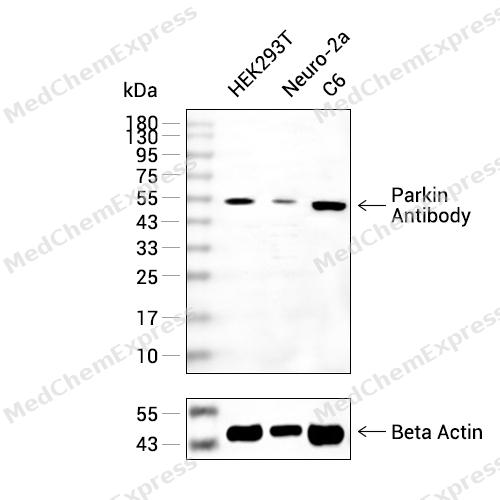 Western blot analysis of extracts from KHEK293T(lane 2(20μg) , Neuro-2a(lane 3(20ug) and C6(lane 4(20μg) using Parkin Antibody (HY-P80779) Rabbit mAb. Proteins were transferred to a PVDF membrane and blocked with 5% non-fat milk in TBST for 2 hour at room temperature. The primary antibody (1/1000) and Loading control antibody (Beta Actin, HY-P80438, 1/10000) was used in 5% non-fat milk in TBST at 4°C overnight. Goat Anti-Mouse/Rabbit IgG-HRP Secondary Antibody (1/10000) was used for 1 hour at room temperature.
 -
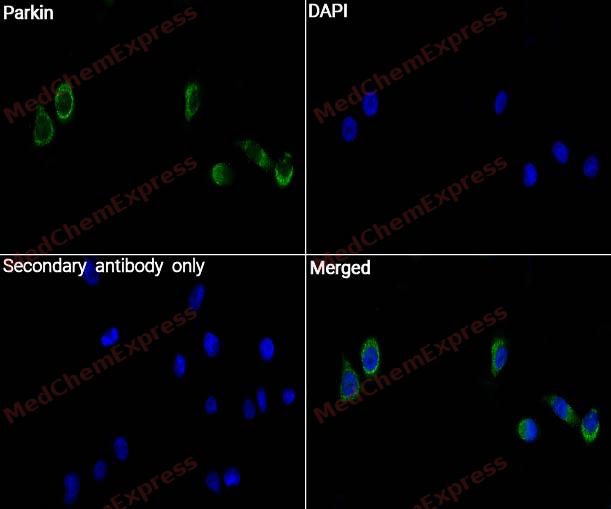 Immunocytochemistry analysis of SH-SY5Y cells labeling Parkin with Parkin Antibody (HY-P80779) at 1/50 dilution. Cells were fixed in 4% paraformaldehyde for 15 minutes at room temperature, permeabilized with 0.1% Triton X-100 for 10 minutes at room temperature, then blocked with QuickBlock™ Blocking Buffer for Immunol Staining for 10 min at room temperature. Cells were then incubated with Parkin Antibody (HY-P80779) at 1/100 dilution in QuickBlock™ Blocking Buffer for Immunol Staining at 4 ℃. Alexa Fluor® 488-conjugated AffiniPure Goat Anti-Rabbit IgG H&L(HY-P8002, Green) was used as the secondary antibody at 1/1,000 dilution. PBS instead of the primary antibody was used as the secondary antibody only control. The Nuclear counterstain was DAPI (Blue).
 -
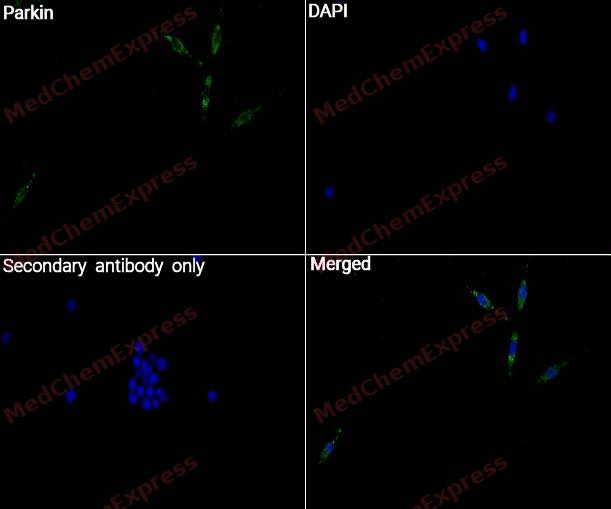 Immunocytochemistry analysis of C6 cells labeling Parkin with Parkin Antibody (HY-P80779) at 1/50 dilution. Cells were fixed in 4% paraformaldehyde for 15 minutes at room temperature, permeabilized with 0.1% Triton X-100 for 10 minutes at room temperature, then blocked with QuickBlock™ Blocking Buffer for Immunol Staining for 10 min at room temperature. Cells were then incubated with Parkin Antibody (HY-P80779) at 1/100 dilution in QuickBlock™ Blocking Buffer for Immunol Staining at 4 ℃. Alexa Fluor® 488-conjugated AffiniPure Goat Anti-Rabbit IgG H&L(HY-P8002, Green) was used as the secondary antibody at 1/1,000 dilution. PBS instead of the primary antibody was used as the secondary antibody only control. The Nuclear counterstain was DAPI (Blue).
 -
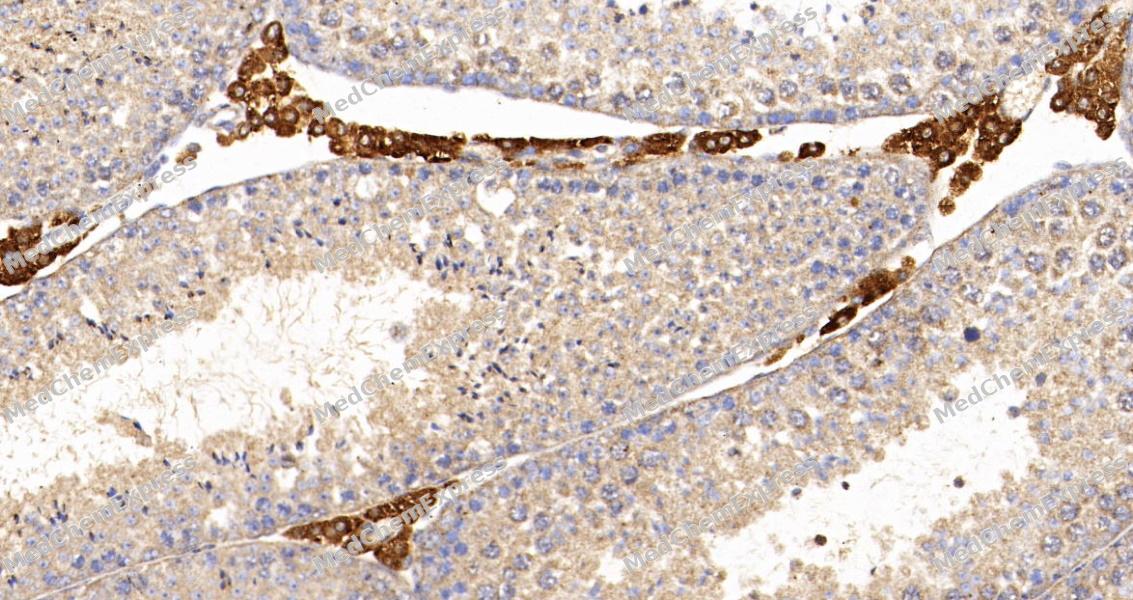 Immunohistochemical analysis of paraffin-embedded mouse testis tissue using Parkin Antibody. The section was pre-treated using heat mediated antigen retrieval with Tris-EDTA buffer (pH 8.0) for 8 minutes. The tissues were blocked in QuickBlock for 20 minutes at room temperature, washed with ddH2O and PBS, and then probed with the primary antibody at 1/100 dilution in 4℃ overnight. The detection was performed using an HRP conjugated compact polymer system. DAB was used as the chromogen. Tissues were counterstained with hematoxylin and mounted with DPX.
 -
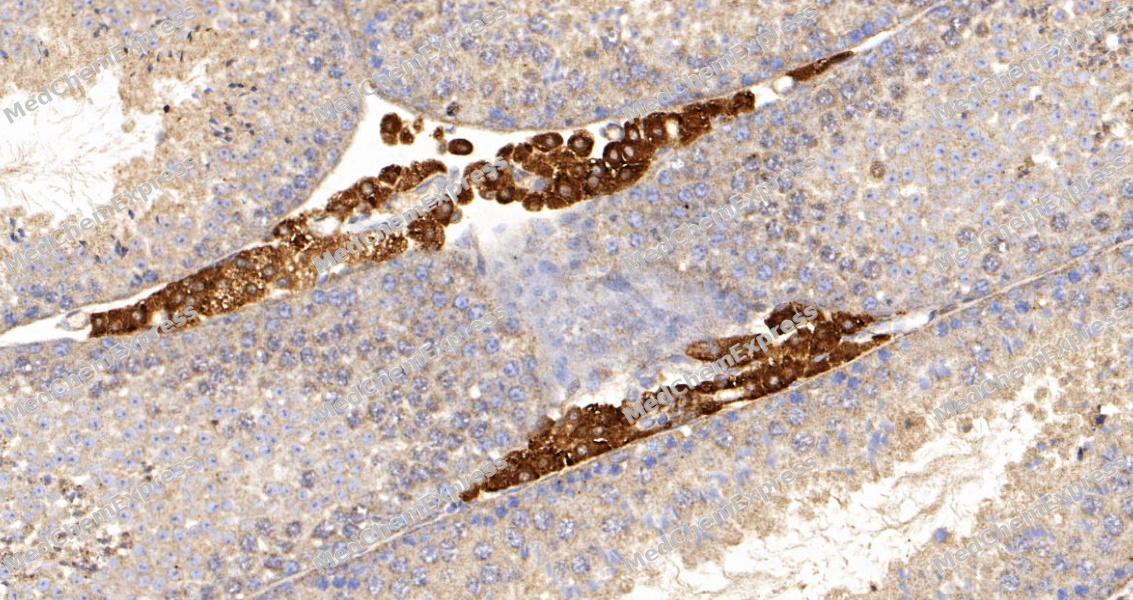 Immunohistochemical analysis of paraffin-embedded mouse testis tissue using Parkin Antibody. The section was pre-treated using heat mediated antigen retrieval with Tris-EDTA buffer (pH 8.0) for 8 minutes. The tissues were blocked in QuickBlock for 20 minutes at room temperature, washed with ddH2O and PBS, and then probed with the primary antibody at 1/100 dilution in 4℃ overnight. The detection was performed using an HRP conjugated compact polymer system. DAB was used as the chromogen. Tissues were counterstained with hematoxylin and mounted with DPX.
 -
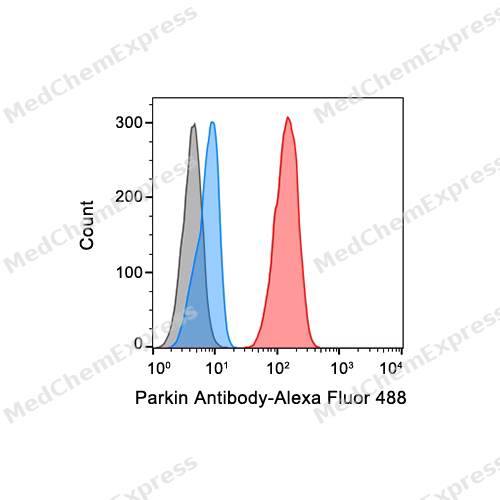 Flow cytometric analysis of 1X10^6 SH-SY5Y cells labeling Parkin Antibody (HY-P80779, red). Cells were fixed with 4% paraformaldehyde and permeabilised with 90% methanol. Then stained with the primary antibody at 1/50 dilution for an hour at 4℃. Alexa Fluor® 488-conjugated AffiniPure Goat Anti-Rabbit IgG H&L (HY-P8002) was used as the secondary antibody at 1/1,000 dilution for 30 minutes at 4℃. Rabbit IgG Isotype Control (HY-P80879, blue) was used as the isotype control, cells without incubation with primary antibody were used as the unlabeled control (black).


Background
-
Function
Parkin functions within a multiprotein E3 ubiquitin ligase complex, catalyzing the covalent attachment of ubiquitin moieties onto substrate proteins. Substrates include SYT11 and VDAC1. Other substrates are BCL2, CCNE1, GPR37, RHOT1/MIRO1, MFN1, MFN2, STUB1, SNCAIP, SEPTIN5, TOMM20, USP30, ZNF746, MIRO1 and AIMP2. Mediates monoubiquitination as well as 'Lys-6', 'Lys-11', 'Lys-48'-linked and 'Lys-63'-linked polyubiquitination of substrates depending on the context. Participates in the removal and/or detoxification of abnormally folded or damaged protein by mediating 'Lys-63'-linked polyubiquitination of misfolded proteins such as PARK7: 'Lys-63'-linked polyubiquitinated misfolded proteins are then recognized by HDAC6, leading to their recruitment to aggresomes, followed by degradation. Mediates 'Lys-63'-linked polyubiquitination of a 22 kDa O-linked glycosylated isoform of SNCAIP, possibly playing a role in Lewy-body formation. Mediates monoubiquitination of BCL2, thereby acting as a positive regulator of autophagy. Protects against mitochondrial dysfunction during cellular stress, by acting downstream of PINK1 to coordinate mitochondrial quality control mechanisms that remove and replace dysfunctional mitochondrial components. Depending on the severity of mitochondrial damage and/or dysfunction, activity ranges from preventing apoptosis and stimulating mitochondrial biogenesis to regulating mitochondrial dynamics and eliminating severely damaged mitochondria via mitophagy. Activation and recruitment onto the outer membrane of damaged/dysfunctional mitochondria (OMM) requires PINK1-mediated phosphorylation of both PRKN and ubiquitin. After mitochondrial damage, functions with PINK1 to mediate the decision between mitophagy or preventing apoptosis by inducing either the poly- or monoubiquitination of VDAC1, respectively; polyubiquitination of VDAC1 promotes mitophagy, while monoubiquitination of VDAC1 decreases mitochondrial calcium influx which ultimately inhibits apoptosis. When cellular stress results in irreversible mitochondrial damage, promotes the autophagic degradation of dysfunctional depolarized mitochondria (mitophagy) by promoting the ubiquitination of mitochondrial proteins such as TOMM20, RHOT1/MIRO1, MFN1 and USP30. Preferentially assembles 'Lys-6'-, 'Lys-11'- and 'Lys-63'-linked polyubiquitin chains, leading to mitophagy. The PINK1-PRKN pathway also promotes fission of damaged mitochondria by PINK1-mediated phosphorylation which promotes the PRKN-dependent degradation of mitochondrial proteins involved in fission such as MFN2. This prevents the refusion of unhealthy mitochondria with the mitochondrial network or initiates mitochondrial fragmentation facilitating their later engulfment by autophagosomes. Regulates motility of damaged mitochondria via the ubiquitination and subsequent degradation of MIRO1 and MIRO2; in motor neurons, this likely inhibits mitochondrial intracellular anterograde transport along the axons which probably increases the chance of the mitochondria undergoing mitophagy in the soma. Involved in mitochondrial biogenesis via the 'Lys-48'-linked polyubiquitination of transcriptional repressor ZNF746/PARIS which leads to its subsequent proteasomal degradation and allows activation of the transcription factor PPARGC1A. Limits the production of reactive oxygen species (ROS). Regulates cyclin-E during neuronal apoptosis. In collaboration with CHPF isoform 2, may enhance cell viability and protect cells from oxidative stress. Independently of its ubiquitin ligase activity, protects from apoptosis by the transcriptional repression of p53/TP53. May protect neurons against alpha synuclein toxicity, proteasomal dysfunction, GPR37 accumulation, and kainate-induced excitotoxicity. May play a role in controlling neurotransmitter trafficking at the presynaptic terminal and in calcium-dependent exocytosis. May represent a tumor suppressor gene[1][2][3][4][5][6][7][8][9][10][11][12][13][14][15][16][17][18][19][20][21][22][23][24][25][26][27][28][29][30][31][32][33][34][35][36][37][38][39].
-
Subcellular Localization
Cytoplasm, cytosol; Nucleus; Endoplasmic reticulum; Mitochondrion; Mitochondrion outer membrane; Cell projection, neuron projection; Postsynaptic density; Presynapse
-
Expression
Tissue_specificity:Highly expressed in the brain (including the substantia nigra) (PubMed:19501131, PubMed:9560156) . Also expressed in the heart, testes, and skeletal muscle (PubMed:9560156) . Downregulated or absent in tumor biopsy tissue, and not detected in the PARK2 brain (PubMed:12719539, PubMed:14614460) . Overexpression protects dopaminergic neurons from fumarate-mediated apoptosis (PubMed:12628165) . Detectable in serum (protein level) (PubMed:19501131) . -
Isoforms & Post-Translational Modification
O60260 has 8 isomers: O60260-1: 51641 Da (predicted); O60260-2: 48713 Da (predicted); O60260-3: 23639 Da (predicted); O60260-4: 30616 Da (predicted); O60260-5: 42407 Da (predicted); O60260-6: 35631 Da (predicted); O60260-7: 43485 Da (predicted); O60260-8: 46413 Da (predicted).
ISGylated. Conjugated to ubiquitin-like protein ISG15 upon IFN-beta stimulation. ISGylation positively regulates its E3 ligase activity;Auto-ubiquitinates in an E2-dependent manner leading to its own degradation (PubMed:19229105, PubMed:23770917, PubMed:25474007). Also polyubiquitinated by RNF41 for proteasomal degradation (PubMed:19229105);S-nitrosylated. The inhibition of PRKN ubiquitin E3 ligase activity by S-nitrosylation could contribute to the degenerative process in PD by impairing the ubiquitination of PRKN substrates;Phosphorylated (PubMed:18957282, PubMed:23754282, PubMed:24660806, PubMed:24784582, PubMed:25474007). Activation requires phosphorylation at Ser-65 by PINK1 and binding to PINK1 phosphorylated ubiquitin (PubMed:18957282, PubMed:23754282, PubMed:24660806, PubMed:24784582, PubMed:25474007). Phosphorylation at Thr-175 by PINK1 and at Thr-217 is important for mitochondrial localization (PubMed:18957282) -
Subunit
Forms an E3 ubiquitin ligase complex with UBE2L3 or UBE2L6 (PubMed:11078524, PubMed:21532592). Mediates 'Lys-63'-linked polyubiquitination by associating with UBE2V1. Part of a SCF-like complex, consisting of PRKN, CUL1 and FBXW7 (PubMed:12628165). Interacts with SNCAIP (PubMed:11590439, PubMed:15728840). Binds to the C2A and C2B domains of SYT11 (PubMed:12925569). Interacts and regulates the turnover of SEPTIN5 (PubMed:11078524). Part of a complex, including STUB1, HSP70 and GPR37 (PubMed:12150907). The amount of STUB1 in the complex increases during ER stress (PubMed:12150907). STUB1 promotes the dissociation of HSP70 from PRKN and GPR37, thus facilitating PRKN-mediated GPR37 ubiquitination (PubMed:12150907). HSP70 transiently associates with unfolded GPR37 and inhibits the E3 activity of PRKN, whereas, STUB1 enhances the E3 activity of PRKN through promotion of dissociation of HSP70 from PRKN-GPR37 complexes (PubMed:12150907). Interacts with PSMD4 and PACRG (PubMed:12634850, PubMed:14532270). Interacts with LRRK2 (PubMed:16352719). Interacts with RANBP2 (PubMed:16332688). Interacts with SUMO1 but not SUMO2, which promotes nuclear localization and autoubiquitination (PubMed:16955485). Interacts (via first RING-type domain) with AIMP2 (via N-terminus) (PubMed:16135753). Interacts with PSMA7 and RNF41 (PubMed:15987638, PubMed:18541373). Interacts with PINK1 (PubMed:19966284, PubMed:20798600). Forms a complex with PINK1 and PARK7 (PubMed:19229105). Interacts with CHPF, the interaction with isoform 2 may facilitate PRKN transport into the mitochondria (PubMed:22082830). Interacts with MFN2 (phosphorylated), promotes PRKN localization in dysfunctional depolarized mitochondria (PubMed:23620051). Interacts with FBXO7; this promotes translocation to dysfunctional depolarized mitochondria (PubMed:23933751). Interacts with ZNF746 (PubMed:21376232). Interacts with heat shock protein 70 family members, including HSPA1L, HSPA1A and HSPA8; interaction HSPA1L promotes translocation to damaged mitochondria (PubMed:24270810). Interacts with BAG4 and, to a lesser extent, BAG5; interaction with BAG4 inhibits translocation to damaged mitochondria (PubMed:24270810). Forms a complex with PRKN and PARK7 (PubMed:19229105). Interacts with AMBRA1 (By similarity)
-
SwissProt ID
-
Synonyms
AR-JP; LPRS2; PARK2; parkin; parkin 2; PDJ; PRKN; PRKN2
-
Research Field
Neuroscience


Documentation
-
Fiche technique (268 KB)
-
SDS (251 KB)
- English - EN (251 KB)
- Français - FR (251 KB)
- Deutsch - DE (251 KB)
- Norwegian - NO (251 KB)
- Español - ES (251 KB)
- Swedish - SV (251 KB)
- Italian - IT (251 KB)
- Korean - KR (251 KB)
- Portuguese - PT (251 KB)
-
User Guide for Antibodies (1077 KB)
References
[1]. Shimura H, et al. Familial Parkinson disease gene product, parkin, is a ubiquitin-protein ligase. Nat Genet. 2000 Jul;25(3):302-5. [Content Brief]
[2]. Imai Y, et al. Parkin suppresses unfolded protein stress-induced cell death through its E3 ubiquitin-protein ligase activity. J Biol Chem. 2000 Nov 17;275(46):35661-4. [Content Brief]
[3]. Shimura H, et al. Ubiquitination of a new form of alpha-synuclein by parkin from human brain: implications for Parkinson's disease. Science. 2001 Jul 13;293(5528):263-9. [Content Brief]
[4]. Imai Y, et al. CHIP is associated with Parkin, a gene responsible for familial Parkinson's disease, and enhances its ubiquitin ligase activity. Mol Cell. 2002 Jul;10(1):55-67. [Content Brief]
[5]. Staropoli JF, et al. Parkin is a component of an SCF-like ubiquitin ligase complex and protects postmitotic neurons from kainate excitotoxicity. Neuron. 2003 Mar 6;37(5):735-49. [Content Brief]
[6]. Chung KK, et al. S-nitrosylation of parkin regulates ubiquitination and compromises parkin's protective function. Science. 2004 May 28;304(5675):1328-31. [Content Brief]
[7]. Ko HS, et al. Accumulation of the authentic parkin substrate aminoacyl-tRNA synthetase cofactor, p38/JTV-1, leads to catecholaminergic cell death. J Neurosci. 2005 Aug 31;25(35):7968-78. [Content Brief]
[8]. Shin JH, et al. PARIS (ZNF746) repression of PGC-1α contributes to neurodegeneration in Parkinson's disease. Cell. 2011 Mar 4;144(5):689-702. [Content Brief]
[9]. Wenzel DM, et al. UBCH7 reactivity profile reveals parkin and HHARI to be RING/HECT hybrids. Nature. 2011 Jun 2;474(7349):105-8. [Content Brief]
[10]. Liu S, et al. Parkinson's disease-associated kinase PINK1 regulates Miro protein level and axonal transport of mitochondria. PLoS Genet. 2012;8(3):e1002537. [Content Brief]
[11]. Chen Y, et al. PINK1-phosphorylated mitofusin 2 is a Parkin receptor for culling damaged mitochondria. Science. 2013 Apr 26;340(6131):471-5. [Content Brief]
[12]. Iguchi M, et al. Parkin-catalyzed ubiquitin-ester transfer is triggered by PINK1-dependent phosphorylation. J Biol Chem. 2013 Jul 26;288(30):22019-32. [Content Brief]
[13]. Kazlauskaite A, et al. Parkin is activated by PINK1-dependent phosphorylation of ubiquitin at Ser65. Biochem J. 2014 May 15;460(1):127-39. [Content Brief]
[14]. Kane LA, et al. PINK1 phosphorylates ubiquitin to activate Parkin E3 ubiquitin ligase activity. J Cell Biol. 2014 Apr 28;205(2):143-53. [Content Brief]
[15]. Wang C, et al. Synaptotagmin-11 is a critical mediator of parkin-linked neurotoxicity and Parkinson's disease-like pathology. Nat Commun. 2018 Jan 8;9(1):81. [Content Brief]
[16]. Ham SJ, et al. Decision between mitophagy and apoptosis by Parkin via VDAC1 ubiquitination. Proc Natl Acad Sci U S A. 2020 Feb 25;117(8):4281-4291. [Content Brief]
[17]. Xiong H, et al. Parkin, PINK1, and DJ-1 form a ubiquitin E3 ligase complex promoting unfolded protein degradation. J Clin Invest. 2009 Mar;119(3):650-60. [Content Brief]
[18]. Chen D, et al. Parkin mono-ubiquitinates Bcl-2 and regulates autophagy. J Biol Chem. 2010 Dec 3;285(49):38214-23. [Content Brief]
[19]. Shiba-Fukushima K, et al. Phosphorylation of mitochondrial polyubiquitin by PINK1 promotes Parkin mitochondrial tethering. PLoS Genet. 2014 Dec;10(12):e1004861. [Content Brief]
[20]. Cunningham CN, et al. USP30 and parkin homeostatically regulate atypical ubiquitin chains on mitochondria. Nat Cell Biol. 2015 Feb;17(2):160-9. [Content Brief]
[21]. Olzmann JA, et al. Parkin-mediated K63-linked polyubiquitination targets misfolded DJ-1 to aggresomes via binding to HDAC6. J Cell Biol. 2007 Sep 10;178(6):1025-38. [Content Brief]
[22]. Chung KK, et al. Parkin ubiquitinates the alpha-synuclein-interacting protein, synphilin-1: implications for Lewy-body formation in Parkinson disease. Nat Med. 2001 Oct;7(10):1144-50. [Content Brief]
[23]. Lim KL, et al. Parkin mediates nonclassical, proteasomal-independent ubiquitination of synphilin-1: implications for Lewy body formation. J Neurosci. 2005 Feb 23;25(8):2002-9. [Content Brief]
[24]. Imai Y, et al. An unfolded putative transmembrane polypeptide, which can lead to endoplasmic reticulum stress, is a substrate of Parkin. Cell. 2001 Jun 29;105(7):891-902. [Content Brief]
[25]. Kim Y, et al. PINK1 controls mitochondrial localization of Parkin through direct phosphorylation. Biochem Biophys Res Commun. 2008 Dec 19;377(3):975-80. [Content Brief]
[26]. Narendra D, et al. Parkin is recruited selectively to impaired mitochondria and promotes their autophagy. J Cell Biol. 2008 Dec 1;183(5):795-803. [Content Brief]
[27]. Vives-Bauza C, et al. PINK1-dependent recruitment of Parkin to mitochondria in mitophagy. Proc Natl Acad Sci U S A. 2010 Jan 5;107(1):378-83. [Content Brief]
[28]. Kuroda Y, et al. Parkin interacts with Klokin1 for mitochondrial import and maintenance of membrane potential. Hum Mol Genet. 2012 Mar 1;21(5):991-1003. [Content Brief]
[29]. Burchell VS, et al. The Parkinson's disease-linked proteins Fbxo7 and Parkin interact to mediate mitophagy. Nat Neurosci. 2013 Sep;16(9):1257-65. [Content Brief]
[30]. Koyano F, et al. Ubiquitin is phosphorylated by PINK1 to activate parkin. Nature. 2014 Jun 5;510(7503):162-6. [Content Brief]
[31]. Bingol B, et al. The mitochondrial deubiquitinase USP30 opposes parkin-mediated mitophagy. Nature. 2014 Jun 19;510(7505):370-5. [Content Brief]
[32]. Wauer T, et al. Ubiquitin Ser65 phosphorylation affects ubiquitin structure, chain assembly and hydrolysis. EMBO J. 2015 Feb 3;34(3):307-25. [Content Brief]
[33]. da Costa CA, et al. Transcriptional repression of p53 by parkin and impairment by mutations associated with autosomal recessive juvenile Parkinson's disease. Nat Cell Biol. 2009 Nov;11(11):1370-5. [Content Brief]
[34]. Haddad DM, et al. Mutations in the intellectual disability gene Ube2a cause neuronal dysfunction and impair parkin-dependent mitophagy. Mol Cell. 2013 Jun 27;50(6):831-43. [Content Brief]
[35]. Kojima W, et al. Mammalian BCAS3 and C16orf70 associate with the phagophore assembly site in response to selective and non-selective autophagy. Autophagy. 2021 Aug;17(8):2011-2036. [Content Brief]
[36]. Im E, et al. Covalent ISG15 conjugation positively regulates the ubiquitin E3 ligase activity of parkin. Open Biol. 2016 Aug;6(8):. [Content Brief]
[37]. Van Humbeeck C, et al. Parkin interacts with Ambra1 to induce mitophagy. J Neurosci. 2011 Jul 13;31(28):10249-61. [Content Brief]
[38]. Yu F, et al. Parkin is ubiquitinated by Nrdp1 and abrogates Nrdp1-induced oxidative stress. Neurosci Lett. 2008 Jul 25;440(1):4-8. [Content Brief]
[39]. Cesari R, et al. Parkin, a gene implicated in autosomal recessive juvenile parkinsonism, is a candidate tumor suppressor gene on chromosome 6q25-q27. Proc Natl Acad Sci U S A. 2003 May 13;100(10):5956-61. [Content Brief]

 Powered by Bioz
