



LC3A/B Antibody
(Synonyms: LC3; LC3A; ATG8E; MAP1ALC3; MAP1BLC3; MAP1LC3A; LC3B; ATG8F; MAP1LC3B-a; MAP1A/1BLC3; MAP1LC3B)
Based on 1 Customer Validation
LC3A/B Antibody is a Rabbit-derived and non-conjugated IgG polyclonal antibody, targeting to LC3A/B.
-
Host:
Rabbit
-
Isotype:
IgG
-
Application:
WB
-
Reactivity :
Human, Mouse, Rat
-
Formulation:
Supplied in 1*PBS (pH 7.3), 50% glycerol and 0.5% BSA. Preservative: 0.02% sodium azide.
-
Conjugation:
Non-conjugated


To place orders, for customer services and technical support, please contact: MedChemExpress USA
Tel: 609-228-6898 E-mail: [email protected] [email protected]



-

HY-P80899
SQSTM1/p62 Antibody (YA062) -
HY-P80779
Parkin Antibody -
HY-P8001
HRP-conjugated Goat Anti-Rabbit IgG H&L -
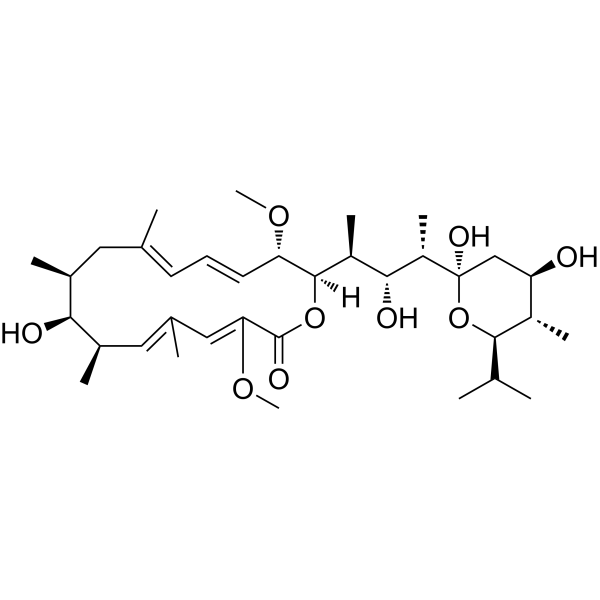
HY-100558
Bafilomycin A1 -
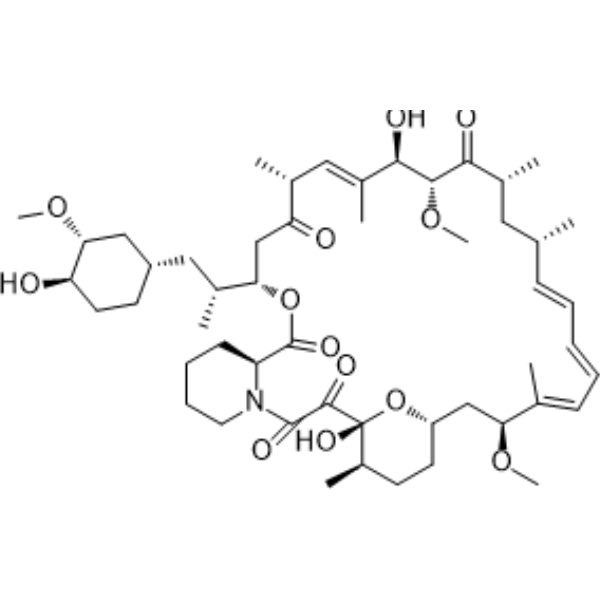
HY-10219
Rapamycin -
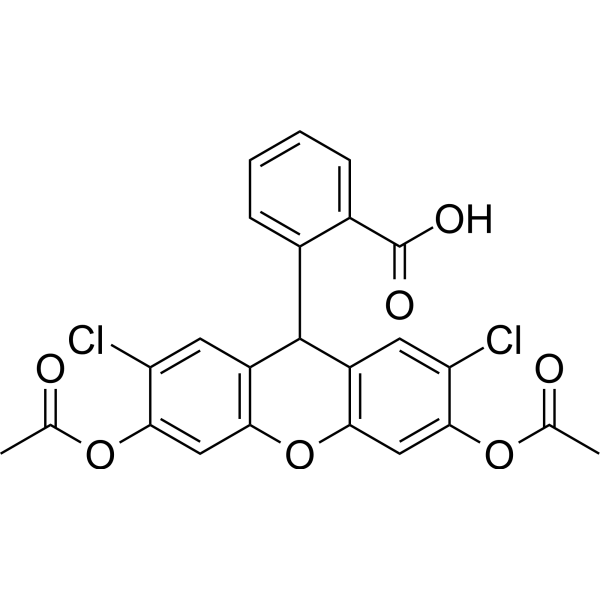
HY-D0940
H2DCFDA -
HY-P80568
Beclin 1 Antibody (YA587) -
HY-P80206
LAMP1 Antibody (YA311) -
HY-P8004
HRP-conjugated Goat Anti-Mouse IgG H&L -
HY-P80137
GAPDH Antibody (YA418) -
HY-P80623
Cleaved-Caspase 3 p12 Antibody (YA499) -
HY-P80438
Beta Actin Antibody (YA823)


Applications
| Application |
WB

WB: Western Blot
|
|---|---|
| Dilution Ratio | 1:500-1:1000 |


Product Details
LC3A/B Antibody is a Rabbit-derived and non-conjugated IgG polyclonal antibody, targeting to LC3A/B.
-
Host Rabbit

-
Clonality Polyclonal

-
Species ReactivityHuman, Mouse, Rat
-
Observed Molecular WeightObserved band size: 14/16 kDa
Note: Due to possible protein modifications or aggregation, the molecular weight should be confirmed by actual measurement, and the predicted value is for reference only.

-
Calculated Molecular Weight Predicted band size: 14 kDa

Entrez Gene: 81631 Human ; 84557 Human ; 66734 Mouse ; 67443 Mouse ; 362245 Rat ; 64862 Rat
SwissProt: Q9GZQ8 Human ; Q9H492 Human ; Q91VR7 Mouse ; Q9CQV6 Mouse ; Q62625 Rat Q6XVN8
OMIM: 609604 Human
Endogenous
affinity purified
Non-conjugated
Unmodified
IgG


Product Properties
-
Appearance
Solution
-
Formulation
Supplied in 1*PBS (pH 7.3), 50% glycerol and 0.5% BSA. Preservative: 0.02% sodium azide.
-
Concentration
Batch-dependent, Please check the COA for the concentration of each lot. Check Lot Concentration
-
Storage & Stability
Stored at -20°C for 1 year. Avoid repeated freeze / thaw cycles.
-
Shipping
Shipping with blue ice.


Verification Images
-
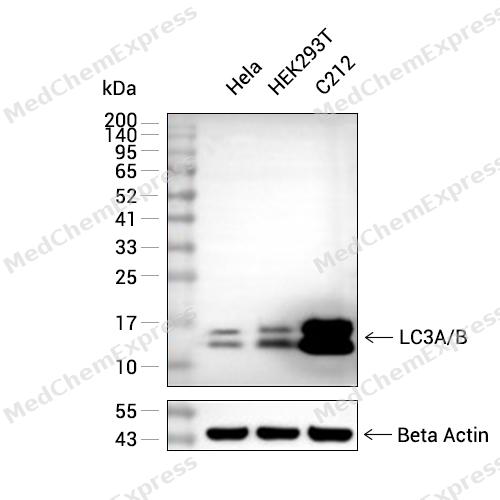 Western blot analysis of extracts from Hela (lane 2(20μg), HEK293T (lane 3(20μg) and C2C12(lane 4(20μg) using LC3A/B (HY-P80741) Rabbit mAb. Proteins were transferred to a PVDF membrane and blocked with 5% non-fat milk in TBST for 2 hour at room temperature. The primary antibody (1/1000) and Loading control antibody (Beta Actin, HY-P80438, 1/10000) was used in 5% non-fat milk in TBST at 4°C overnight. Goat Anti-Mouse/Rabbit IgG-HRP Secondary Antibody (1/10000) was used for 1 hour at room temperature.


Background
-
Function
LC3A/B is a Q9H492: Ubiquitin-like modifier involved in formation of autophagosomal vacuoles (autophagosomes). While LC3s are involved in elongation of the phagophore membrane, the GABARAP/GATE-16 subfamily is essential for a later stage in autophagosome maturation. Through its interaction with the reticulophagy receptor TEX264, participates in the remodeling of subdomains of the endoplasmic reticulum into autophagosomes upon nutrient stress, which then fuse with lysosomes for endoplasmic reticulum turnover
Q9GZQ8: Ubiquitin-like modifier involved in formation of autophagosomal vacuoles (autophagosomes). Plays a role in mitophagy which contributes to regulate mitochondrial quantity and quality by eliminating the mitochondria to a basal level to fulfill cellular energy requirements and preventing excess ROS production. In response to cellular stress and upon mitochondria fission, binds C-18 ceramides and anchors autophagolysosomes to outer mitochondrial membranes to eliminate damaged mitochondria. While LC3s are involved in elongation of the phagophore membrane, the GABARAP/GATE-16 subfamily is essential for a later stage in autophagosome maturation. Promotes primary ciliogenesis by removing OFD1 from centriolar satellites via the autophagic pathway.
[1][2][3][4][5][6][7][8][9]. -
Subcellular Localization
Q9H492: Cytoplasmic vesicle, autophagosome membrane; Lipid-anchor; Endomembrane system; Lipid-anchor; Cytoplasm, cytoskeleton
Q9GZQ8: Cytoplasmic vesicle, autophagosome membrane; Lipid-anchor; Endomembrane system; Lipid-anchor; Mitochondrion membrane; Lipid-anchor; Cytoplasm, cytoskeleton; Cytoplasmic vesicle -
Expression
Tissue_specificity: Q9H492: Most abundant in heart, brain, liver, skeletal muscle and testis but absent in thymus and peripheral blood leukocytes
Q9GZQ8: Most abundant in heart, brain, skeletal muscle and testis. Little expression observed in liver -
Isoforms & Post-Translational Modification
Q9H492 has 2 isomers: Q9H492-1: 14272 Da (predicted); Q9H492-2: 14493 Da (predicted).
The precursor molecule is cleaved by ATG4 (ATG4A, ATG4B, ATG4C or ATG4D) to expose the glycine at the C-terminus and form the cytosolic form, LC3-I (PubMed:15187094, PubMed:30661429). The processed form is then activated by APG7L/ATG7, transferred to ATG3 and conjugated to phosphatidylethanolamine (PE) phospholipid to form the membrane-bound form, LC3-II (PubMed:15187094). During non-canonical autophagy, the processed form is conjugated to phosphatidylserine (PS) phospholipid (PubMed:33909989). ATG4 proteins also mediate the delipidation of PE-conjugated forms (PubMed:32686895, PubMed:33909989). In addition, ATG4B and ATG4D mediate delipidation of ATG8 proteins conjugated to PS during non-canonical autophagy (PubMed:33909989). ATG4B constitutes the major protein for proteolytic activation (PubMed:30661429, PubMed:33909989). ATG4D is the main enzyme for delipidation activity (By similarity);(Microbial infection) The Legionella effector RavZ is a deconjugating enzyme that hydrolyzes the amide bond between the C-terminal glycine residue and an adjacent aromatic residue in ATG8 proteins conjugated to phosphatidylethanolamine (PE), producing an ATG8 protein that is resistant to reconjugation by the host machinery due to the cleavage of the reactive C-terminal glycine (PubMed:23112293, PubMed:31722778, PubMed:32686895). RavZ is also able to mediate delipidation of ATG8 proteins conjugated to phosphatidylserine (PS) (PubMed:33909989);Phosphorylation at Ser-12 by PKA inhibits conjugation to phosphatidylethanolamine (PE) -
Subunit
Q9H492: Interacts with TP53INP1 and TP53INP2 (PubMed:19056683, PubMed:22470510). Directly interacts with SQSTM1; this interaction leads to MAP1LC3A recruitment to inclusion bodies containing polyubiquitinated protein aggregates and to inclusion body degradation by autophagy (PubMed:17580304).
Q9GZQ8: 3 different light chains, LC1 (a cleavage product of MAP1B) , LC2 (a cleavage product of MAP1A) and LC3 (produced by one of the MAP1LC3 genes) , can associate with the MAP1A or MAP1B heavy chains (By similarity). -
Synonyms
LC3; LC3A; ATG8E; MAP1ALC3; MAP1BLC3; MAP1LC3A; LC3B; ATG8F; MAP1LC3B-a; MAP1A/1BLC3; MAP1LC3B
-
Research Field
Signal Transduction


Documentation
-
Data Sheet (262 KB)
-
SDS (252 KB)
- English - EN (252 KB)
- Français - FR (252 KB)
- Deutsch - DE (252 KB)
- Norwegian - NO (252 KB)
- Español - ES (252 KB)
- Swedish - SV (252 KB)
- Italian - IT (252 KB)
- Korean - KR (252 KB)
- Portuguese - PT (252 KB)
-
User Guide for Antibodies (1077 KB)
References
[1]. Cherra SJ 3rd, et al. Regulation of the autophagy protein LC3 by phosphorylation. J Cell Biol. 2010 Aug 23;190(4):533-9. [Content Brief]
[2]. Suzuki H, et al. Structural basis of the autophagy-related LC3/Atg13 LIR complex: recognition and interaction mechanism. Structure. 2014 Jan 7;22(1):47-58. [Content Brief]
[3]. An H, et al. TEX264 Is an Endoplasmic Reticulum-Resident ATG8-Interacting Protein Critical for ER Remodeling during Nutrient Stress. Mol Cell. 2019 Jun 6;74(5):891-908.e10. [Content Brief]
[4]. Chino H, et al. Intrinsically Disordered Protein TEX264 Mediates ER-phagy. Mol Cell. 2019 Jun 6;74(5):909-921.e6. [Content Brief]
[5]. Weidberg H, et al. LC3 and GATE-16/GABARAP subfamilies are both essential yet act differently in autophagosome biogenesis. EMBO J. 2010 Jun 2;29(11):1792-802. [Content Brief]
[6]. Zhu Y, et al. Modulation of serines 17 and 24 in the LC3-interacting region of Bnip3 determines pro-survival mitophagy versus apoptosis. J Biol Chem. 2013 Jan 11;288(2):1099-113. [Content Brief]
[7]. Wei Y, et al. Prohibitin 2 Is an Inner Mitochondrial Membrane Mitophagy Receptor. Cell. 2017 Jan 12;168(1-2):224-238.e10. [Content Brief]
[8]. Sentelle RD, et al. Ceramide targets autophagosomes to mitochondria and induces lethal mitophagy. Nat Chem Biol. 2012 Oct;8(10):831-8. [Content Brief]
[9]. Tang Z, et al. Autophagy promotes primary ciliogenesis by removing OFD1 from centriolar satellites. Nature. 2013 Oct 10;502(7470):254-7. [Content Brief]

 Powered by Bioz
