



CMX410

Based on 1 Customer Validation
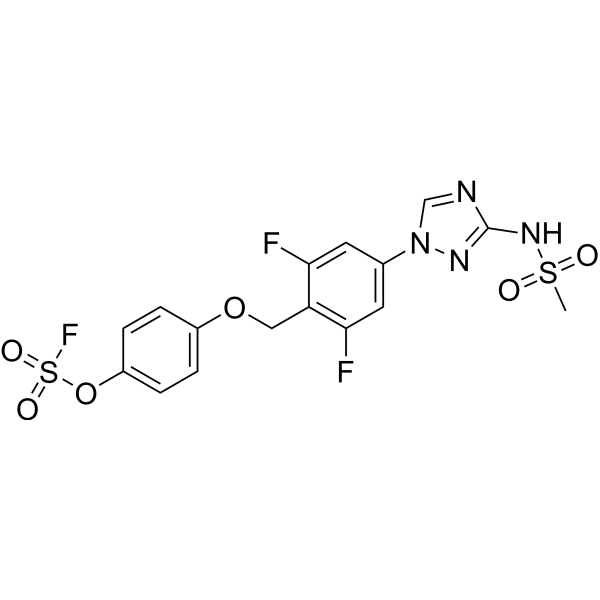
CMX410 is an orally active and selective Mycobacterium tuberculosis Pks13 acyltransferase domain inhibitor and anti-bacterial agent. CMX410 reacts with the catalytic serine of the Pks13-AT domain to form a stable β-lactam ring, disables the enzyme’s active site, reduces trehalose monomycolate and trehalose dimycolate levels, triggers cell lysis, and reduces intracellular bacterial burden. CMX410 can be used for the research of tuberculosis.
商品は「研究用試薬」です。人や動物の医療用・臨床診断用・食品用の製品ではありません。
研究用途以外に使用した場合、当社は一切の責任を負いかねます。
- 純度 : 99.79%
- CAS 番号: 3027135-80-1
- 分子式: C16H13F3N4O6S2
- 分子量:478.42
-
保管条件:Powder -20°C, 3 years , 4°C, 2 years ; In solvent -80°C, 6 months , -20°C, 1 month

To place orders, for customer services and technical support, please contact: MedChemExpress USA
Tel: 609-228-6898 E-mail: [email protected] [email protected]


-
 生物活性
生物活性
-
化学情報
-
溶剤 & 溶解度
- プロトコル
- 純度とドキュメンテーション
- 参考文献
-
 Help & FAQs




生物活性
製品説明
Cellular Effect
|
Cell Line

|
Type | Value | Description | References |
|---|---|---|---|---|
| HEK-293T | CC50 |
>40 μM
Compound: 21b
|
Cytotoxicity against human HEK293T cells assessed as reduction in cell viability measured after 3 days by CellTiterGlo Luminescent assay
Cytotoxicity against human HEK293T cells assessed as reduction in cell viability measured after 3 days by CellTiterGlo Luminescent assay
|
[PMID: 38142914] |
| HepG2 | CC50 |
>40 μM
Compound: 21b
|
Cytotoxicity against human HepG2 cells assessed as reduction in cell viability measured after 3 days by CellTiterGlo Luminescent assay
Cytotoxicity against human HepG2 cells assessed as reduction in cell viability measured after 3 days by CellTiterGlo Luminescent assay
|
[PMID: 38142914] |
体外実験
CMX410 (Compound 21b) (0.06 µM) potently inhibits Mycobacterium tuberculosis H37Rv with an MIC of 0.06 µM[1].
CMX410 (>40 µM) shows no cytotoxicity against HEK293T or HepG2 cell lines[1].
CMX410 (6 weeks) is equipotent against drug-susceptible and drug-resistant Mtb clinical isolates, with an MIC90 of 0.039 µM against Mtb H37Rv, and has a narrow spectrum of activity limited to mycobacterial species[2].
CMX410 (0.3-20 µM; 3 days) potently reduces intracellular Mtb burden in THP-1 macrophages, with an EC90 of 0.11 µM[2].
CMX410 (0.39 µM, 20 µM; 21 days, 7 days) demonstrates rapid bactericidal activity against replicating Mtb H37Rv and is active against non-replicating persistent Mtb populations[2].
MedChemExpress (MCE) has not independently confirmed the accuracy of these methods. They are for reference only. Further protocols information, click here.
Parmacokinetics
体内実験
CMX410 (50 mg/kg; p.o.; twice daily; 5 days per week for 4 weeks) reduces bacterial burden in both lungs and spleens of mice with chronic tuberculosis, with an additive effect when combined with rifampicin that yields a 0.8-log10 greater lung CFU reduction than monotherapy[2].
CMX410 (20 mg/kg; p.o.; daily; 5 days per week for 2 months) protects mice from lethal high-dose tuberculosis infection and reduces lung bacterial burden by 1.6-log10 following 2 months of oral daily treatment at 20 mg/kg[2].
CMX410 (100-1000 mg/kg per day; p.o.; twice daily; 14 days) is well tolerated in Wistar Han rats at oral doses up to 1000 mg/kg per day twice daily for 14 days, with no observed adverse effects[2].
MedChemExpress (MCE) has not independently confirmed the accuracy of these methods. They are for reference only.
-
Animal Model:BALB/c mice[2]
-
Dosage:2 mg/kg; 7 mg/kg; 20 mg/kg
-
Administration:p.o.; daily; 12 days
-
Result:Produced a significant 3.1-log10 reduction in lung CFU compared to untreated controls.
Produced a 2.0-log10 reduction in lung CFU compared to untreated controls.
Produced a smaller reduction in lung CFU compared to untreated controls.
-
Animal Model:BALB/c mice[2]
-
Dosage:50 mg/kg
-
Administration:p.o.; twice daily; 5 days per week for 4 weeks
-
Result:Produced a 1.37-log10 reduction in lung CFU compared to untreated controls.
Produced a 2.37-log10 reduction in spleen CFU compared to untreated controls.
When combined with rifampicin, produced an extra 0.8-log10 reduction in lung CFU compared to either drug alone.
-
Animal Model:BALB/c mice[2]
-
Dosage:20 mg/kg
-
Administration:p.o.; daily; 5 days per week for 2 months
-
Result:Protected mice from lethal outcome.
Reduced lung bacterial burden by 1.6-log10 after 2 months of treatment.
-
Animal Model:Wistar Han rats (male and female, 6-7 weeks old, initial body weights 219.8-247.1 g (males) and 143.7-171.3 g (females))[2]
-
Dosage:100 mg/kg per day; 300 mg/kg per day; 1000 mg/kg per day
-
Administration:p.o.; twice daily; 14 days
-
Result:Observed no treatment-related mortality, adverse clinical signs, body weight changes, food consumption changes, ophthalmology abnormalities, or clinical pathology abnormalities at any dose level.
Established no observed adverse effect level at 1000 mg/kg per day.


化学情報
-
CAS 番号 3027135-80-1
-
性状 Solid
-
分子量 478.42
-
分子式 C16H13F3N4O6S2
-
Color White to off-white
-
SMILES
FC1=CC(N2N=C(NS(=O)(C)=O)N=C2)=CC(F)=C1COC3=CC=C(OS(F)(=O)=O)C=C3
-
輸送条件
Room temperature in continental US; may vary elsewhere.
-
保管条件
Powder -20°C 3 years 4°C 2 years In solvent -80°C 6 months -20°C 1 month


溶剤 & 溶解度
体外:
DMSO : 4.17 mg/mL (8.72 mM; Need ultrasonic; Hygroscopic DMSO has a significant impact on the solubility of product, please use newly opened DMSO)
Please refer to the solubility information to select the appropriate solvent. Once prepared, please aliquot and store the solution to prevent product inactivation from repeated freeze-thaw cycles.
Storage method and period of stock solution: -80°C, 6 months; -20°C, 1 month. When stored at -80°C, please use it within 6 months. When stored at -20°C, please use it within 1 month.
Please refer to the solubility information to select the appropriate solvent. Once prepared, please aliquot and store the solution to prevent product inactivation from repeated freeze-thaw cycles.
Storage method and period of stock solution: -80°C, 6 months; -20°C, 1 month. When stored at -80°C, please use it within 6 months. When stored at -20°C, please use it within 1 month.
濃度 (開始) × 体積 (開始) = 濃度 (終了) × 体積 (終了)

プロトコル
-
Protein Extraction
Protein extraction uses physical, chemical or biological methods, such as ultrasonic disruption, salting out, cell lysis, electrophoresis, etc., to destroy the cell membrane structure and to separate the proteins from different components according to their characteristics.


純度とドキュメンテーション
-
データシート (277 KB)
-
SDS (254 KB)
- English - EN (254 KB)
- Français - FR (254 KB)
- Deutsch - DE (254 KB)
- Norwegian - NO (254 KB)
- Español - ES (254 KB)
- Swedish - SV (254 KB)
- Italian - IT (254 KB)
- Korean - KR (254 KB)
- Portuguese - PT (254 KB)
-
取扱説明書 (2659 KB)
参考文献
[1]. Yang B, et al. Synthesis and structure-activity relationships of aryl fluorosulfate-based inhibitors as novel antitubercular agents. Bioorg Med Chem Lett. 2024;98:129596. [Content Brief]
[2]. Krieger IV, et al. SuFEx-based antitubercular compound irreversibly inhibits Pks13. Nature. 2025;645(8081):755-763. [Content Brief]


Complete Stock Solution Preparation Table
Please refer to the solubility information to select the appropriate solvent. Once prepared, please aliquot and store the solution to prevent product inactivation from repeated freeze-thaw cycles.
Storage method and period of stock solution: -80°C, 6 months; -20°C, 1 month. When stored at -80°C, please use it within 6 months. When stored at -20°C, please use it within 1 month.
| Optional Solvent | Concentration Solvent Mass | 1 mg | 5 mg | 10 mg | 25 mg |
|---|---|---|---|---|---|
| DMSO | 1 mM | 2.0902 mL | 10.4511 mL | 20.9021 mL | 52.2553 mL |
| 5 mM | 0.4180 mL | 2.0902 mL | 4.1804 mL | 10.4511 mL |


CMX410 関連分類
HY-162094 関連分類
 Powered by Bioz