



Astressin 2B TFA
Based on 1 publication(s) in Google Scholar
Astressin 2B TFA is a blood-brain barrier-impermeable, highly selective CRFR2 antagonist (rCRFR2, IC50=0.57 nM). Astressin 2B TFA blocks the protective effects mediated by CRFR2, thereby exacerbating indomethacin (HY-14397)-induced hemorrhagic intestinal injury in rats. Astressin 2B TFA reverses the protective effects of Urocortin 1 against intestinal hypermotility, bacterial invasion and upregulation of inflammatory mediators. Astressin 2B TFA also blocks the anxiogenic effect of Urocortin 2 and attenuates stress-induced anxiety-related behaviors. In the Clostridioides difficile toxin A (C. difficile toxin A)-mediated enteritis model, Astressin 2B TFA mimics the phenotype of CRFR2-deficient mice, significantly exacerbating intestinal epithelial damage, edema, neutrophil migration and the expression of multiple proinflammatory cytokines. Astressin 2B TFA is an important tool molecule for investigating the intestinal protective mechanisms of CRFR2.
For research use only. We do not sell to patients.
- Purity : 99.75%
- Formula: C183H307N49O53.xC2HF3O2
- Molecular Weight:4041.69 (free base)
-
Storage:
Sealed storage, away from moisture and light.
Powder -80°C, 2 years , -20°C, 1 year* In solvent : -80°C, 6 months; -20°C, 1 month (sealed storage, away from moisture and light)

To place orders, for customer services and technical support, please contact: MedChemExpress USA
Tel: 609-228-6898 E-mail: [email protected] [email protected]


-
 Biological Activity
-
Chemical Information
-
Solvent & Solubility
- Protocols
- Purity & Documentation
- References
-
 Help & FAQs


Publications Citing Use of MedChemExpress (MCE) Astressin 2B TFA
More

Biological Activity
Description
IC50 & Target
|
CRFR2 |
In Vitro
Astressin 2B TFA potently binds to CRF2 receptors in rat choroid plexus and blood vessels (IC50=0.57 nM)[1].
Astressin 2B TFA binds to the cloned human CRF2 (a) receptor expressed in CHO-K1 cell membranes with extremely high affinity (Ki=0.49 nM)[2].
Astressin 2B TFA binds to endogenous rat CRF2 (b) receptors in A7r5 cell homogenates with extremely high affinity (Ki=0.17 nM)[2].
Astressin 2B TFA (1-100 nM; 15 min) concentration-dependently inhibits Urocortin III (HY-P1858)-mediated relaxation of tracheal smooth muscle in in vitro relaxation assays of methacholine (HY-A0083)-precontracted mouse tracheal smooth muscle, with an IC50 of approximately 3 nM[5].
MedChemExpress (MCE) has not independently confirmed the accuracy of these methods. They are for reference only. Further protocols information, click here.
-
Cell Line:Mouse tracheal smooth muscle
-
Concentration:1 nM, 10 nM, 100 nM
-
Incubation Time:15 min; followed by Methacholine treatment for 30 min
-
Result:Concentration-dependent inhibited Urocortin III (HY-P1858)-mediated tracheal smooth muscle relaxation.
In Vivo
Following septal administration of Astressin 2B (24-192 pmol; bilateral septal perfusion) TFA, doses of 24 pmol and 96 pmol block the stress-dependent anxiogenic effect of septal urocortin 2, whereas the 192 pmol dose reduces stress-induced anxiety in both vehicle-treated and urocortin 2-treated mice[3].
Astressin 2B (60 μg/kg; intravenous injection) TFA reverses the CRFR2-mediated protective effects of Ucn I, including attenuation of injury, inhibition of MPO activity, reduction of intestinal bacterial invasion, downregulation of iNOS expression, and alleviation of intestinal hypermotility[4].
Astressin 2B (60 μg/kg; intravenous injection; administered 10 minutes prior to exposure; single dose) TFA exacerbates Indomethacin (HY-14397)-induced small intestinal injury, and completely reverses all the protective effects mediated by Urocortin I (HY-P1858) against Indomethacin-induced intestinal injury, inflammation, bacterial invasion and hyperdynamic state, confirming that these protective effects are mediated via CRFR2[6].
Astressin 2B (3-300 μg/kg; i.p.; administered 30 min prior to exposure; single dose) TFA dose-dependently reduces intestinal fluid secretion, and inhibits neutrophil infiltration, MPO activity and production of proinflammatory chemokines in a mouse model of intestinal inflammation induced by Clostridium difficile toxin A[7].
MedChemExpress (MCE) has not independently confirmed the accuracy of these methods. They are for reference only.
-
Animal Model:CRF2 receptor wild-type (C57BL/6 × 129 mixed background) mice[3]
-
Dosage:24 pmol; 96 pmol; 192 pmol
-
Administration:i.c., bilateral lateral septal infusion; single dose 10 minutes before urocortin 2
-
Result:Blocked the anxiogenic effects of 48 pmol urocortin 2 in high-stress condition at 24 and 96 pmol: significantly decreased latency to enter the light side of the light-dark box, increased time spent in the light side of the light-dark box, and increased percentage time spent in the center of the novel-object test.
Increased percentage time spent in the center of the open field in urocortin 2-treated mice under high-stress condition at 24 pmol.
Reduced anxiety-related behavior in both urocortin 2-treated and vehicle-treated stressed mice at 192 pmol: decreased latency to enter the light side of the light-dark box, increased time spent in the light side of the light-dark box, increased percentage time spent in the center of the open field, and increased percentage time spent in the center of the novel-object test.
Showed no significant effect on anxiety-related behavior in no-stress condition at any dose tested, and no dose altered locomotor activity in either stress condition.


Chemical Information
-
Appearance Solid
-
Molecular Weight 4041.69 (free base)
-
Formula C183H307N49O53.xC2HF3O2
-
Color White to off-white
-
Sequence
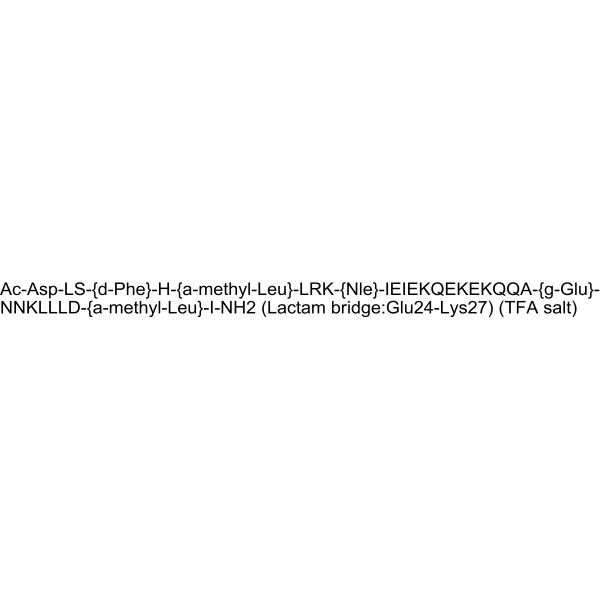
Ac-Asp-Leu-Ser-{d-Phe}-His-{a-methyl-Leu}-Leu-Arg-Lys-{Nle}-Ile-Glu-Ile-Glu-Lys-Gln-Glu-Lys-Glu-Lys-Gln-Gln-Ala-cyclo(Glu-Asn-Asn-Lys)-Leu-Leu-Leu-Asp-{a-methyl-Leu}-Ile-NH2
-
Sequence Shortening
Ac-DLS-{d-Phe}-H-{a-methyl-Leu}-LRK-{Nle}-IEIEKQEKEKQQA-cyclo(ENNK)-LLLD-{a-methyl-Leu}-I-NH2
-
Shipping
Room temperature in continental US; may vary elsewhere.
-
Storage
Sealed storage, away from moisture and light
Powder -80°C 2 years -20°C 1 year * In solvent : -80°C, 6 months; -20°C, 1 month (sealed storage, away from moisture and light)


Publications (1)
-
Journal Impact Factor
-
Most Recent
-
Neuron
Astrocyte-mediated central amygdala microcircuit gates comorbid anxiety symptoms in chronic pain. [Abstract]2025 Oct 2:S0896-6273(25)00670-1. PMID: 41043420


Solvent & Solubility
In Vitro:
DMSO : 100 mg/mL (Need ultrasonic; Hygroscopic DMSO has a significant impact on the solubility of product, please use newly opened DMSO)
In Vivo:
Select the appropriate dissolution method based on your experimental animal and administration route.
- For the following dissolution methods, please ensure to first prepare a clear stock solution using an In Vitro approach and then sequentially add co-solvents:
- To ensure reliable experimental results, the clarified stock solution can be appropriately stored based on storage conditions. As for the working solution for In Vivo experiments, it is recommended to prepare freshly and use it on the same day.
- The percentages shown for the solvents indicate their volumetric ratio in the final prepared solution. If precipitation or phase separation occurs during preparation, heat and/or sonication can be used to aid dissolution.
In Vivo Dissolution Calculator
Please enter the basic information of animal experiments:
-
-
-
-
Recommended: Prepare an additional quantity of animals to account for potential losses during experiments.
Please enter your animal formula composition:
-
%DMSO +
Recommended: Keep the proportion of DMSO in working solution below 2% if your animal is weak.
-
%+
-
+%Tween-80 + +
-
%Saline +
The co-solvents required include: DMSO, . All of co-solvents are available by MedChemExpress (MCE). , Tween 80. All of co-solvents are available by MedChemExpress (MCE).
Working solution concentration: 0.22 mg/mL
Method for preparing stock solution: mg drug dissolved in μL DMSO. Stock solution concentration: mg/mL. * In solvent : -80°C, 6 months; -20°C, 1 month (sealed storage, away from moisture and light)
1. Take μL DMSO stock solution;
2. Add μL .
μL , mix evenly;
3. Then add μL Tween 80, mix evenly;
4. Then add μL
Please ensure that the stock solution in the first step is dissolved to a clear state, and add co-solvents in sequence. You can use ultrasonic heating (ultrasonic cleaner, recommended frequency 20-40 kHz), vortexing, etc. to assist dissolution.

Protocols
-
RNA extraction experimental
By lysing cells, releasing RNA, and removing impurities such as proteins and DNA, high-purity RNA products are finally obtained. The commonly used traditional method is the guanidine isothiocyanate/phenol/chloroform method (Trizol), which is suitable for a variety of animal materials including animal tissues, microorganisms, cultured cells, etc., and most plant materials.
-
Cell Cytotoxicity Assay
Cytotoxicity assays are usually based on the assessment of cell membrane damage, which can also be indirectly detected by measuring cell viability. Detection methods include MTT assay, CKK-8 assay, LDH assay and ATP assay, etc.
-
Cell migration
Cell migration is a method that plays an important role in wound healing, cell differentiation, embryonic development, etc.
-
Cell invasion
Cell invasion is the ability of cells to migrate from one area to another via the extracellular matrix. Cell invasion is the response of normal and cancer cells to chemical and mechanical stimuli. Before migrating to a new region, the extracellular matrix is degraded by proteases within the cell. Cell invasion often occurs during wound repair, vascularization and inflammation, abnormal tissue invasion, and tumor cell metastasis.


Purity & Documentation
-
Data Sheet (296 KB)
-
SDS (252 KB)
- English - EN (252 KB)
- Français - FR (252 KB)
- Deutsch - DE (252 KB)
- Norwegian - NO (252 KB)
- Español - ES (252 KB)
- Swedish - SV (252 KB)
- Italian - IT (252 KB)
- Korean - KR (252 KB)
- Portuguese - PT (252 KB)
-
Handling Instructions (2659 KB)
References
[1]. Rivier J, et al. Potent and long-acting corticotropin releasing factor (CRF) receptor 2 selective peptide competitive antagonists. J Med Chem. 2002;45(21):4737-4747. [Content Brief]
[2]. Hoare SR, et al. Peptide ligand binding properties of the corticotropin-releasing factor (CRF) type 2 receptor: pharmacology of endogenously expressed receptors, G-protein-coupling sensitivity and determinants of CRF2 receptor selectivity. Peptides. 2005;26(3):457-470. [Content Brief]
[3]. Henry B, et al. The effect of lateral septum corticotropin-releasing factor receptor 2 activation on anxiety is modulated by stress. J Neurosci. 2006;26(36):9142-9152. [Content Brief]
[4]. Kubo Y, et al. Urocortin prevents indomethacin-induced small intestinal lesions in rats through activation of CRF2 receptors. Dig Dis Sci. 2010;55(6):1570-1580. [Content Brief]

Calculators
Concentration (start) × Volume (start) = Concentration (final) × Volume (final)


Astressin 2B TFA Related Classifications
HY-P1108A Related Classifications
 Powered by Bioz