



Azelnidipine
Based on 3 publication(s) in Google Scholar
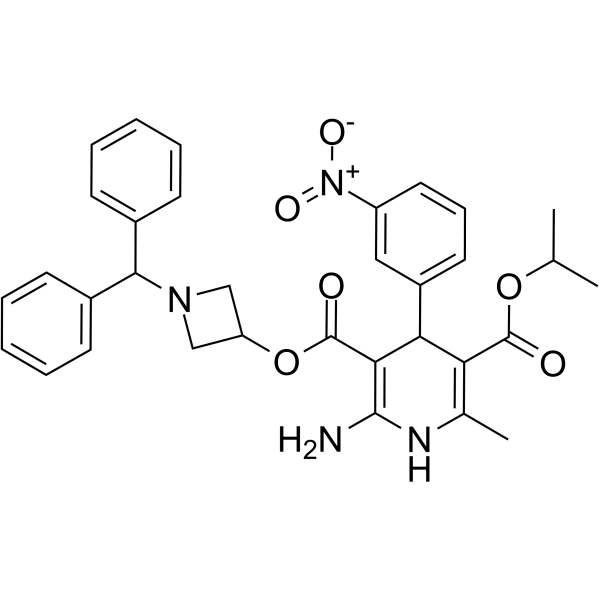
Azelnidipine (CS 905) is a dihydropyridine calcium channel blocker that is effective orally. Azelnidipine inhibits the intracellular calcium ion flow and lower blood pressure by selectively blocking L-type calcium channel on the membrane of vascular smooth muscle. Azelnidipine inhibits esophageal squamous cell carcinoma proliferation by targeting MEK1/2. Azelnidipine also has anti-inflammatory, antioxidant and neuroprotective effects .
For research use only. We do not sell to patients.
- Purity: 99.79%
- CAS No.: 123524-52-7
- Formula: C33H34N4O6
- Molecular Weight:582.65
-
Storage:Powder -20°C, 3 years , 4°C, 2 years ; In solvent -80°C, 2 years , -20°C, 1 year


-
 Biological Activity
-
Chemical Information
-
Solvent & Solubility
- Purity & Documentation
- References
-
 Help & FAQs
-

Immunology/Inflammation Compound Library
HY-L007
-
Kinase Inhibitor Library
HY-L009
-
MAPK Compound Library
HY-L010
-
Membrane Transporter/Ion Channel Compound Library
HY-L011
-
Neuronal Signaling Compound Library
HY-L013
-
FDA-Approved Drug Library
HY-L022
-
Anti-Cancer Compound Library
HY-L025
-
Drug Repurposing Compound Library
HY-L035
-
Antioxidant Compound Library
HY-L037
-
Reprogramming Compound Library
HY-L039
-
Oxygen Sensing Compound Library
HY-L045
-
Anti-Cardiovascular Disease Compound Library
HY-L046
-
Ferroptosis Compound Library
HY-L051
-
Anti-COVID-19 Compound Library
HY-L052
-
NMPA-Approved Drug Library
HY-L053
-
Orally Active Compound Library
HY-L061
-
Glutamine Metabolism Compound Library
HY-L064
-
FDA Approved & Pharmacopeial Drug Library
HY-L066
-
Neuroprotective Compound Library
HY-L070
-
Anti-Pancreatic Cancer Compound Library
HY-L077
-
Anti-Obesity Compound Library
HY-L087
-
Angiogenesis-Related Compound Library
HY-L088
-
Anti-Liver Cancer Compound Library
HY-L101
-
Anti-Colorectal Cancer Compound Library
HY-L103
-
Calcium Channel Blocker Library
HY-L117
-
FDA-Approved Anticancer Drug Library
HY-L122
-
Human Metabolite Library
HY-L123
-
Pain-Related Compound Library
HY-L139
-
Off-patent Drug Library
HY-L141
-
Antihypertensive Compound Library
HY-L145
-
Membrane Protein-targeted Compound Library
HY-L149
-
Membrane Receptor-targeted Compound Library
HY-L150
-
Highly Selective Inhibitors Library
HY-L158
-
Serine/Threonine Kinase Inhibitor Library
HY-L164
-
Ion Channel Compound Library
HY-L166
-
Multi-Target Compound Library
HY-L176
-
Radioprotector Library
HY-L178
-
Bioactive Compound Library Max
HY-L181
-
MCE Bioactive Compound Library
HY-L001V
-
Drug Repurposing Compound Library Plus
HY-L035P
-
FDA-Approved Drug Library Plus
HY-L022P
-
FDA-Approved Drug Library Mini
HY-L022M
-
Bioactive Compound Library
HY-L001
-
Anti-Fibrosis Compound Library
HY-L185
-
Anti-Brain Cancer Compound Library
HY-L188
-
Protein Kinase Compound Library
HY-L196
-
Cell Proliferation Compound Library
HY-L201
-
High-Throughput Bioactive Compound Library
HY-L205
-
Anti-Rheumatic Arthritis Compound Library
HY-L210
-
Mass Spectrometry Human Metabolite Library
HY-L215
-
Posttranslational Modification Library
HY-L226
-
FDA Kinase Inhibitor Library
HY-L230


Publications Citing Use of MedChemExpress (MCE) Azelnidipine
MoreAll Calcium Channel Isoforms
MoreAll MEK Isoforms
More

Biological Activity
|
L-type calcium channel |
MEK1 |
MEK2 |
|
Cell Line

|
Type | Value | Description | References |
|---|---|---|---|---|
| LLC-MK2 | IC50 |
2.9 μM
Compound: Azelnidipine
|
Antitrypanosomal activity against trypomastigotes of Trypanosoma cruzi infected in rhesus monkey LLC-MK2 cells after 48 hrs by MTT assay
Antitrypanosomal activity against trypomastigotes of Trypanosoma cruzi infected in rhesus monkey LLC-MK2 cells after 48 hrs by MTT assay
|
[PMID: 20934347] |
| LLC-MK2 | IC50 |
33.48 μM
Compound: Azelnidipine
|
Cytotoxicity against rhesus monkey LLC-MK2 cells after 48 hrs by MTT assay
Cytotoxicity against rhesus monkey LLC-MK2 cells after 48 hrs by MTT assay
|
[PMID: 20934347] |
Azelnidipine (0-10 μM; 96 h) inhibits esophageal squamous cell carcinoma proliferation by targeting MEK1/2 [2].
MedChemExpress (MCE) has not independently confirmed the accuracy of these methods. They are for reference only.
-
Cell Line:ESCC and SHEE cells
-
Concentration:0, 1, 2.5, 5 and 10 μM
-
Incubation Time:96 h
-
Result:Inhibited the proliferation of ESCC cells in a concentration- and time-dependent manner and did not significantly inhibit the proliferation of SHEE cells.
-
Cell Line:ESCC cells
-
Concentration:0, 1, 2.5, 5 and 10 μM
-
Incubation Time:24 h
-
Result:Reduced MEK1/2 phosphorylation in a dose-dependent manner.
Azelnidipine (0-3 mg/kg; Oral administration/Intravenous injection; 0-24 h) reduces blood pressure in hypertensive rat models. Oral efficacy is more than three times of Nicardipine (HY-12515). Intravenous injection is three times less effective than Nicardipine (HY-12515) [4].
MedChemExpress (MCE) has not independently confirmed the accuracy of these methods. They are for reference only.
-
Animal Model:BCCAO and reperfusion treated adult male Sprague-Dawley rats (200-300 g) [3]
-
Dosage:3 mg/kg/day
-
Administration:Oral gavage (i.g.); 7 days
-
Result:Significantly increased total antioxidant capacity.
Reduced IL-6, TNF-α, NF-κB p65, and ICAM-1 levels.
Reversed the ischemic injury after cerebral ischemia/reperfusion and reduced cerebral infarct volume in rats.
-
Animal Model:Male spontaneously hypertensive rats aged 23 weeks old [4]
-
Dosage:0.3, 1 and 3 mg/kg;
100 and 300 μg/kg -
Administration:Oral administration (p.o.); single dose; 0-24 h;
Intravenous injection (i.v.); single dose; 0-2 h -
Result:Reduced blood pressure in a dose-dependent manner, was more than 3 times as potent as Nicardipine (HY-12515) by p.o.
Gradually decreased blood pressure, was 3 times less potent than Nicardipine (HY-12515) by i.v.
| NCT Number | Sponsor | Condition | Start Date |
Phase
|
|---|---|---|---|---|
| NCT01329991 | Plexxikon| | 2011-05 | PHASE1 |


Chemical Information
-
CAS No. 123524-52-7
-
Appearance Solid
-
Molecular Weight 582.65
-
Formula C33H34N4O6
-
Color Light yellow to yellow
-
SMILES
O=C(C1=C(N)NC(C)=C(C(OC(C)C)=O)C1C2=CC=CC([N+]([O-])=O)=C2)OC3CN(C(C4=CC=CC=C4)C5=CC=CC=C5)C3
-
Synonyms
CS 905
-
Shipping
Room temperature in continental US; may vary elsewhere.
-
Storage
Powder -20°C 3 years 4°C 2 years In solvent -80°C 2 years -20°C 1 year


Publications (3)
-
Journal Impact Factor
-
Most Recent
-
Adv Mater
Efficient Delivery of Lomitapide using Hybrid Membrane-Coated Tetrahedral DNA Nanostructures for Glioblastoma Therapy. [Abstract]2024 Jun;36(24):e2311760. PMID: 38569065 -
Drug Deliv Transl Res
Leveraging quantum chemical properties in transfer learning for predicting blood-brain barrier permeability of drugs. [Abstract]2025 Oct 29. PMID: 41160380 -
Viruses
Azelnidipine Exhibits In Vitro and In Vivo Antiviral Effects against Flavivirus Infections by Targeting the Viral RdRp. [Abstract]2022 Jun 5;14(6):1228. PMID: 35746699


Solvent & Solubility
DMSO : ≥ 100 mg/mL (171.63 mM; Hygroscopic DMSO has a significant impact on the solubility of product, please use newly opened DMSO)
* "≥" means soluble, but saturation unknown.
Please refer to the solubility information to select the appropriate solvent. Once prepared, please aliquot and store the solution to prevent product inactivation from repeated freeze-thaw cycles.
Storage method and period of stock solution: -80°C, 2 years; -20°C, 1 year. When stored at -80°C, please use it within 2 years. When stored at -20°C, please use it within 1 year.
Please refer to the solubility information to select the appropriate solvent. Once prepared, please aliquot and store the solution to prevent product inactivation from repeated freeze-thaw cycles.
Storage method and period of stock solution: -80°C, 2 years; -20°C, 1 year. When stored at -80°C, please use it within 2 years. When stored at -20°C, please use it within 1 year.
Concentration (start) × Volume (start) = Concentration (final) × Volume (final)
Select the appropriate dissolution method based on your experimental animal and administration route.
- For the following dissolution methods, please ensure to first prepare a clear stock solution using an In Vitro approach and then sequentially add co-solvents:
- To ensure reliable experimental results, the clarified stock solution can be appropriately stored based on storage conditions. As for the working solution for In Vivo experiments, it is recommended to prepare freshly and use it on the same day.
- The percentages shown for the solvents indicate their volumetric ratio in the final prepared solution. If precipitation or phase separation occurs during preparation, heat and/or sonication can be used to aid dissolution.
Add each solvent one by one: 10% DMSO 40% PEG300 5% Tween-80 45% Saline
Solubility: ≥ 2.5 mg/mL (4.29 mM); Clear solution
This protocol yields a clear solution of ≥ 2.5 mg/mL (saturation unknown).
Taking 1 mL working solution as an example, add 100 μL DMSO stock solution (25.0 mg/mL) to 400 μL PEG300, and mix evenly; then add 50 μL Tween-80 and mix evenly; then add 450 μL Saline to adjust the volume to 1 mL.
Preparation of Saline: Dissolve 0.9 g sodium chloride in ddH₂O and dilute to 100 mL to obtain a clear Saline solution.
Please enter the basic information of animal experiments:
-
-
-
-
Recommended: Prepare an additional quantity of animals to account for potential losses during experiments.
Please enter your animal formula composition:
-
%DMSO +
Recommended: Keep the proportion of DMSO in working solution below 2% if your animal is weak.
-
%+
-
+%Tween-80 + +
-
%Saline +
The co-solvents required include: DMSO, . All of co-solvents are available by MedChemExpress (MCE). , Tween 80. All of co-solvents are available by MedChemExpress (MCE).
Working solution concentration: 0.22 mg/mL
Method for preparing stock solution: mg drug dissolved in μL DMSO. Stock solution concentration: mg/mL.
1. Take μL DMSO stock solution;
2. Add μL .
μL , mix evenly;
3. Then add μL Tween 80, mix evenly;
4. Then add μL
Please ensure that the stock solution in the first step is dissolved to a clear state, and add co-solvents in sequence. You can use ultrasonic heating (ultrasonic cleaner, recommended frequency 20-40 kHz), vortexing, etc. to assist dissolution.


Purity & Documentation
-
Data Sheet (284 KB)
-
SDS (476 KB)
- English - EN (476 KB)
- Français - FR (476 KB)
- Deutsch - DE (476 KB)
- Norwegian - NO (476 KB)
- Español - ES (476 KB)
- Swedish - SV (476 KB)
- Italian - IT (476 KB)
- Portuguese - PT (476 KB)
-
Handling Instructions (2659 KB)
References
[1]. Ram CVS. Therapeutic Usefulness of a Novel Calcium Channel Blocker Azelnidipine in the Treatment of Hypertension: A Narrative Review. Cardiol Ther. 2022 Dec;11(4):473-489. [Content Brief]
[2]. Zhao L, et al. Azelnidipine inhibits esophageal squamous cell carcinoma proliferation in vivo and in vitro by targeting MEK1/2. Mol Ther Oncolytics. 2022 Sep 26;27:61-72. [Content Brief]
[3]. Fakharaldeen Z, et al. Potential protective effects of Azelnidipine against cerebral ischemia-reperfusion injury in male rats. J Med Life. 2022 Nov;15(11):1384-1391. [Content Brief]
[4]. Oizumi K, et al. Antihypertensive effects of CS-905, a novel dihydropyridine Ca ++ channel blocker. Jpn J Pharmacol. 1989 Sep;51(1):57-64. [Content Brief]


Complete Stock Solution Preparation Table
Please refer to the solubility information to select the appropriate solvent. Once prepared, please aliquot and store the solution to prevent product inactivation from repeated freeze-thaw cycles.
Storage method and period of stock solution: -80°C, 2 years; -20°C, 1 year. When stored at -80°C, please use it within 2 years. When stored at -20°C, please use it within 1 year.
| Optional Solvent | Concentration Solvent Mass | 1 mg | 5 mg | 10 mg | 25 mg |
|---|---|---|---|---|---|
| DMSO | 1 mM | 1.7163 mL | 8.5815 mL | 17.1630 mL | 42.9074 mL |
| 5 mM | 0.3433 mL | 1.7163 mL | 3.4326 mL | 8.5815 mL | |
| 10 mM | 0.1716 mL | 0.8581 mL | 1.7163 mL | 4.2907 mL | |
| 15 mM | 0.1144 mL | 0.5721 mL | 1.1442 mL | 2.8605 mL | |
| 20 mM | 0.0858 mL | 0.4291 mL | 0.8581 mL | 2.1454 mL | |
| 25 mM | 0.0687 mL | 0.3433 mL | 0.6865 mL | 1.7163 mL | |
| 30 mM | 0.0572 mL | 0.2860 mL | 0.5721 mL | 1.4302 mL | |
| 40 mM | 0.0429 mL | 0.2145 mL | 0.4291 mL | 1.0727 mL | |
| 50 mM | 0.0343 mL | 0.1716 mL | 0.3433 mL | 0.8581 mL | |
| 60 mM | 0.0286 mL | 0.1430 mL | 0.2860 mL | 0.7151 mL | |
| 80 mM | 0.0215 mL | 0.1073 mL | 0.2145 mL | 0.5363 mL | |
| 100 mM | 0.0172 mL | 0.0858 mL | 0.1716 mL | 0.4291 mL |


 Powered by Bioz