



PF-06751979
Based on 1 publication(s) in Google Scholar
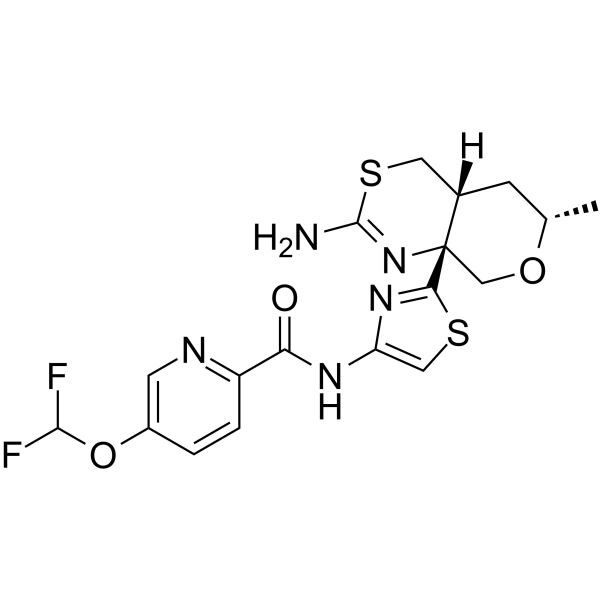
PF-06751979 is a potent, brain penetrant, β-site amyloid precursor protein cleaving enzyme 1 (BACE1) inhibitor with an IC50 of 7.3 nM in BACE1 binding assay.
Nur für Forschungszwecke. Wir verkaufen nicht an Patienten.
- Reinheit: 99.57%
- CAS. Nr.: 1818339-66-0
- Formel: C18H19F2N5O3S2
- Molecular Weight:455.50
-
Speicherung:Powder -20°C, 3 years , 4°C, 2 years ; In solvent -80°C, 6 months , -20°C, 1 month

To place orders, for customer services and technical support, please contact: MedChemExpress USA
Tel: 609-228-6898 E-mail: [email protected] [email protected]


-
 Biologische Aktivität
-
Chemical Information
-
Lösungsmittel & Löslichkeit
- Protokoll
- Reinheit & Dokumentation
- Verweise
-
 Help & FAQs
-

Anti-Alzheimer's Disease Compound Library
HY-L069
-
Neurodegenerative Disease-related Compound Library
HY-L086
-
Targeted Diversity Library
HY-L099
-
Heterocyclic Compound Library
HY-L138
-
Protease Inhibitor Library
HY-L147
-
Bioactive Compound Library Max
HY-L181
-
MCE Bioactive Compound Library
HY-L001V
-
Clinical Compound Library Plus
HY-L026P
-
Bioactive Compound Library
HY-L001
-
High-Throughput Bioactive Compound Library
HY-L205
-
Neuronal Signaling Compound Library
HY-L013
-
Clinical Compound Library
HY-L026
-
CNS-Penetrant Compound Library
HY-L028


Publications Citing Use of MedChemExpress (MCE) PF-06751979
More

Biologische Aktivität
|
BACE1 |
|
Cell Line

|
Type | Value | Description | References |
|---|---|---|---|---|
| CHO | IC50 |
9.9 μM
Compound: 8; PF-06751979
|
Inhibition of human ERG expressed in CHO cells at holding potential of -80 mV by patch clamp method
Inhibition of human ERG expressed in CHO cells at holding potential of -80 mV by patch clamp method
|
[PMID: 30709653] |
| CHO-K1 | IC50 |
41 nM
Compound: 8; PF-06751979
|
Inhibition of BACE1 (unknown origin) expressed in CHO-K1 cells using Biotin-GLTNIKTEEISEISYAEVEFR-C[Oregon Green]KK-OH as substrate incubated for 3 hrs by fluorescence polarization
Inhibition of BACE1 (unknown origin) expressed in CHO-K1 cells using Biotin-GLTNIKTEEISEISYAEVEFR-C[Oregon Green]KK-OH as substrate incubated for 3 hrs by fluorescence polarization
|
[PMID: 30709653] |
PF-06751979 shows improved selectivity over BACE2 (IC50=194 nM) in binding (27-fold) relative to the literature examples and across multiple chemical series in BACE1 program. PF-06751979 also inhibits BACE1 and BACE2 in a fluorescent polarization (FP) assay with IC50s of 26.9 nM and 238 nM, respectively. PF-06751979 has excellent potency at BACE1 in binding or FP assay formats along with cellular activity looking at production of sAPPβ in H4 cells with an IC50 of 5 nM[1].
MedChemExpress (MCE) has not independently confirmed the accuracy of these methods. They are for reference only.
MedChemExpress (MCE) has not independently confirmed the accuracy of these methods. They are for reference only.
| NCT Number | Sponsor | Condition | Start Date |
Phase
|
|---|---|---|---|---|
| NCT01329991 | Plexxikon| | 2011-05 | PHASE1 |


Chemical Information
-
CAS. Nr. 1818339-66-0
-
Appearance Solid
-
Molecular Weight 455.50
-
Formel C18H19F2N5O3S2
-
Color White to off-white
-
SMILES
FC(F)OC1=CN=C(C(NC2=CSC([C@]34CO[C@@H](C)C[C@@]3([H])CSC(N)=N4)=N2)=O)C=C1
-
Versand
Room temperature in continental US; may vary elsewhere.
-
Speicherung
Powder -20°C 3 years 4°C 2 years In solvent -80°C 6 months -20°C 1 month


Publications (1)
-
Journal Impact Factor
-
Most Recent
-
Alzheimers Dement
Multiple BACE1 inhibitors abnormally increase the BACE1 protein level in neurons by prolonging its half-life. [Abstract]2019 Sep;15(9):1183-1194. PMID: 31416794


Lösungsmittel & Löslichkeit
DMSO : 150 mg/mL (329.31 mM; Need ultrasonic; Hygroscopic DMSO has a significant impact on the solubility of product, please use newly opened DMSO)
Ethanol : 50 mg/mL (109.77 mM; Need ultrasonic)
Please refer to the solubility information to select the appropriate solvent. Once prepared, please aliquot and store the solution to prevent product inactivation from repeated freeze-thaw cycles.
Storage method and period of stock solution: -80°C, 6 months; -20°C, 1 month. When stored at -80°C, please use it within 6 months. When stored at -20°C, please use it within 1 month.
Please refer to the solubility information to select the appropriate solvent. Once prepared, please aliquot and store the solution to prevent product inactivation from repeated freeze-thaw cycles.
Storage method and period of stock solution: -80°C, 6 months; -20°C, 1 month. When stored at -80°C, please use it within 6 months. When stored at -20°C, please use it within 1 month.
Konzentration (Stammlösung) × Volumen (Stammlösung) = Konzentration (Ziellösung) × Volumen (Ziellösung)
Select the appropriate dissolution method based on your experimental animal and administration route.
- For the following dissolution methods, please ensure to first prepare a clear stock solution using an In Vitro approach and then sequentially add co-solvents:
- To ensure reliable experimental results, the clarified stock solution can be appropriately stored based on storage conditions. As for the working solution for In Vivo experiments, it is recommended to prepare freshly and use it on the same day.
- The percentages shown for the solvents indicate their volumetric ratio in the final prepared solution. If precipitation or phase separation occurs during preparation, heat and/or sonication can be used to aid dissolution.
Add each solvent one by one: 10% DMSO 40% PEG300 5% Tween-80 45% Saline
Solubility: ≥ 2.75 mg/mL (6.04 mM); Clear solution
This protocol yields a clear solution of ≥ 2.75 mg/mL (saturation unknown).
Taking 1 mL working solution as an example, add 100 μL DMSO stock solution (27.5 mg/mL) to 400 μL PEG300, and mix evenly; then add 50 μL Tween-80 and mix evenly; then add 450 μL Saline to adjust the volume to 1 mL.
Preparation of Saline: Dissolve 0.9 g sodium chloride in ddH₂O and dilute to 100 mL to obtain a clear Saline solution.
Please enter the basic information of animal experiments:
-
-
-
-
Recommended: Prepare an additional quantity of animals to account for potential losses during experiments.
Please enter your animal formula composition:
-
%DMSO +
Recommended: Keep the proportion of DMSO in working solution below 2% if your animal is weak.
-
%+
-
+%Tween-80 + +
-
%Saline +
The co-solvents required include: DMSO, . All of co-solvents are available by MedChemExpress (MCE). , Tween 80. All of co-solvents are available by MedChemExpress (MCE).
Working solution concentration: 0.22 mg/mL
Method for preparing stock solution: mg drug dissolved in μL DMSO. Stock solution concentration: mg/mL.
1. Take μL DMSO stock solution;
2. Add μL .
μL , mix evenly;
3. Then add μL Tween 80, mix evenly;
4. Then add μL
Please ensure that the stock solution in the first step is dissolved to a clear state, and add co-solvents in sequence. You can use ultrasonic heating (ultrasonic cleaner, recommended frequency 20-40 kHz), vortexing, etc. to assist dissolution.

Protokoll
Both BACE1 and BACE2 enzymatic activity is measured with the aid of an optimized synthetic peptide substrate biotin-GLTNIKTEEISEISYEVEFR-C[Oregon green]KK-OH. Upon cleavage of the peptide substrate, a decrease in fluorescence polarization is measured. Compounds are diluted by half log in 100% DMSO 11 times with a top concentration of 10mM in a 384-well polypropylene plate. The 100% DMSO dose response curve is then added to a 384-well black assay plate as 0.150 μL per well. The final working top concentration is 0.1 mM, and the DMSO concentration is 1%. A volume of 7.5 μL of BACE substrate is then added in assay buffer (100 mM sodium acetate, pH to 4.5 with glacial acetic acid, 0.001% Tween 20). The background wells in column 1 of the 384-well assay plate receive 7.5 μL of assay buffer. The reaction is started with the addition of 7.5 μL of BACE1 or BACE2 enzyme in assay buffer to all wells except the background wells in column 1. The final concentration of peptide substrate is 150 nM, and the final concentration of BACE1 and BACE2 enzyme is 0.15 and 2.5 nM, respectively. The assay plate is sealed and incubated at 37°C for 3 or 1 h (BACE1 or BACE2, respectively). After incubation, 15 μL of stop solution (1.5 μM streptavidin in Dulbecco’s PBS) is added to all wells, and the plate is read. Percent effect values for each concentration of compound are calculated based on fluorescence polarization (FP) readings in the 100% effect control wells containing no enzyme and the 0% effect control wells containing no compound. Curve-fitting analysis utilizing concentrations and percent effect values for a given compound is plotted, and the IC50 is determined using a sigmoidal four-parameter fit algorithm[1].
MedChemExpress (MCE) has not independently confirmed the accuracy of these methods. They are for reference only.
The neuroglioma cell line H4 cells are grown in Dulbecco’s modified Eagle’s medium (DMEM) with 10% fetal bovine serum (FBS) and 200 mM glutamax. Cells are plated overnight in tissue culture treated Falcon 384-well plates at a cell density of 4500 cells/well in 50 μL of media. The next day, media is removed, and cells are washed once with PBS, after which 25 μL of media is placed in all wells, followed by the addition of the diluted PF-06751979 dose response curve. The highest concentration tested is 30 μM with 1% DMSO. Cells serving as the background controls receive 30 μM of a proprietary compound. Compounds are allowed to incubate with cells overnight in a 37°C incubator. Concurrently, 384-well black Nunc Maxisorp plates are also incubated overnight at 4°C with 10 μL of 4 μg/mL Aβ antibody in coating buffer (0.1 M sodium bicarbonate, pH 8.8 to 9.0)[1].
MedChemExpress (MCE) has not independently confirmed the accuracy of these methods. They are for reference only.
Mice[1]
Male 129/sve wild-type mice (20-25 g) are in a nonfasted state prior to subcutaneous dosing with vehicle or PF-06751979 using a dosing volume of 10 mL/kg. The mice are dosed subcutaneously once a day for 5 days with PF-06751979 (10 or 50 mg/kg/day) or vehicle. The mice (n=5 per group) are then sacrificed at 1, 3, 5, 7, 14, 20, and 30 h postdose. Following cardiac puncture into ethylenediaminetetraacetic acid (EDTA)-containing tubes, whole blood samples (0.5-1.0 mL) are collected, and plasma is separated by centrifugation (1500× g for 10 min at 4°C). The generated plasma is distributed into separate tubes on wet ice for exposure measurements (50 μL) and Aβ analysis (remainder). CSF samples (8-12 μL) are obtained by cisterna magna puncture using a sterile 25 gauge needle and collected with a P-20 Eppendorff pipet. CSF samples are distributed into separate tubes on dry ice for exposure measurements (3 μL) and Aβ analysis (remainder). Whole brain is removed and divided for exposure measurements (cerebellum) and Aβ analysis (left and right hemispheres), weighed, and frozen on dry ice. Prior to the assay, all samples are stored at -80°C[1].
MedChemExpress (MCE) has not independently confirmed the accuracy of these methods. They are for reference only.


Reinheit & Dokumentation
-
Data Sheet (283 KB)
-
SDS (396 KB)
- English - EN (396 KB)
- Français - FR (396 KB)
- Deutsch - DE (396 KB)
- Norwegian - NO (396 KB)
- Español - ES (396 KB)
- Swedish - SV (396 KB)
- Italian - IT (396 KB)
- Korean - KR (396 KB)
- Portuguese - PT (396 KB)
-
Handling Instructions (2659 KB)
Verweise


Complete Stock Solution Preparation Table
Please refer to the solubility information to select the appropriate solvent. Once prepared, please aliquot and store the solution to prevent product inactivation from repeated freeze-thaw cycles.
Storage method and period of stock solution: -80°C, 6 months; -20°C, 1 month. When stored at -80°C, please use it within 6 months. When stored at -20°C, please use it within 1 month.
| Optional Solvent | Concentration Solvent Mass | 1 mg | 5 mg | 10 mg | 25 mg |
|---|---|---|---|---|---|
| Ethanol / DMSO | 1 mM | 2.1954 mL | 10.9769 mL | 21.9539 mL | 54.8847 mL |
| 5 mM | 0.4391 mL | 2.1954 mL | 4.3908 mL | 10.9769 mL | |
| 10 mM | 0.2195 mL | 1.0977 mL | 2.1954 mL | 5.4885 mL | |
| 15 mM | 0.1464 mL | 0.7318 mL | 1.4636 mL | 3.6590 mL | |
| 20 mM | 0.1098 mL | 0.5488 mL | 1.0977 mL | 2.7442 mL | |
| 25 mM | 0.0878 mL | 0.4391 mL | 0.8782 mL | 2.1954 mL | |
| 30 mM | 0.0732 mL | 0.3659 mL | 0.7318 mL | 1.8295 mL | |
| 40 mM | 0.0549 mL | 0.2744 mL | 0.5488 mL | 1.3721 mL | |
| 50 mM | 0.0439 mL | 0.2195 mL | 0.4391 mL | 1.0977 mL | |
| 60 mM | 0.0366 mL | 0.1829 mL | 0.3659 mL | 0.9147 mL | |
| 80 mM | 0.0274 mL | 0.1372 mL | 0.2744 mL | 0.6861 mL | |
| 100 mM | 0.0220 mL | 0.1098 mL | 0.2195 mL | 0.5488 mL |


PF-06751979 Related Classifications
HY-112157 Related Classifications
 Powered by Bioz