



ATR-107

Based on 1 Customer Validation
For research use only. We do not sell to patients.
- Purity : 99.9%
- Molecular Weight:143.42 kDa
-
Storage:
Please store the product under the recommended conditions in the Certificate of Analysis.


To place orders, for customer services and technical support, please contact: MedChemExpress USA
Tel: 609-228-6898 E-mail: [email protected] [email protected]


-
 Biological Activity
-
Chemical Information
- Protocols
- Purity & Documentation
- References
-
 Help & FAQs


-

HY-P99187
BococizumabAnti-human PCSK9 Antibody -

HY-P9908
AdalimumabTNF-α Inhibitor -

HY-P9906
BevacizumabVEGF-A Inhibitor -

HY-P9930
EvolocumabPCSK9 Inhibitor -

HY-P9970
InfliximabTNF-α Inhibitor -

HY-P9902
PembrolizumabPD-1 Inhibitor -

HY-P9907
TrastuzumabHER2 Blocking Antibody -

HY-P9904
AtezolizumabAnti-PD-L1 Antibody -

HY-P99280
BimekizumabAnti-IL17A/IL17F Antibody -

HY-P9927
SecukinumabIL-17A Antagonist -

HY-P9924
IxekizumabIL-17A Antagonist -
HY-P9906A
Bevacizumab (Anti-VEGFA)VEGF-A Inhibitor


Biological Activity
Description
Isotype
Human IgG1 lambda
Recommend Isotype Controls
Species Reactivity
Human
IC50 & Target
IL21R/CD360
In Vitro
ATR-107 (100 μg/mL; 24 h) induces a significantly higher DC50 internalization index than bevacizumab and a significantly lower index than bococizumab in human monocyte-derived DCs, consistent with its high clinical anti-drug antibody incidence[2].
ATR-107 (50 μg/mL; 7-day total incubation, with BrdU added for the final 24 h) induces significant CD4+ T cell proliferation in human PBMCs, with a positive response rate in ~30% of healthy donors, consistent with its high clinical anti-drug antibody incidence[2].
ATR-107 (100 μg/mL; 16 h (MAPPs assay)) has 11 in silico-predicted immunogenic T cell epitopes, 9 of which overlap with MHC-II-associated peptides detected via MAPPs, indicating a high potential for T cell-mediated immunogenicity[2].
MedChemExpress (MCE) has not independently confirmed the accuracy of these methods. They are for reference only.
Parmacokinetics
In Vivo
ATR-107 (1-10 mg/kg; i.v.; weekly; up to 4 doses) induces liver injury in female Sprague-Dawley rats that requires ≥3 weekly i.v. doses, correlates with high ADA titers, and causes transiently elevated liver enzymes with microscopic changes morphologically consistent with the 13-week study findings[1].
ATR-107 (0.1-10 mg/kg; i.v.; weekly; 3 or 4 doses) does not cause liver injury in female nude rats, indicating that a functional immune system (and resulting ADA formation) is required for the liver effects observed in immunocompetent Sprague-Dawley rats[1].
ATR-107 (0.1-250 mg/kg; i.v., s.c.; weekly; up to 4 doses) causes dose-dependent anaphylactic mortality in CD-1 mice after ≥2 weekly i.v. doses (bell-shaped curve centered at 1 mg/kg i.v.), correlated with high ADA incidence, with no such effects observed with s.c. administration[1].
ATR-107 (10-100 mg/kg; i.v., s.c.; weekly; 13 weeks) shows no ATR-107-related mortality, clinical observations, clinical pathology changes, organ weight changes, or macroscopic/microscopic tissue findings at any dose or route in Cynomolgus monkeys, with low ADA incidence at lower doses and 0% at higher doses[1].
MedChemExpress (MCE) has not independently confirmed the accuracy of these methods. They are for reference only.
-
Animal Model:Sprague-Dawley (Crl:CD[SD]) (male and female, 7 to 9 weeks old, ≥170 g)[1]
-
Dosage:10 mg/kg; 50 mg/kg; 250 mg/kg (i.v.); 10 mg/kg; 250 mg/kg (s.c.)
-
Administration:i.v.; weekly; 13 weeks; s.c.; weekly; 13 weeks
-
Result:Caused 1 female death on day 16 due to marked midzonal to diffuse bridging liver necrosis at 10 mg/kg i.v. At end of dosing phase, induced moderate to marked diffuse bridging liver fibrosis with parenchymal nodules, single-cell hepatocyte necrosis, vacuolation, pigment-laden macrophages, bile duct hyperplasia/degeneration/necrosis, and eosinophil-rich mixed inflammation in 2 males and 2 females, and elevated ALT (70-109 IU/L), AST (194-383 IU/L), and AP (239-281 IU/L) in 3 males at 10 mg/kg i.v. At end of recovery phase, resulted in minimal to moderate diffuse bridging fibrosis in 1 male and 4 females, and elevated ALT (115 IU/L), AST (251 IU/L), and AP (186 IU/L) in 1 male at 10 mg/kg i.v. Induced 100% ADA incidence (log titers >4.74) at end of dosing and recovery phases at 10 mg/kg i.v. Showed no ATR-107-related liver findings, mortality, or clinical pathology changes at 50 mg/kg, 250 mg/kg i.v., and 10 mg/kg, 250 mg/kg s.c. Resulted in 33.3% ADA incidence at 50 mg/kg i.v., 0% at 250 mg/kg i.v., 100% at 10 mg/kg s.c., and 66.7% at 250 mg/kg s.c. at end of dosing phase. Increased serum ATR-107 exposures with dose at i.v. routes. Had lower serum ATR-107 exposure at 250 mg/kg s.c. than at 50 mg/kg i.v.
-
Animal Model:Sprague-Dawley (Crl:CD[SD]) (female, 7 to 9 weeks old, ≥170 g)[1]
-
Dosage:1 mg/kg; 10 mg/kg
-
Administration:i.v.; weekly; up to 4 doses
-
Result:Caused no mortality, but elevated ALT (189-1329 IU/L) and AST (294-2079 IU/L) first detected on day 15 (after 3rd dose) in 9/20 and 3/20 rats respectively, values returned to control levels by day 20 then re-elevated in 2/10 rats on day 22 (after 4th dose) at 1 mg/kg i.v. Induced liver microscopic findings (hepatocellular degeneration/necrosis, eosinophilic cytoplasmic droplets, mixed cell inflammation with slight bile duct hyperplasia) after 3 or 4 doses, with necrotic areas and cytoplasmic droplets immunopositive for rat IgG, IgM, and C3 at 1 mg/kg i.v. Detected ADAs at low titers prior to 3rd dose, with high titers (2.75 to >4.74 log titer) in all rats after 3 or 4 doses, and sharp drop in serum ATR-107 concentrations after 3rd dose at 1 mg/kg i.v. Led to 1 female elective euthanasia on day 22 after 4 doses, with marked midzonal hepatocellular necrosis and eosinophilic cytoplasmic droplets at 10 mg/kg i.v. Detected elevated ALT (170-220 IU/L) in 2/20 rats on day 15 (after 3rd dose) and 1/10 rats on day 22 (after 4th dose) at 10 mg/kg i.v. Observed liver microscopic findings (hepatocellular degeneration/necrosis, eosinophilic cytoplasmic droplets) after 4 doses in 1/10 rats, with immunopositivity for rat IgG, IgM, and C3 in affected areas at 10 mg/kg i.v. Detected ADAs in 7/10 rats after 3 doses and 9/10 rats after 4 doses, with measurable but lower serum ATR-107 concentrations after 3rd/4th doses compared to earlier doses at 10 mg/kg i.v.
-
Animal Model:Crl:CD-1 (ICR) (male and female, 7 to 9 weeks old, ~22 g)[1]
-
Dosage:0.1 mg/kg; 1 mg/kg; 10 mg/kg; 250 mg/kg (i.v.); 10 mg/kg; 250 mg/kg (s.c.)
-
Administration:i.v.; weekly; up to 4 doses (dosing discontinued after 2 or 3 doses in 1 mg/kg i.v. group); s.c.; weekly; up to 4 doses
-
Result:Caused dose-dependent anaphylactic mortality after ≥2 weekly i.v. doses, with a bell-shaped incidence curve centered at 1 mg/kg i.v. (20/76 animals at 1 mg/kg, 5/76 at 0.1 mg/kg, 4/76 at 10 mg/kg, 1/76 at 250 mg/kg). Induced clinical signs (decreased motor activity, convulsions, ataxia, dyspnea, hunched posture, cool to touch, ptosis, tachypnea, bradypnea) within 4 minutes to 1 hour of dosing at all i.v. doses. Observed mild to moderate pulmonary thrombi with increased intravascular neutrophils in some 1 mg/kg i.v. animals that died. Showed no ATR-107-related body weight, food consumption, or macroscopic/microscopic findings in surviving animals (except clinical signs in 0.1 and 1 mg/kg i.v. groups) at i.v. doses. Resulted in 77% (54/70) ADA incidence at 0.1 mg/kg i.v., 73% (41/56) at 1 mg/kg i.v., 7% (5/71) at 10 mg/kg i.v., and 0% (0/74) at 250 mg/kg i.v. Showed no mortality, clinical signs, or ATR-107-related findings at 10 mg/kg and 250 mg/kg s.c. Resulted in 22% (16/74) ADA incidence at 10 mg/kg s.c. and 0% (0/70) at 250 mg/kg s.c.
-
Animal Model:Cynomolgus Monkey (male and female, ~3 to 5 years old, ~2 to 6 kg)[1]
-
Dosage:10 mg/kg; 30 mg/kg; 100 mg/kg (i.v.); 10 mg/kg; 100 mg/kg (s.c.)
-
Administration:i.v.; weekly; 13 weeks; s.c.; weekly; 13 weeks
-
Result:Caused no ATR-107-related mortality, clinical observations, clinical pathology changes, organ weight changes, or macroscopic/microscopic tissue findings at any dose or route. Resulted in 8.3% ADA incidence at 10 mg/kg i.v., 16.7% at 10 mg/kg s.c., and 0% at all higher i.v. and s.c. doses.
Clinical Trial
| NCT Number | Sponsor | Condition | Start Date |
Phase

|
|---|---|---|---|---|
| NCT01329991 | Plexxikon| | 2011-05 | PHASE1 |
Gene ID
Accession
Conjugated
Unconjugated
Reconsititution
The product can be reconstituted/diluted with sterile PBS or saline.
Application
ELISA, FACS, Functional assay
Verified Bioactivity
-
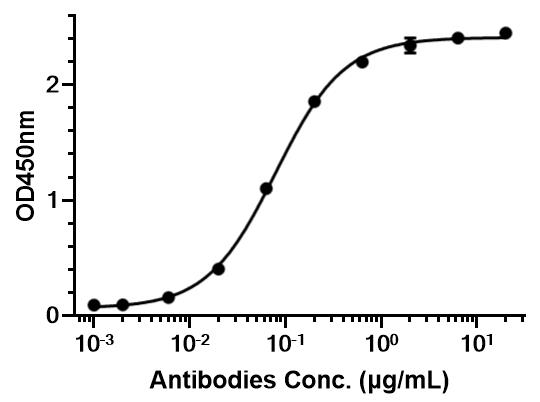 Immobilized Human IL-21 R Protein, His Tag can bind ATR-107. The EC50 for this effect is 79 ng/mL.
 -
 Flow cytometric analysis of 1X10⁶ HepG2 cells labeling CD360 with ATR-107 (HY-P991272, red). Cells were fixed with 4% paraformaldehyde. Then stained with the primary antibody at 1/200 for an hour at 4℃. AF488-conjugated Goat Anti-Human IgG H&L (AF488) (HY-P83776) was used as the secondary antibody at 1/1,000 dilution for 30 minutes at 4℃. Human IgG1 kappa Isotype Control (HY-P99992, blue) was used as the isotype control, cells without incubation with primary antibody were used as the unlabeled control (black).


Chemical Information
-
Appearance Liquid
-
Molecular Weight 143.42 kDa
-
Color Colorless to light yellow
-
SMILES
N/A
-
Synonyms
PF-05230900
-
Shipping
Shipping with dry ice.
-
Formulation
Please refer to the lot-specific COA for specific buffer information.
-
Storage
Please store the product under the recommended conditions in the Certificate of Analysis.


Purity & Documentation
-
Data Sheet (267 KB)
-
SDS (251 KB)
- English - EN (251 KB)
- Français - FR (251 KB)
- Deutsch - DE (251 KB)
- Norwegian - NO (251 KB)
- Español - ES (251 KB)
- Swedish - SV (251 KB)
- Italian - IT (251 KB)
- Korean - KR (251 KB)
- Portuguese - PT (251 KB)
-
Inhibitory Antibodies User Guide (603 KB)
References
[1]. Hu W, et al. Immune-Mediated Liver Effects Associated With Administration of a Human Anti-IL-21 Receptor Antibody (ATR-107) in Rats. Toxicol Pathol. 2024;52(5):232-250. [Content Brief]
[2]. Tsai WK, et al. Nonclinical immunogenicity risk assessment for knobs-into-holes bispecific IgG1 antibodies. MAbs. 2024;16(1):2362789. [Content Brief]

Calculators
Concentration (start) × Volume (start) = Concentration (final) × Volume (final)


ATR-107 Related Classifications
HY-P991272 Related Classifications
 Powered by Bioz