



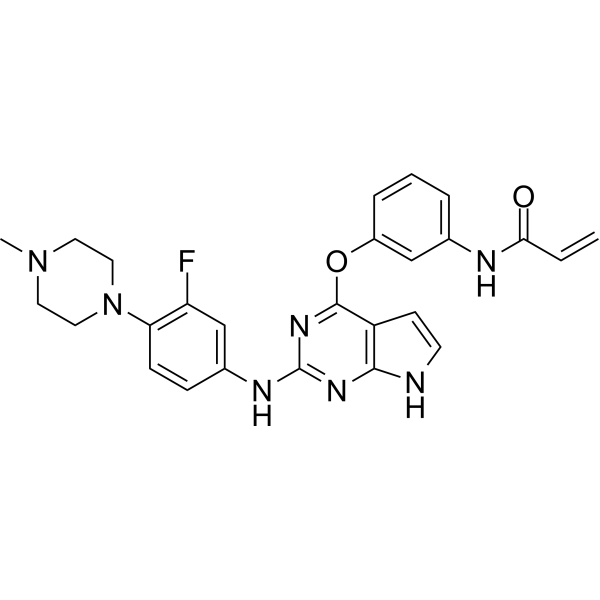
Avitinib
Based on 4 publication(s) in Google Scholar
Avitinib (Abivertinib) is a third-generation, irreversible and orally active selective EGFR inhibitor, with IC50 values of 0.18 nM, 0.18 nM, 7.68 nM and against EGFR L858R, EGFR T790M and wild-type EGFR. Avitinib is also a BTK inhibitor that induces apoptosis and inhibits phosphorylation of BTK in mantle cell lymphoma. Avitinib shows anticancer effects.
Para uso exclusivo en investigación. No vendemos a pacientes.
- Pureza : 99.95%
- No. CAS: 1557267-42-1
- Fòrmula: C26H26FN7O2
- Peso molecular:487.53
-
Almacenamiento:
4°C, sealed storage, away from moisture
* In solvent : -80°C, 6 months; -20°C, 1 month (sealed storage, away from moisture)

To place orders, for customer services and technical support, please contact: MedChemExpress USA
Tel: 609-228-6898 E-mail: [email protected] [email protected]


-
 Actividad biológica
-
Chemical Information
-
Solvente y solubilidad
- Protocolo
- Pureza y Documentación
- Referencias
-
 Help & FAQs


Publications Citing Use of MedChemExpress (MCE) Avitinib
MoreVer todos los productos específicos de isoformas EGFR
More

Actividad biológica
Descripciòn
IC50 & Target
[1]|
EGFR L858R 0.18 nM (IC50) |
EGFRT790M 0.18 nM (IC50) |
EGFR (WT) 7.68 nM (IC50) |
Cellular Effect
|
Cell Line

|
Type | Value | Description | References |
|---|---|---|---|---|
| A549 | IC50 |
1.92 μM
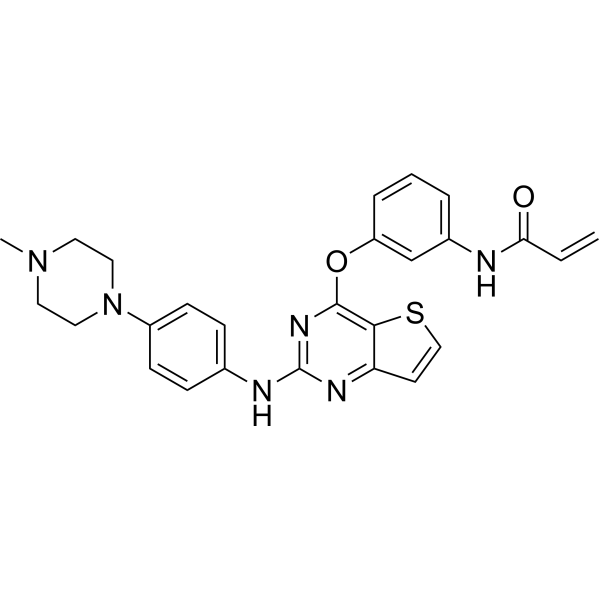
Compound: 12b
|
Cytotoxicity against human A549 cells harboring wild type EGFR assessed as reduction in cell viability measured after 48 hrs by CCK8 assay
Cytotoxicity against human A549 cells harboring wild type EGFR assessed as reduction in cell viability measured after 48 hrs by CCK8 assay
|
[PMID: 34315040] |
| BEAS-2B | IC50 |
3.68 μM
Compound: 12b
|
Cytotoxicity against human BEAS-2B cells assessed as reduction in cell viability measured after 48 hrs by CCK8 assay
Cytotoxicity against human BEAS-2B cells assessed as reduction in cell viability measured after 48 hrs by CCK8 assay
|
[PMID: 34315040] |
| HCC827 | IC50 |
0.1 μM
Compound: 12b
|
Cytotoxicity against human HCC827 cells harboring EGFR del E746-A750 mutant assessed as reduction in cell viability measured after 48 hrs by CCK8 assay
Cytotoxicity against human HCC827 cells harboring EGFR del E746-A750 mutant assessed as reduction in cell viability measured after 48 hrs by CCK8 assay
|
[PMID: 34315040] |
| NCI-H1975 | IC50 |
1.56 μM
Compound: 12b
|
Cytotoxicity against human NCI-H1975 cells harboring EGFR L858R/T790M mutant assessed as reduction in cell viability measured after 48 hrs by CCK8 assay
Cytotoxicity against human NCI-H1975 cells harboring EGFR L858R/T790M mutant assessed as reduction in cell viability measured after 48 hrs by CCK8 assay
|
[PMID: 34315040] |
| NCI-H460 | IC50 |
6.02 μM
Compound: 12b
|
Cytotoxicity against human NCI-H460 cells harboring wild type EGFR assessed as reduction in cell viability measured after 48 hrs by CCK8 assay
Cytotoxicity against human NCI-H460 cells harboring wild type EGFR assessed as reduction in cell viability measured after 48 hrs by CCK8 assay
|
[PMID: 34315040] |
In Vitro
Avitinib (AC0010; 0.13 nM-2 μM; 2 h) selectively inhibits mutant EGFR phosphorylation with IC50 values of 7.3 and 2.8 nM in NCI-H1975 and NIH/3T3_TC32T8 cells, about 115- and 298-fold more sensitive than that of the inhibition of wild-type EGFR in A431. Avitinib potently inhibits EGFR-Tyr1068 phosphorylation in NCI-H1975 cells, and the selectivity ratio is at 65-fold for NCI-H1975 cells versus A431 cells. In addition to inhibition of EGFR-Tyr1068 phosphorylation, Avitinib inhibits phosphorylation of the downstream targets Akt and ERK1/2 in NCI-H1975 and HCC827 cells[1].
MedChemExpress (MCE) has not independently confirmed the accuracy of these methods. They are for reference only.
-
Cell Line:NCI-H1975, HCC827, A431 cells
-
Concentration:0.13 nM, 0.64 nM, 3.2 nM, 16 nM, 80 nM, 0.4 μM, 2 μM
-
Incubation Time:2 h
-
Result:Selectively inhibits mutant EGFR phosphorylation with IC50 values of 7.3 and 2.8 nM in NCI-H1975 and NIH/3T3_TC32T8 cells.
In Vivo
MedChemExpress (MCE) has not independently confirmed the accuracy of these methods. They are for reference only.
-
Animal Model:Nu/Nu nude mice (Six- to 8-week-old) injected with NCI-H1975 and A431 cells[1]
-
Dosage:12.5, 50, and 500 mg/kg
-
Administration:Orally administration; once daily; for 14 days
-
Result:Inhibited EGFR-mutant tumor growth but not wild-type EGFR tumor growth.


Chemical Information
-
No. CAS 1557267-42-1
-
Appearance Solid
-
Peso molecular 487.53
-
Fòrmula C26H26FN7O2
-
Color White to off-white
-
SMILES
O=C(C=C)NC1=CC=CC(OC2=NC(NC3=CC(F)=C(N4CCN(C)CC4)C=C3)=NC5=C2C=CN5)=C1
-
Synonyms
Abivertinib; AC0010
-
Envío
Room temperature in continental US; may vary elsewhere.
-
Almacenamiento
4°C, sealed storage, away from moisture
* In solvent : -80°C, 6 months; -20°C, 1 month (sealed storage, away from moisture)


Publications (4)
-
Journal Impact Factor
-
Most Recent
-
Antioxidants (Basel)
A Novel SIRT1 Activator Hydroxygenkwanin Alleviates Osteoporosis by Inhibiting Ferroptosis and Lactylation in Skeletal Stem/Progenitor Cells. [Abstract]2026 May 12;15(5):612. PMID: 42193234 -
Bioorg Chem
Identification of FTY720 and COH29 as novel topoisomerase I catalytic inhibitors by experimental and computational studies. [Abstract]2024 Jun:147:107412. PMID: 38696845 -
Molecules
A Validated LC-MS/MS Assay for the Simultaneous Quantification of the FDA-Approved Anticancer Mixture (Encorafenib and Binimetinib): Metabolic Stability Estimation. [Abstract]2021 May 5;26(9):2717. PMID: 34063139 -
J Pharm Biomed Anal
Reactive intermediates and bioactivation pathways characterization of avitinib by LC-MS/MS: In vitro metabolic investigation. [Abstract]2019 Feb 5:164:659-667. PMID: 30472584


Solvente y solubilidad
In Vitro:
DMSO : 83.33 mg/mL (170.92 mM; Need ultrasonic; Hygroscopic DMSO has a significant impact on the solubility of product, please use newly opened DMSO)
Please refer to the solubility information to select the appropriate solvent. Once prepared, please aliquot and store the solution to prevent product inactivation from repeated freeze-thaw cycles.
Storage method and period of stock solution: -80°C, 6 months; -20°C, 1 month (sealed storage, away from moisture). When stored at -80°C, please use it within 6 months. When stored at -20°C, please use it within 1 month.
Please refer to the solubility information to select the appropriate solvent. Once prepared, please aliquot and store the solution to prevent product inactivation from repeated freeze-thaw cycles.
Storage method and period of stock solution: -80°C, 6 months; -20°C, 1 month (sealed storage, away from moisture). When stored at -80°C, please use it within 6 months. When stored at -20°C, please use it within 1 month.
Concentration (start) × Volume (start) = Concentration (final) × Volume (final)
In Vivo:
Select the appropriate dissolution method based on your experimental animal and administration route.
- For the following dissolution methods, please ensure to first prepare a clear stock solution using an In Vitro approach and then sequentially add co-solvents:
- To ensure reliable experimental results, the clarified stock solution can be appropriately stored based on storage conditions. As for the working solution for In Vivo experiments, it is recommended to prepare freshly and use it on the same day.
- The percentages shown for the solvents indicate their volumetric ratio in the final prepared solution. If precipitation or phase separation occurs during preparation, heat and/or sonication can be used to aid dissolution.
Add each solvent one by one: 10% DMSO 40% PEG300 5% Tween-80 45% Saline
Solubility: ≥ 3.57 mg/mL (7.32 mM); Clear solution
This protocol yields a clear solution of ≥ 3.57 mg/mL (saturation unknown).
Taking 1 mL working solution as an example, add 100 μL DMSO stock solution (35.7 mg/mL) to 400 μL PEG300, and mix evenly; then add 50 μL Tween-80 and mix evenly; then add 450 μL Saline to adjust the volume to 1 mL.
Preparation of Saline: Dissolve 0.9 g sodium chloride in ddH₂O and dilute to 100 mL to obtain a clear Saline solution.
In Vivo Dissolution Calculator
Please enter the basic information of animal experiments:
-
-
-
-
Recommended: Prepare an additional quantity of animals to account for potential losses during experiments.
Please enter your animal formula composition:
-
%DMSO +
Recommended: Keep the proportion of DMSO in working solution below 2% if your animal is weak.
-
%+
-
+%Tween-80 + +
-
%Saline +
The co-solvents required include: DMSO, . All of co-solvents are available by MedChemExpress (MCE). , Tween 80. All of co-solvents are available by MedChemExpress (MCE).
Working solution concentration: 0.22 mg/mL
Method for preparing stock solution: mg drug dissolved in μL DMSO. Stock solution concentration: mg/mL. * In solvent : -80°C, 6 months; -20°C, 1 month (sealed storage, away from moisture)
1. Take μL DMSO stock solution;
2. Add μL .
μL , mix evenly;
3. Then add μL Tween 80, mix evenly;
4. Then add μL
Please ensure that the stock solution in the first step is dissolved to a clear state, and add co-solvents in sequence. You can use ultrasonic heating (ultrasonic cleaner, recommended frequency 20-40 kHz), vortexing, etc. to assist dissolution.


Pureza y Documentación
-
Ficha de datos (283 KB)
-
SDS (393 KB)
- English - EN (393 KB)
- Français - FR (393 KB)
- Deutsch - DE (393 KB)
- Norwegian - NO (393 KB)
- Español - ES (393 KB)
- Swedish - SV (393 KB)
- Italian - IT (393 KB)
- Korean - KR (393 KB)
- Portuguese - PT (393 KB)
-
Instrucciones de manejo (2659 KB)
Referencias
[1]. Xu X, Mao L, Xu W, et al. AC0010, an Irreversible EGFR Inhibitor Selectively Targeting Mutated EGFR and Overcoming T790M-Induced Resistance in Animal Models and Lung Cancer Patients. Mol Cancer Ther. 2016;15(11):2586-2597. [Content Brief]
[2]. Yan X, Zhou Y, Huang S, et al. Promising efficacy of novel BTK inhibitor AC0010 in mantle cell lymphoma. J Cancer Res Clin Oncol. 2018;144(4):697-706. [Content Brief]


Complete Stock Solution Preparation Table
Please refer to the solubility information to select the appropriate solvent. Once prepared, please aliquot and store the solution to prevent product inactivation from repeated freeze-thaw cycles.
Storage method and period of stock solution: -80°C, 6 months; -20°C, 1 month (sealed storage, away from moisture). When stored at -80°C, please use it within 6 months. When stored at -20°C, please use it within 1 month.
| Optional Solvent | Concentration Solvent Mass | 1 mg | 5 mg | 10 mg | 25 mg |
|---|---|---|---|---|---|
| DMSO | 1 mM | 2.0512 mL | 10.2558 mL | 20.5116 mL | 51.2789 mL |
| 5 mM | 0.4102 mL | 2.0512 mL | 4.1023 mL | 10.2558 mL | |
| 10 mM | 0.2051 mL | 1.0256 mL | 2.0512 mL | 5.1279 mL | |
| 15 mM | 0.1367 mL | 0.6837 mL | 1.3674 mL | 3.4186 mL | |
| 20 mM | 0.1026 mL | 0.5128 mL | 1.0256 mL | 2.5639 mL | |
| 25 mM | 0.0820 mL | 0.4102 mL | 0.8205 mL | 2.0512 mL | |
| 30 mM | 0.0684 mL | 0.3419 mL | 0.6837 mL | 1.7093 mL | |
| 40 mM | 0.0513 mL | 0.2564 mL | 0.5128 mL | 1.2820 mL | |
| 50 mM | 0.0410 mL | 0.2051 mL | 0.4102 mL | 1.0256 mL | |
| 60 mM | 0.0342 mL | 0.1709 mL | 0.3419 mL | 0.8546 mL | |
| 80 mM | 0.0256 mL | 0.1282 mL | 0.2564 mL | 0.6410 mL | |
| 100 mM | 0.0205 mL | 0.1026 mL | 0.2051 mL | 0.5128 mL |


Avitinib Related Classifications
HY-19816 Related Classifications
 Powered by Bioz