



BPN-15477

Based on 1 Customer Validation
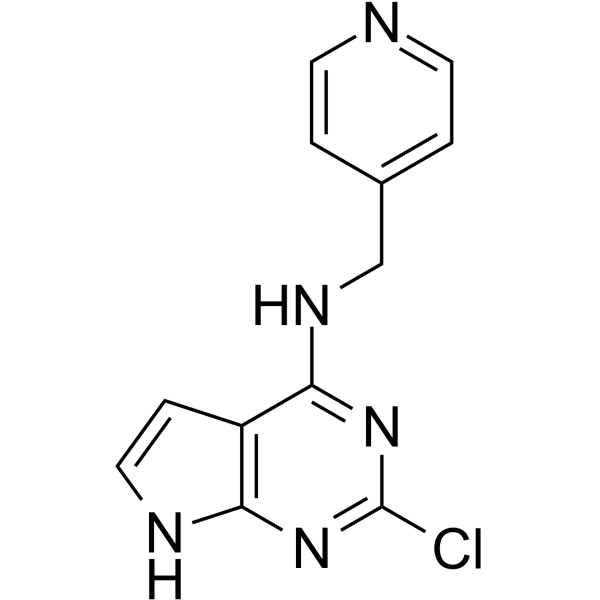
BPN-15477 is an orally active, blood-brain barrier-permeable splicing modulator compound (SMC). BPN-15477 restores the correct splicing of exon 20 of the elongator complex protein 1 (ELP1) (EC50 = 1.9 μM), thereby significantly increasing the in vivo functional protein levels in all tissues including the brain. BPN-15477 can be used in the research of familial dysautonomia, such as frontotemporal dementia.
For research use only. We do not sell to patients.
- Purity : 99.92%
- CAS No.: 1971086-99-3
- Formula: C12H10ClN5
- Molecular Weight:259.69
-
Storage:Powder -20°C, 3 years , 4°C, 2 years ; In solvent -80°C, 6 months , -20°C, 1 month

To place orders, for customer services and technical support, please contact: MedChemExpress USA
Tel: 609-228-6898 E-mail: [email protected] [email protected]


-
 Biological Activity
-
Chemical Information
-
Solvent & Solubility
- Purity & Documentation
- References
-
 Help & FAQs


All DNA/RNA Synthesis Isoforms
More

Biological Activity
Description
In Vitro
BPN-15477 (24 h) potently increases the inclusion rate of ELP1 exon 20 in HEK293T cells transfected with Rluc-FD-Fluc, with an EC50 of 1.9 μM[1].
BPN-15477 (0.3-60 μM; 24 h) dose-dependently increases the inclusion rate of ELP1 exon 20 in fibroblasts from FD patients, reaching up to 99.6% after treatment with 60 μM for 24 h[1].
BPN-15477 (30 μM; 7 days) selectively regulates genome-wide transcriptome splicing in wild-type human fibroblasts, altering the inclusion or exclusion of 934 exon triplets after 7 days of treatment at 30 μM, and RT-PCR validates the results of RNA-seq[1].
BPN-15477 (60 μM; 24 h) regulates the splicing of intermediate exons in HEK293T cells transfected with PARP6 and SETD5 minigenes, which is consistent with the prediction results of the CNN model; specifically, treatment with 60 μM for 24 h increases the inclusion rate of PARP6 exons and decreases that of SETD5 exons[1].
BPN-15477 (60 μM; 24-5 days) corrects aberrant splicing in disease-related models: after treatment at 60 μM for 24 to 5 days, it increases the inclusion rate of LIPA exon 8 in fibroblasts from patients with c.894G > A, elevates the inclusion rate of CFTR exon 18 in minigene cells with c.2988G > A, enhances the inclusion rate of MLH1 exon 17 in minigene cells with c.1989G > A, and reduces the inclusion rate of MAPT exon 10 in minigene cells with c.1866 and 16C > T[1].
BPN-15477 (60 μM; 5-7 days) increases the level of functional LIPA protein in fibroblasts from patients with c.894G > A, as well as the level of mature CFTR protein in Flp-In-293 cells expressing the c.2988G > A minigene following treatment with 60 μM for 5 to 7 days[1].
BPN-15477 (0.3-10 μM; 3 days) dose-dependently restores the function of CFTR chloride channels in CFBE cells, with maximal function achieved at a concentration of 3 μM after 3 days of treatment[1].
MedChemExpress (MCE) has not independently confirmed the accuracy of these methods. They are for reference only.
-
Cell Line:Familial dysautonomia (FD) patient fibroblasts carrying the ELP1 c.2204+6T>C mutation
-
Concentration:0.3, 1, 3, 10, 30 and 60 μM
-
Incubation Time:24 h
-
Result:Increased ELP1 exon 20 inclusion in a dose-dependent manner, reaching 99.6% inclusion at 60 μM, compared to 51.1% inclusion with DMSO vehicle.
-
Cell Line:HEK293T cells transfected with PARP6 or SETD5 minigenes (wild-type and mutated)
-
Concentration:60 μM
-
Incubation Time:24 h
-
Result:Increased middle exon inclusion in wild-type PARP6 minigene from 33.0% to 56.2% and in mutated PARP6 minigene from 2.9% to 13.2%.
Decreased middle exon inclusion in wild-type SETD5 minigene from 18.7% to 13.1% and in mutated SETD5 minigene from 93.0% to 83.4%.
Matched CNN model predictions of treatment response.
-
Cell Line:LIPA patient fibroblasts carrying the c.894G>A mutation; Flp-In-293 cells stably expressing c.2988G>A CFTR expression minigene; HEK293T cells transfected with c.1989G>A MLH1 minigene; HEK293 cells stably expressing c.1866+16C>T MAPT minigene
-
Concentration:60 μM
-
Incubation Time:24 h (LIPA, MLH1, MAPT cells); 5 days (CFTR minigene cells)
-
Result:Increased LIPA exon 8 inclusion from 54.2% (DMSO) to 66.1% in LIPA patient fibroblasts.
Increased CFTR exon 18 inclusion from 4.4% (DMSO) to 13.2% in CFTR minigene cells.
Increased MLH1 exon 17 inclusion from 5.1% (DMSO) to 11.1% in MLH1 minigene cells.
Decreased MAPT exon 10 inclusion from 90.9% (DMSO) to 87.0% in MAPT minigene cells.
-
Cell Line:LIPA patient fibroblasts carrying the c.894G>A mutation; Flp-In-293 cells stably expressing c.2988G>A CFTR expression minigene
-
Concentration:60 μM
-
Incubation Time:7 days (LIPA fibroblasts); 5 days (CFTR minigene cells)
-
Result:Increased functional LIPA protein levels to ~10% of wild-type levels, compared to near-undetectable levels with DMSO in LIPA patient fibroblasts.
Increased mature CFTR protein levels to ~20% of wild-type levels, compared to ~3% with DMSO in CFTR minigene cells.
In Vivo
BPN-15477 (70 mg/kg/day; p.o.; daily; 5 weeks) achieves near-complete correction of ELP1 exon 20 splicing in the retina of humanized FD transgenic mice, with mean exon 20 inclusion reaching ~95%[2].
MedChemExpress (MCE) has not independently confirmed the accuracy of these methods. They are for reference only.
-
Animal Model:TgFD9 transgenic mice (adult)[1]
-
Dosage:10 mg/kg; 30 mg/kg; 60 mg/kg; 100 mg/kg
-
Administration:p.o.; daily; 7 days
-
Result:Increased full-length ELP1 transcript in a dose-dependent manner across all tissues.
Achieved at least a two-fold increase in functional ELP1 protein in brain, liver, kidney, heart, and skin at all tested doses.
Showed good tolerability, with no weight loss or adverse effects observed in treated groups.
-
Animal Model:mixed C57BL/6J and C57BL/6N background (both sexes, humanized transgenic carrying ELP1 transgene with FD splice mutation, TgFD9)[2]
-
Dosage:70 mg/kg/day
-
Administration:p.o.; daily; 5 weeks
-
Result:Increased ELP1 exon 20 inclusion in the retina from a mean of 52% in untreated mice to a mean of 95% in treated mice, representing near-complete correction of the splicing defect.


Chemical Information
-
CAS No. 1971086-99-3
-
Appearance Solid
-
Molecular Weight 259.69
-
Formula C12H10ClN5
-
Color White to light yellow
-
SMILES
ClC1=NC2=C(C=CN2)C(NCC3=CC=NC=C3)=N1
-
Shipping
Room temperature in continental US; may vary elsewhere.
-
Storage
Powder -20°C 3 years 4°C 2 years In solvent -80°C 6 months -20°C 1 month


Solvent & Solubility
In Vitro:
DMSO : 25 mg/mL (96.27 mM; Need ultrasonic; Hygroscopic DMSO has a significant impact on the solubility of product, please use newly opened DMSO)
Please refer to the solubility information to select the appropriate solvent. Once prepared, please aliquot and store the solution to prevent product inactivation from repeated freeze-thaw cycles.
Storage method and period of stock solution: -80°C, 6 months; -20°C, 1 month. When stored at -80°C, please use it within 6 months. When stored at -20°C, please use it within 1 month.
Please refer to the solubility information to select the appropriate solvent. Once prepared, please aliquot and store the solution to prevent product inactivation from repeated freeze-thaw cycles.
Storage method and period of stock solution: -80°C, 6 months; -20°C, 1 month. When stored at -80°C, please use it within 6 months. When stored at -20°C, please use it within 1 month.
Concentration (start) × Volume (start) = Concentration (final) × Volume (final)


Purity & Documentation
-
Data Sheet (280 KB)
-
SDS (251 KB)
- English - EN (251 KB)
- Français - FR (251 KB)
- Deutsch - DE (251 KB)
- Norwegian - NO (251 KB)
- Español - ES (251 KB)
- Swedish - SV (251 KB)
- Italian - IT (251 KB)
- Korean - KR (251 KB)
- Portuguese - PT (251 KB)
-
Handling Instructions (2659 KB)
References
[1].
Gao D, et al. A deep learning approach to identify gene targets of a therapeutic for human splicing disorders. Nat Commun. 2021 Jun 7;12(1):3332.
[Content Brief]
[2].
Chekuri A, et al. Selective retinal ganglion cell loss and optic neuropathy in a humanized mouse model of familial dysautonomia. Human Molecular Genetics. 2022 Jun 1;31(11):1776-87.
[Content Brief]


Complete Stock Solution Preparation Table
Please refer to the solubility information to select the appropriate solvent. Once prepared, please aliquot and store the solution to prevent product inactivation from repeated freeze-thaw cycles.
Storage method and period of stock solution: -80°C, 6 months; -20°C, 1 month. When stored at -80°C, please use it within 6 months. When stored at -20°C, please use it within 1 month.
| Optional Solvent | Concentration Solvent Mass | 1 mg | 5 mg | 10 mg | 25 mg |
|---|---|---|---|---|---|
| DMSO | 1 mM | 3.8507 mL | 19.2537 mL | 38.5075 mL | 96.2686 mL |
| 5 mM | 0.7701 mL | 3.8507 mL | 7.7015 mL | 19.2537 mL | |
| 10 mM | 0.3851 mL | 1.9254 mL | 3.8507 mL | 9.6269 mL | |
| 15 mM | 0.2567 mL | 1.2836 mL | 2.5672 mL | 6.4179 mL | |
| 20 mM | 0.1925 mL | 0.9627 mL | 1.9254 mL | 4.8134 mL | |
| 25 mM | 0.1540 mL | 0.7701 mL | 1.5403 mL | 3.8507 mL | |
| 30 mM | 0.1284 mL | 0.6418 mL | 1.2836 mL | 3.2090 mL | |
| 40 mM | 0.0963 mL | 0.4813 mL | 0.9627 mL | 2.4067 mL | |
| 50 mM | 0.0770 mL | 0.3851 mL | 0.7701 mL | 1.9254 mL | |
| 60 mM | 0.0642 mL | 0.3209 mL | 0.6418 mL | 1.6045 mL | |
| 80 mM | 0.0481 mL | 0.2407 mL | 0.4813 mL | 1.2034 mL |


BPN-15477 Related Classifications
HY-147149 Related Classifications
 Powered by Bioz