



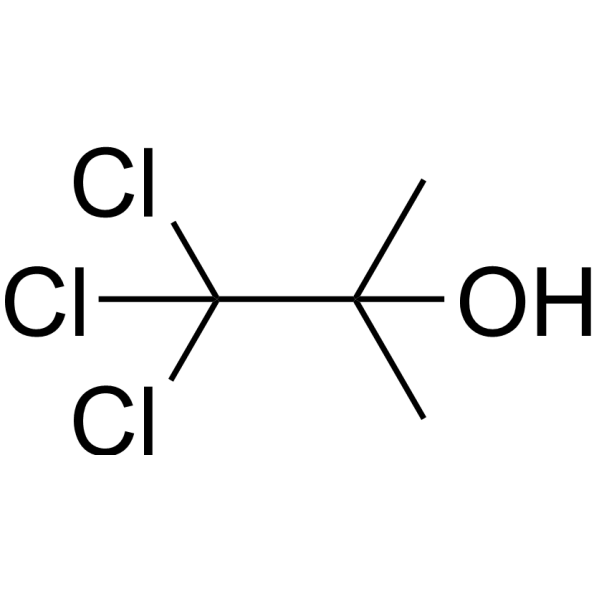
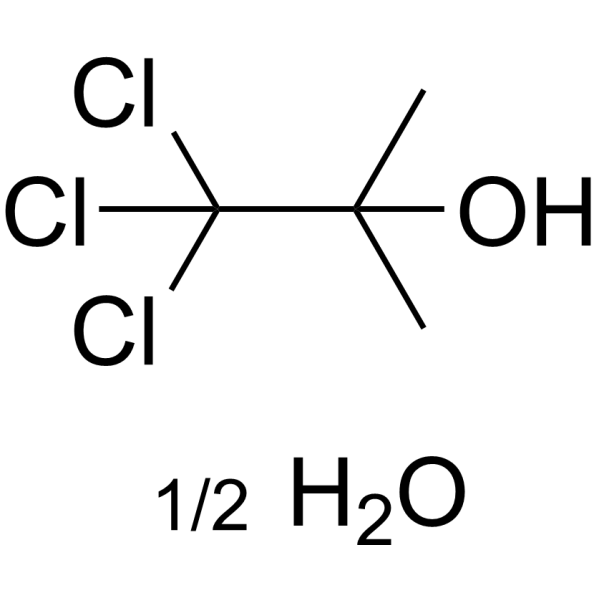
Chlorobutanol

Based on 1 Customer Validation
Chlorobutanol is an orally active and potent inhibitor of platelet aggregation and release and a pharmaceutical preservative with antibacterial activity. Chlorobutanol inhibits thromboxane B2 formation, ATP release, and elevation of cytosolic free calcium caused by collagen, ADP, epinephrine, arachidonic acid and thrombin. Chlorobutanol is active against a wide variety of Gram-positive and Gram-negative bacteria, and several mold spores and fungi. Chlorobutanol is widely used in food and cosmetic industry.
For research use only. We do not sell to patients.
- Purity: 98.0%
- CAS No.: 57-15-8
- Formula: C4H7Cl3O
- Molecular Weight:177.46
-
Storage:Powder -20°C, 3 years , 4°C, 2 years ; In solvent -80°C, 2 years , -20°C, 1 year

To place orders, for customer services and technical support, please contact: MedChemExpress USA
Tel: 609-228-6898 E-mail: [email protected] [email protected]


-
 Biological Activity
-
Chemical Information
-
Solvent & Solubility
- Purity & Documentation
- References
-
 Help & FAQs





Biological Activity
Chlorobutanol (25-100 mg/mL, 4 min) has no influence on the static sensitivity of the muscle spindle endings and the axon membrane[3].
MedChemExpress (MCE) has not independently confirmed the accuracy of these methods. They are for reference only.
MedChemExpress (MCE) has not independently confirmed the accuracy of these methods. They are for reference only.
-
Animal Model:Rats (age 6 weeks)[4]
-
Dosage:62.5-250 mg/kg
-
Administration:oral gavage, daily for 2 weeks
-
Result:Significantly decreased the body weight in rats.
-
Animal Model:Rats (age 6 weeks)[4]
-
Dosage:12.5-100 mg/kg
-
Administration:oral gavage, daily for 4 weeks
-
Result:Showed an unusual form and significant lesions in the organs and tubular hyaline droplets in rats.


Chemical Information
-
CAS No. 57-15-8
-
Appearance Solid
-
Molecular Weight 177.46
-
Formula C4H7Cl3O
-
Color White to off-white
-
SMILES
CC(O)(C)C(Cl)(Cl)Cl
-
Shipping
Room temperature in continental US; may vary elsewhere.
-
Storage
Powder -20°C 3 years 4°C 2 years In solvent -80°C 2 years -20°C 1 year


Solvent & Solubility
DMSO : 100 mg/mL (563.51 mM; Need ultrasonic; Hygroscopic DMSO has a significant impact on the solubility of product, please use newly opened DMSO)
Please refer to the solubility information to select the appropriate solvent. Once prepared, please aliquot and store the solution to prevent product inactivation from repeated freeze-thaw cycles.
Storage method and period of stock solution: -80°C, 2 years; -20°C, 1 year. When stored at -80°C, please use it within 2 years. When stored at -20°C, please use it within 1 year.
Please refer to the solubility information to select the appropriate solvent. Once prepared, please aliquot and store the solution to prevent product inactivation from repeated freeze-thaw cycles.
Storage method and period of stock solution: -80°C, 2 years; -20°C, 1 year. When stored at -80°C, please use it within 2 years. When stored at -20°C, please use it within 1 year.
Concentration (start) × Volume (start) = Concentration (final) × Volume (final)
Select the appropriate dissolution method based on your experimental animal and administration route.
- For the following dissolution methods, please ensure to first prepare a clear stock solution using an In Vitro approach and then sequentially add co-solvents:
- To ensure reliable experimental results, the clarified stock solution can be appropriately stored based on storage conditions. As for the working solution for In Vivo experiments, it is recommended to prepare freshly and use it on the same day.
- The percentages shown for the solvents indicate their volumetric ratio in the final prepared solution. If precipitation or phase separation occurs during preparation, heat and/or sonication can be used to aid dissolution.
Add each solvent one by one: 10% DMSO 40% PEG300 5% Tween-80 45% Saline
Solubility: ≥ 2.5 mg/mL (14.09 mM); Clear solution
This protocol yields a clear solution of ≥ 2.5 mg/mL (saturation unknown).
Taking 1 mL working solution as an example, add 100 μL DMSO stock solution (25.0 mg/mL) to 400 μL PEG300, and mix evenly; then add 50 μL Tween-80 and mix evenly; then add 450 μL Saline to adjust the volume to 1 mL.
Preparation of Saline: Dissolve 0.9 g sodium chloride in ddH₂O and dilute to 100 mL to obtain a clear Saline solution.
Add each solvent one by one: 10% DMSO 90% (20% SBE-β-CD in Saline)
Solubility: ≥ 2.5 mg/mL (14.09 mM); Clear solution
This protocol yields a clear solution of ≥ 2.5 mg/mL (saturation unknown).
Taking 1 mL working solution as an example, add 100 μL DMSO stock solution (25.0 mg/mL) to 900 μL 20% SBE-β-CD in Saline, and mix evenly.
Preparation of 20% SBE-β-CD in Saline (4°C, storage for one week): 2 g SBE-β-CD powder is dissolved in 10 mL Saline, completely dissolve until clear.
Please enter the basic information of animal experiments:
-
-
-
-
Recommended: Prepare an additional quantity of animals to account for potential losses during experiments.
Please enter your animal formula composition:
-
%DMSO +
Recommended: Keep the proportion of DMSO in working solution below 2% if your animal is weak.
-
%+
-
+%Tween-80 + +
-
%Saline +
The co-solvents required include: DMSO, . All of co-solvents are available by MedChemExpress (MCE). , Tween 80. All of co-solvents are available by MedChemExpress (MCE).
Working solution concentration: 0.22 mg/mL
Method for preparing stock solution: mg drug dissolved in μL DMSO. Stock solution concentration: mg/mL.
1. Take μL DMSO stock solution;
2. Add μL .
μL , mix evenly;
3. Then add μL Tween 80, mix evenly;
4. Then add μL
Please ensure that the stock solution in the first step is dissolved to a clear state, and add co-solvents in sequence. You can use ultrasonic heating (ultrasonic cleaner, recommended frequency 20-40 kHz), vortexing, etc. to assist dissolution.


Purity & Documentation
-
Data Sheet (274 KB)
-
SDS (393 KB)
- English - EN (393 KB)
- Français - FR (393 KB)
- Deutsch - DE (393 KB)
- Norwegian - NO (393 KB)
- Español - ES (393 KB)
- Swedish - SV (393 KB)
- Italian - IT (393 KB)
- Korean - KR (393 KB)
- Portuguese - PT (393 KB)
-
Handling Instructions (2659 KB)
References
[1]. Smoak IW, et al. Chlorobutanol: maternal serum levels and placental transfer in the mouse. Vet Hum Toxicol. 1997 Oct;39(5):287-90. [Content Brief]
[2]. Chen SL, et al. Chlorobutanol, a preservative of desmopressin, inhibits human platelet aggregation and release in vitro. Thromb Haemost. 1990 Nov 30;64(3):473-7. [Content Brief]
[3]. Fischer M. Effects of chlorobutanol on primary and secondary endings of isolated cat muscle spindles. Brain Res. 2000 Jan 31;854(1-2):106-21. [Content Brief]
[4]. Jeong D, et al. In Vivo Evaluation of the Oral Toxicity of the Chlorobutanol. Toxics. 2022 Jan 7;10(1):24. [Content Brief]
[5]. Friesen WT, et al. The antibacterial stability of chlorobutanol stored in polyethylene bottles. Am J Hosp Pharm. 1971 Jul;28(7):507-12. [Content Brief]


Complete Stock Solution Preparation Table
Please refer to the solubility information to select the appropriate solvent. Once prepared, please aliquot and store the solution to prevent product inactivation from repeated freeze-thaw cycles.
Storage method and period of stock solution: -80°C, 2 years; -20°C, 1 year. When stored at -80°C, please use it within 2 years. When stored at -20°C, please use it within 1 year.
| Optional Solvent | Concentration Solvent Mass | 1 mg | 5 mg | 10 mg | 25 mg |
|---|---|---|---|---|---|
| DMSO | 1 mM | 5.6351 mL | 28.1754 mL | 56.3507 mL | 140.8768 mL |
| 5 mM | 1.1270 mL | 5.6351 mL | 11.2701 mL | 28.1754 mL | |
| 10 mM | 0.5635 mL | 2.8175 mL | 5.6351 mL | 14.0877 mL | |
| 15 mM | 0.3757 mL | 1.8784 mL | 3.7567 mL | 9.3918 mL | |
| 20 mM | 0.2818 mL | 1.4088 mL | 2.8175 mL | 7.0438 mL | |
| 25 mM | 0.2254 mL | 1.1270 mL | 2.2540 mL | 5.6351 mL | |
| 30 mM | 0.1878 mL | 0.9392 mL | 1.8784 mL | 4.6959 mL | |
| 40 mM | 0.1409 mL | 0.7044 mL | 1.4088 mL | 3.5219 mL | |
| 50 mM | 0.1127 mL | 0.5635 mL | 1.1270 mL | 2.8175 mL | |
| 60 mM | 0.0939 mL | 0.4696 mL | 0.9392 mL | 2.3479 mL | |
| 80 mM | 0.0704 mL | 0.3522 mL | 0.7044 mL | 1.7610 mL | |
| 100 mM | 0.0564 mL | 0.2818 mL | 0.5635 mL | 1.4088 mL |


Chlorobutanol Related Classifications
HY-B1263 Related Classifications
 Powered by Bioz