



Dehydrocholic acid

Based on 1 Customer Validation
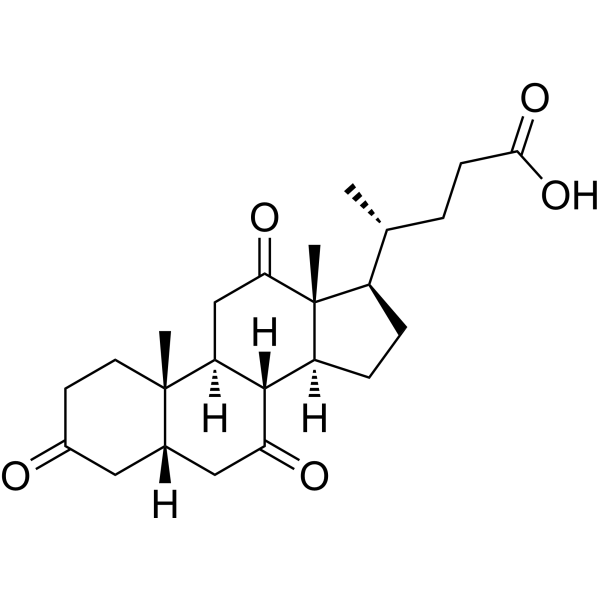
Dehydrocholic acid (Dehydrocholate) is an orally active hydrocholeretic agent. Dehydrocholic acid modulates Autophagy, reduces serum amylase and lipase levels. Dehydrocholic acid has the effects of promoting choleretic function, protecting the liver, reducing pancreatic damage, and regulating cholesterol metabolism. Dehydrocholic acid can be used in the study of acute biliary pancreatitis and obstructive jaundice.
Nos produits utilisent uniquement pour la recherche. Nous ne vendons pas aux patients.
- Pureté: 99.92%
- CAS No.: 81-23-2
- Formule: C24H34O5
- Masse moléculaire:402.52
-
Stockage:Powder -20°C, 3 years , 4°C, 2 years ; In solvent -80°C, 2 years , -20°C, 1 year

To place orders, for customer services and technical support, please contact: MedChemExpress USA
Tel: 609-228-6898 E-mail: [email protected] [email protected]


-
 Activité biologique
-
Chemical Information
-
Solvant et solubilité
- Pureté et documentation
- Références
-
 Help & FAQs
-

Metabolism/Protease Compound Library
HY-L012
-
FDA-Approved Drug Library
HY-L022
-
Autophagy Compound Library
HY-L029
-
Drug Repurposing Compound Library
HY-L035
-
Lipid Compound Library
HY-L043
-
NMPA-Approved Drug Library
HY-L053
-
FDA Approved & Pharmacopeial Drug Library
HY-L066
-
Off-patent Drug Library
HY-L141
-
Metabolic Enzyme Compound Library
HY-L146
-
Cysteine Targeted Covalent Library
HY-L153
-
Cell Death Library
HY-L162
-
Multi-Target Compound Library
HY-L176
-
Bioactive Compound Library Max
HY-L181
-
MCE Bioactive Compound Library
HY-L001V
-
Natural Product-like Compound Library
HY-L021L
-
Drug Repurposing Compound Library Plus
HY-L035P
-
FDA-Approved Drug Library Plus
HY-L022P
-
FDA-Approved Drug Library Mini
HY-L022M
-
Natural Product and Natural Product-Like Compound Library
HY-L021M
-
Bioactive Compound Library
HY-L001
-
Fatty Acids Compound Library
HY-L182
-
High-Throughput Bioactive Compound Library
HY-L205
-
Bile Acids Library
HY-L208




Activité biologique
Dehydrocholate sodium (1-4 μmol/min/100g BW; intravenous infusion) increases bile flow and reduces the secretion of endogenous and exogenous biliary bile acids and biliary lipids in rats[2].
Dehydrocholate sodium (Dehydrocholic acid; 100 mg/kg; p.o. via water bottles) shows choleretic and mild hepatoprotective effects in albino rats with obstructive jaundice[3].
Dehydrocholate sodium (0.4% in diet; p.o.; 1 week) increases liver cholesterol level, bile flow and biliary lipid secretion in rats, and its biological effect is similar to that of cholate[4].
Dehydrocholate sodium (50 mg/kg initial dose, then 167 mg/kg/hr infusion; i.v. and infusion) increases bile flow but does not affect the biliary excretion of methylmercury in rats[5].
MedChemExpress (MCE) has not independently confirmed the accuracy of these methods. They are for reference only.


Chemical Information
-
CAS No. 81-23-2
-
Appearance Solid
-
Masse moléculaire 402.52
-
Formule C24H34O5
-
Color White to off-white
-
SMILES
C[C@H](CCC(O)=O)[C@H]([C@]12C)CC[C@@]1([H])[C@]3([H])C(C[C@]4([H])CC(CC[C@]4(C)[C@@]3([H])CC2=O)=O)=O
-
Synonyms
Dehydrocholate
-
Livraison
Room temperature in continental US; may vary elsewhere.
-
Stockage
Powder -20°C 3 years 4°C 2 years In solvent -80°C 2 years -20°C 1 year


Solvant et solubilité
DMSO : 25 mg/mL (62.11 mM; Need ultrasonic; Hygroscopic DMSO has a significant impact on the solubility of product, please use newly opened DMSO)
H2O : < 0.1 mg/mL (insoluble)
Please refer to the solubility information to select the appropriate solvent. Once prepared, please aliquot and store the solution to prevent product inactivation from repeated freeze-thaw cycles.
Storage method and period of stock solution: -80°C, 2 years; -20°C, 1 year. When stored at -80°C, please use it within 2 years. When stored at -20°C, please use it within 1 year.
Please refer to the solubility information to select the appropriate solvent. Once prepared, please aliquot and store the solution to prevent product inactivation from repeated freeze-thaw cycles.
Storage method and period of stock solution: -80°C, 2 years; -20°C, 1 year. When stored at -80°C, please use it within 2 years. When stored at -20°C, please use it within 1 year.
Concentration (start) × Volume (start) = Concentration (final) × Volume (final)
Select the appropriate dissolution method based on your experimental animal and administration route.
- For the following dissolution methods, please ensure to first prepare a clear stock solution using an In Vitro approach and then sequentially add co-solvents:
- To ensure reliable experimental results, the clarified stock solution can be appropriately stored based on storage conditions. As for the working solution for In Vivo experiments, it is recommended to prepare freshly and use it on the same day.
- The percentages shown for the solvents indicate their volumetric ratio in the final prepared solution. If precipitation or phase separation occurs during preparation, heat and/or sonication can be used to aid dissolution.
Add each solvent one by one: 10% DMSO 40% PEG300 5% Tween-80 45% Saline
Solubility: 2.5 mg/mL (6.21 mM); Suspended solution; Need ultrasonic
This protocol yields a suspended solution of 2.5 mg/mL. Suspended solution can be used for oral and intraperitoneal injection.
Taking 1 mL working solution as an example, add 100 μL DMSO stock solution (25.0 mg/mL) to 400 μL PEG300, and mix evenly; then add 50 μL Tween-80 and mix evenly; then add 450 μL Saline to adjust the volume to 1 mL.
Preparation of Saline: Dissolve 0.9 g sodium chloride in ddH₂O and dilute to 100 mL to obtain a clear Saline solution.
Add each solvent one by one: 10% DMSO 90% (20% SBE-β-CD in Saline)
Solubility: ≥ 2.5 mg/mL (6.21 mM); Clear solution
This protocol yields a clear solution of ≥ 2.5 mg/mL (saturation unknown).
Taking 1 mL working solution as an example, add 100 μL DMSO stock solution (25.0 mg/mL) to 900 μL 20% SBE-β-CD in Saline, and mix evenly.
Preparation of 20% SBE-β-CD in Saline (4°C, storage for one week): 2 g SBE-β-CD powder is dissolved in 10 mL Saline, completely dissolve until clear.
Please enter the basic information of animal experiments:
-
-
-
-
Recommended: Prepare an additional quantity of animals to account for potential losses during experiments.
Please enter your animal formula composition:
-
%DMSO +
Recommended: Keep the proportion of DMSO in working solution below 2% if your animal is weak.
-
%+
-
+%Tween-80 + +
-
%Saline +
The co-solvents required include: DMSO, . All of co-solvents are available by MedChemExpress (MCE). , Tween 80. All of co-solvents are available by MedChemExpress (MCE).
Working solution concentration: 0.22 mg/mL
Method for preparing stock solution: mg drug dissolved in μL DMSO. Stock solution concentration: mg/mL.
1. Take μL DMSO stock solution;
2. Add μL .
μL , mix evenly;
3. Then add μL Tween 80, mix evenly;
4. Then add μL
Please ensure that the stock solution in the first step is dissolved to a clear state, and add co-solvents in sequence. You can use ultrasonic heating (ultrasonic cleaner, recommended frequency 20-40 kHz), vortexing, etc. to assist dissolution.


Pureté et documentation
-
Fiche technique (277 KB)
-
SDS (396 KB)
- English - EN (396 KB)
- Français - FR (396 KB)
- Deutsch - DE (396 KB)
- Norwegian - NO (396 KB)
- Español - ES (396 KB)
- Swedish - SV (396 KB)
- Italian - IT (396 KB)
- Korean - KR (396 KB)
- Portuguese - PT (396 KB)
-
Instruction de manipulation (2659 KB)
Références
[1]. Zhang X, et al. Dehydrocholic Acid Ameliorates Sodium Taurocholate-Induced Acute Biliary Pancreatitis in Mice. Biol Pharm Bull. 2020;43(6):985-993. [Content Brief]
[2]. Yousef IM, et al. Influence of dehydrocholic acid on the secretion of bile acids and biliary lipids in rats. Digestion. 1990;45(1):40-51. [Content Brief]
[3]. Ratan J, et al. A controlled trial of choleretic and hepatoprotective actions of Livzon and dehydrocholic acid in a model of obstructive jaundice in albino rats. Tohoku J Exp Med. 1997 Jan;181(1):161-6. [Content Brief]


Complete Stock Solution Preparation Table
Please refer to the solubility information to select the appropriate solvent. Once prepared, please aliquot and store the solution to prevent product inactivation from repeated freeze-thaw cycles.
Storage method and period of stock solution: -80°C, 2 years; -20°C, 1 year. When stored at -80°C, please use it within 2 years. When stored at -20°C, please use it within 1 year.
| Optional Solvent | Concentration Solvent Mass | 1 mg | 5 mg | 10 mg | 25 mg |
|---|---|---|---|---|---|
| DMSO | 1 mM | 2.4843 mL | 12.4217 mL | 24.8435 mL | 62.1087 mL |
| 5 mM | 0.4969 mL | 2.4843 mL | 4.9687 mL | 12.4217 mL | |
| 10 mM | 0.2484 mL | 1.2422 mL | 2.4843 mL | 6.2109 mL | |
| 15 mM | 0.1656 mL | 0.8281 mL | 1.6562 mL | 4.1406 mL | |
| 20 mM | 0.1242 mL | 0.6211 mL | 1.2422 mL | 3.1054 mL | |
| 25 mM | 0.0994 mL | 0.4969 mL | 0.9937 mL | 2.4843 mL | |
| 30 mM | 0.0828 mL | 0.4141 mL | 0.8281 mL | 2.0703 mL | |
| 40 mM | 0.0621 mL | 0.3105 mL | 0.6211 mL | 1.5527 mL | |
| 50 mM | 0.0497 mL | 0.2484 mL | 0.4969 mL | 1.2422 mL | |
| 60 mM | 0.0414 mL | 0.2070 mL | 0.4141 mL | 1.0351 mL |


Dehydrocholic acid Related Classifications
HY-B1393 Related Classifications
 Powered by Bioz