



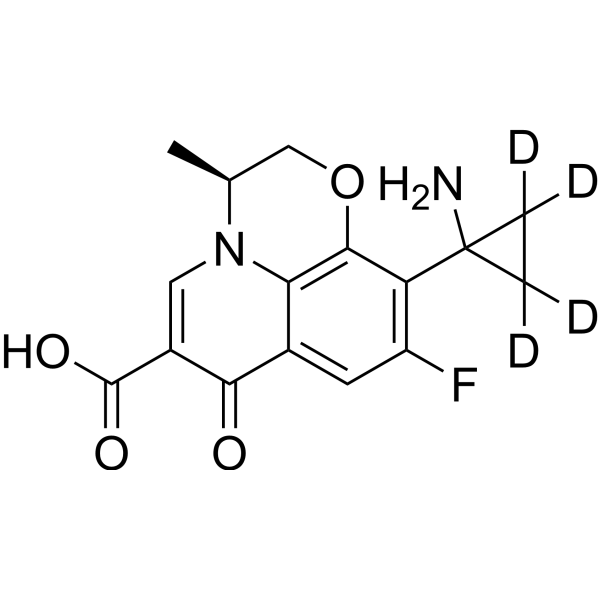
Pazufloxacin-d4
Pazufloxacin-d4 is deuterium labeled Pazufloxacin (HY-B0724B). Pazufloxacin is an orally active fluoroquinolone antimicrobial agent. Pazufloxacin inhibits DNA gyrase with IC50 values of 0.88 μg/mL (E. coli) and 1.9 μg/mL (P. aeruginosa). Pazufloxacin exhibits broad-spectrum antimicrobial activity, with MIC90 values ranging from 0.025 to 100 μg/mL against Gram-positive and Gram-negative bacteria, non-fermenting bacteria, Legionella spp., and anaerobic bacteria. Pazufloxacin is indicated for research on systemic infections, lung infections, urinary tract infections, and Legionella pneumonia.
Nos produits utilisent uniquement pour la recherche. Nous ne vendons pas aux patients.
- CAS No.: 1346602-96-7
- Formule: C16H11D4FN2O4
- Masse moléculaire:322.32
-
Stockage:
Please store the product under the recommended conditions in the Certificate of Analysis.

To place orders, for customer services and technical support, please contact: MedChemExpress USA
Tel: 609-228-6898 E-mail: [email protected] [email protected]


-
 Activité biologique
-
Chemical Information
- Pureté et documentation
- Références
-
 Help & FAQs


Voir tous les produits spécifiques à Isoform DNA/RNA Synthesis
More

Activité biologique
Stable heavy isotopes of hydrogen, carbon, and other elements have been incorporated into drug molecules, largely as tracers for quantitation during the drug development process. Deuteration has gained attention because of its potential to affect the pharmacokinetic and metabolic profiles of drugs[1].
MedChemExpress (MCE) has not independently confirmed the accuracy of these methods. They are for reference only.
1. This compound can be used as a tracer
2. This compound can be used as an internal standard for quantitative analysis by NMR, GC-MS, or LC-MS.


Chemical Information
-
CAS No. 1346602-96-7
-
Unlabeled Cas 127045-41-4
-
Masse moléculaire 322.32
-
Formule C16H11D4FN2O4
-
SMILES
O=C1C2=CC(F)=C(C3(C([2H])([2H])C3([2H])[2H])N)C4=C2N(C=C1C(O)=O)[C@@H](C)CO4
-
Synonyms
T3761-d4
-
Livraison
Room temperature in continental US; may vary elsewhere.
-
Stockage
Please store the product under the recommended conditions in the Certificate of Analysis.


Pureté et documentation
Références
[1]. Russak EM, et al. Impact of Deuterium Substitution on the Pharmacokinetics of Pharmaceuticals. Ann Pharmacother. 2019;53(2):211-216. [Content Brief]
[2]. Fukuoka, Y., et al., In vitro and in vivo antibacterial activities of T-3761, a new quinolone derivative. Antimicrob Agents Chemother, 1993. 37(3): p. 384-92. [Content Brief]
[3]. Muratani, T., M. Inoue, and S. Mitsuhashi, In vitro activity of T-3761, a new fluoroquinolone. Antimicrob Agents Chemother, 1992. 36(10): p. 2293-303. [Content Brief]
[4]. Takei M, et al. Target preference of 15 quinolones against Staphylococcus aureus, based on antibacterial activities and target inhibition. Antimicrob Agents Chemother. 2001 Dec;45(12):3544-7. [Content Brief]
[5]. Sousa J, et al. First liquid chromatography method for the simultaneous determination of levofloxacin, Pazufloxacin hydrochloride, gatifloxacin, moxifloxacin and trovafloxacin in human plasma. J Chromatogr B Analyt Technol Biomed Life Sci. 2013 Jul 1;930:104-11. [Content Brief]
[6]. Morinaga Y, et al. In vivo efficacy of sivelestat in combination with Pazufloxacin hydrochloride against Legionella pneumonia. Exp Lung Res. 2010 Oct;36(8):484-90. [Content Brief]

Calculators
Concentration (start) × Volume (start) = Concentration (final) × Volume (final)


Pazufloxacin-d4 Related Classifications
HY-B0724BS Related Classifications
 Powered by Bioz