



Grepafloxacin
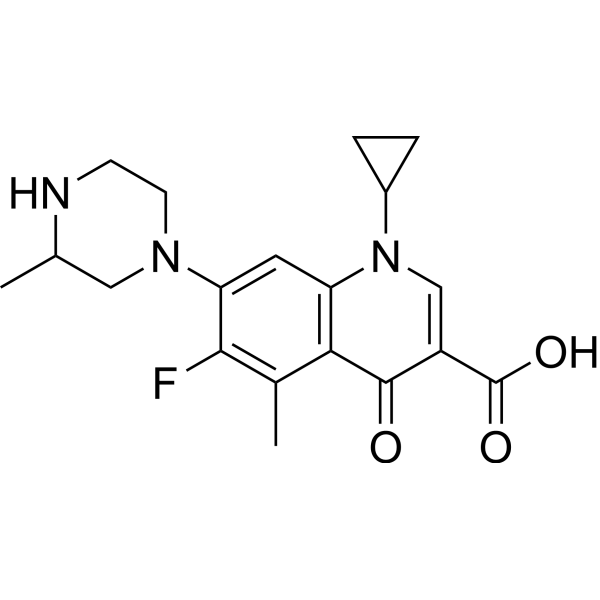
Grepafloxacin (OPC-17116) is an oral actively fluoroquinolone antibiotic with potent activity against community-acquired respiratory pathogens including Streptococcus pneumonia. Grepafloxacin has high tissue penetration and a promising pharmacodynamic profile.
Nur für Forschungszwecke. Wir verkaufen nicht an Patienten.
- CAS. Nr.: 119914-60-2
- Formel: C19H22FN3O3
- Molecular Weight:359.39
-
Speicherung:
Please store the product under the recommended conditions in the Certificate of Analysis.


-
 Biologische Aktivität
-
Chemical Information
- Reinheit & Dokumentation
- Verweise
-
 Help & FAQs


Alle Antibiotic Isoform-spezifische Produkte anzeigen
More

Biologische Aktivität
|
Quinolone |
|
Cell Line

|
Type | Value | Description | References |
|---|---|---|---|---|
| HEK293 | IC50 |
>50 μM
Compound: 45, Grepa-floxacin
|
Inhibition of human ERG potassium channel in HEK293 cells by patch clamp assay
Inhibition of human ERG potassium channel in HEK293 cells by patch clamp assay
|
[PMID: 16931010] |
Grepafloxacin (OPC-17116; 0-1 mg/L; 14-21 d) has antibiotic activity with a MIC value of ≤ 0.006 mg/L for E. coli strain[1].
Grepafloxacin (0-1 mg/L; 3 h) has antimicrobial activity against mycobacteria in macrophages with a MIC value of 0.5 mg/L for M. avium[1].
Grepafloxacin exhibits potent in vitro antibacterial activity against Gram-positive bacteria such as Streptococcus pneumoniae and high in vivo efficacy on the experimental systemic infections caused by the Gram-positive and -negative bacteria tested[4].
MedChemExpress (MCE) has not independently confirmed the accuracy of these methods. They are for reference only.
Grepafloxacin (25-200 mg/kg; p.o.; 5 days/week for 4 weeks; female C57BL6/J-Lyst bg-J/ mice/beige mice) has modest activities in both intranasal (IN) infection and intravenous (IV) Mycobacterium avium infection models[3].
MedChemExpress (MCE) has not independently confirmed the accuracy of these methods. They are for reference only.
-
Animal Model:Female Balb/c mice (5-6 weeks)[2]
-
Dosage:200 mg/kg
-
Administration:Oral administration; once
-
Result:Had mild and short-lived erythema and no changed auricular thickness.
-
Animal Model:Female C57BL6/J-Lyst bg-J/ mice/beige mice with mycobacterium avium infection[3]
-
Dosage:25, 50, 100, and 200 mg/kg
-
Administration:Oral administration; 5 days/week for 4 weeks
-
Result:Had bactericidal activity and limited the growth of the bacteria.


Chemical Information
-
CAS. Nr. 119914-60-2
-
Molecular Weight 359.39
-
Formel C19H22FN3O3
-
SMILES
O=C(C1=CN(C2CC2)C3=C(C(C)=C(F)C(N4CC(C)NCC4)=C3)C1=O)O
-
Synonyms
OPC-17116; dl-Grepafloxacin
-
Versand
Room temperature in continental US; may vary elsewhere.
-
Speicherung
Please store the product under the recommended conditions in the Certificate of Analysis.


Reinheit & Dokumentation
Verweise
[1]. Vacher S, et, al. Comparative antimycobacterial activities of ofloxacin, ciprofloxacin and grepafloxacin. J Antimicrob Chemother. 1999 Nov;44(5):647-52. [Content Brief]
[2]. Owen K. Comparative grepafloxacin phototoxicity in mouse skin. J Antimicrob Chemother. 1998 Aug;42(2):261-4. [Content Brief]
[3]. Cynamon MH, et, al. The activity of grepafloxacin in two murine models of Mycobacterium avium infection. J Infect Chemother. 2004 Jun;10(3):185-8. [Content Brief]
[4]. Miyamoto H, et al. Synthesis and biological properties of substituted 1,4-dihydro-5-methyl-4-oxo-3-quinolinecarboxylic acids. Bioorg Med Chem. 1995;3(12):1699-1706. [Content Brief]

Calculators
Konzentration (Stammlösung) × Volumen (Stammlösung) = Konzentration (Ziellösung) × Volumen (Ziellösung)


 Powered by Bioz